Wed, Sep 30, 2026
[Archive]
Volume 19, Issue 1 (2026)
J Med Edu Dev 2026, 19(1): 4-11 |
Back to browse issues page


Download citation:
BibTeX | RIS | EndNote | Medlars | ProCite | Reference Manager | RefWorks
Send citation to:


BibTeX | RIS | EndNote | Medlars | ProCite | Reference Manager | RefWorks
Send citation to:
Abdi M. Basic concepts in medical education within the teaching-learning domain: a first guide. J Med Edu Dev 2026; 19 (1) :4-11
URL: http://edujournal.zums.ac.ir/article-1-2755-en.html
URL: http://edujournal.zums.ac.ir/article-1-2755-en.html

Department of Medical Education, Social Determinants of Health Research Center & Education Development Center (EDC), Zanjan University of Medical Sciences, Zanjan, Iran , M.abdi252@yahoo.com
Keywords: education, medical, teaching, learning, educational methods, strategies, models, educational, theories, terminology
Full-Text [PDF 440 kb]
(503 Downloads)
| Abstract (HTML) (709 Views)
Full-Text: (155 Views)
Abstract
Understanding the specialized concepts and terminology of medical education is essential for medical sciences educators and researchers. This article is the first in a series of commentary articles aimed at outlining a conceptual map of the main domains in medical education and clarifying basic terminology for experts in the field. In this issue, the core domain of teaching-learning is examined, highlighting its central role in shaping effective educational processes and outcomes. Foundational concepts such as instruction, teaching, learning, and bildung are differentiated. Various levels of academic intervention, including teaching methods, strategies, and techniques, along with concrete examples in medical education, are explained. Corresponding concepts on the learner's side, such as learning strategies and techniques, are also addressed. Finally, key educational paradigms such as behaviorism, cognitivism, and constructivism, along with prominent learning theories like situated learning and self-determination theory, are introduced. Their applications in medical education are then elaborated. By providing a common language and a coherent framework, this conceptual framework enables medical educators to design and implement educational interventions based on clearer theoretical distinctions.
Domain one: teaching-learning
This domain is the heart of education, where knowledge, skills, and attitudes are transferred from teacher to learner. The teacher's informed choice of methods, supported by empirical studies, directly affects learning and retention, as evidenced by research showing improved outcomes when teaching strategies are aligned with learning objectives [1]. Below, we describe the fundamental concepts of this domain.
1. Instruction
Instruction is the entire process of planning, designing, and structuring that is carefully thought out with the intention of promoting learning. This is the most general term that includes both actions of teachers (teaching) and pre-designed environments that can be used to promote learning even in the absence of teachers (for example, interactive learning software). Instruction is the process of designing learning environments with particular learning objectives in mind [4].
2. Teaching
Teaching is an individual's interaction with one or more learners to promote learning. It is one of the most common ways of carrying out an instructional plan. It is a key term that highlights the teacher's active, dynamic role in real-time. Teaching can be done in person or through virtual media. Teaching is a component of instruction, though not every instructional plan necessitates direct teaching [5]. For example, an internal medicine professor who asks residents questions based on physical findings in front of a patient is teaching within an instructional plan in an internal medicine residency program. This teaching is part of an instructional plan in an internal medicine residency program.
3. Learning
Learning is a personal, internal, and permanent process that leads to a permanent change in a person’s knowledge, skill, attitude, or behavior as a result of experience or practice.
The change has to be inferred on the basis of observable or measurable performance [6].
Learning is the ultimate goal of instruction and teaching processes.
However, learning can also take place completely without instruction and teaching. Learning is under the learner's control. Instruction and teaching can only facilitate learning.
For example, if a resident is finally able to perform a procedure independently, smoothly, and correctly after several attempts under supervision, then learning has occurred [7].
4. Bildung / education in a broader sense
This concept extends beyond instruction and teaching and includes the comprehensive development of a person’s character, ethical judgment, professionalism, sense of social responsibility, and thinking ability. Bildung has a long-term goal and includes becoming a whole person as a physician, rather than "learning" what it means to be a physician [8].
Effective instruction and teaching can lay the basis for Bildung, but Bildung is usually attained via broad experiences, modeling by instructors, reflection on practice, and participation in professional culture. A medical student, for example, is not only taught how to treat a certain disease but is also made aware of how to empathetically communicate bad news to a patient or how to understand the ethical implications of resource scarcity—this is part of their Bildung [9].
Essentially, any educational process is composed of two interrelated but contrasting aspects: the teacher's activity, which is teaching, and the student's activity, which is learning.
Though these two sets of concepts are interlinked, they are nevertheless differentiated.
The definitions and differentiation of these concepts will be briefly highlighted in the following section. These sets of concepts may be incorporated into your article’s teaching-learning section in a separate subsection entitled “Distinction Between Concepts Related to Teacher and Learner.”
Key concepts related to the teaching process
1. Teaching method
An all-encompassing and systematic approach for organizing the educational process, which is established based on a particular learning philosophy.
The method is accountable for the "why" and "what" of the educational process altogether [3]. Teaching
modalities are broadly classified into traditional, interactive, practical, and assessment-based modalities. However, with the progress of education in medical science and the development of new technologies, new and varied modalities have been developed, which are listed in the box below (Table 1).
Table 1. Example classification of common teaching methods in medical education
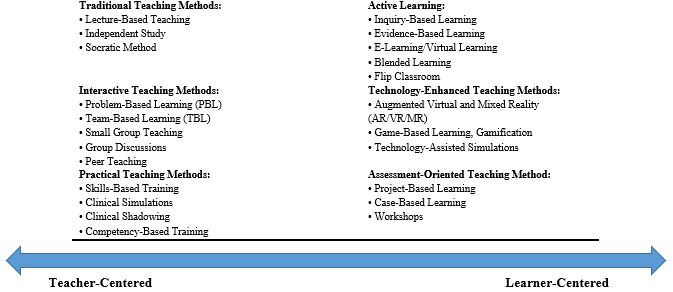
Table2. Distinguishing concepts related to teaching and learning
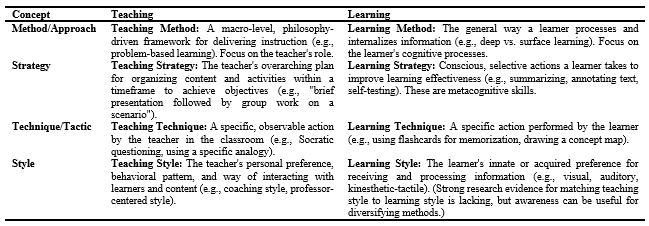
As may be seen from the above table, for educational effectiveness, there needs to be a conscious match between the decisions made by the teacher at different levels (teaching method, teaching strategy, teaching technique) and the decisions and learning processes and strategies evoked and consolidated in learners. The medical educator's task is to establish conditions for deep and self-directed learning.
Educational Paradigms and Learning Theories
In the preceding sections, operational concepts related to the "how" of designing and implementing instruction (method, strategy, technique) and the "how" of learning occurrence (learning strategies) were discussed. But what are the basic beliefs upon which these practices are based?
This is the question we now answer, and in so answering, we move from the level of practice to the level of theory and philosophy. Not only will teachers understand various techniques, but they will also be able to articulate the reasons for their practices in an informed, critical, and coherent fashion. Two concepts are central here: "Educational Paradigm" and "Learning Theory." These are distinguished below.
a) Educational Paradigm
An educational paradigm is a broad framework, a set of beliefs, assumptions, and values, which define education, learning, the roles of teachers and learners, and the goals of education within a particular historical period or school of thought.
Paradigms function as a 'lens' or 'dominant perspective' which defines education and learning problems and provides the key for their solution [14, 15]. Examples of recognized paradigms in medical education are given below:
Behaviorist Paradigm: Learning as a modification in overt behavior. Emphasis on environment, stimulus, response, and reinforcement. Teacher's Role: Designer and controller of the environment for learning. Learner's Role: Passive learner.
Cognitive Paradigm: Learning as a modification in mental structures and internal information processing. Emphasis on memory, attention, perception, and problem-solving. Teacher's Role: Organizer and facilitator of cognitive processes.
Constructivist Paradigm: The learner actively constructs knowledge in their social and cultural environment. Emphasis on experience, interaction, collaboration, and meaning-making. Teacher's Role: Coach, guide, and collaborator with the learner. Learner's Role: Active participant and constructor of knowledge.
b) Learning Theory
An explanatory statement that, in the context of a particular paradigm, describes, explains, and predicts learning.
Theories are more specific and operational than paradigms and can be used as a foundation for designing educational interventions [6]. More than one theory can be associated with a particular paradigm. For instance, under the Cognitive Paradigm, theories such as Cognitive Load Theory or Information Processing Theory exist. Some of the major examples and their applications in medical education are given below:
Operant Conditioning Theory (Skinner): Under the Behaviorist Paradigm, describes how positive or negative reinforcement increases or decreases the probability of repetition of a behavior (e.g., a skill). It applied to developing a step-by-step approach for skill training with immediate feedback [16].
Situated Learning Theory: Under the Social Constructivist Paradigm, it stresses that learning is a function of participation in a Community of Practice and is therefore meaningless without a social context [17]. It applied to justifying the need for learning in real-world settings, working in therapeutic teams, and professional socialization.
Self-Determination Theory: A motivational approach, suggests that optimal learning occurs when learners' innate psychological needs for competence, autonomy, and relatedness are satisfied [18]. It applied to developing courses where learners are offered a choice, feedback on their competence, and a sense of belonging.
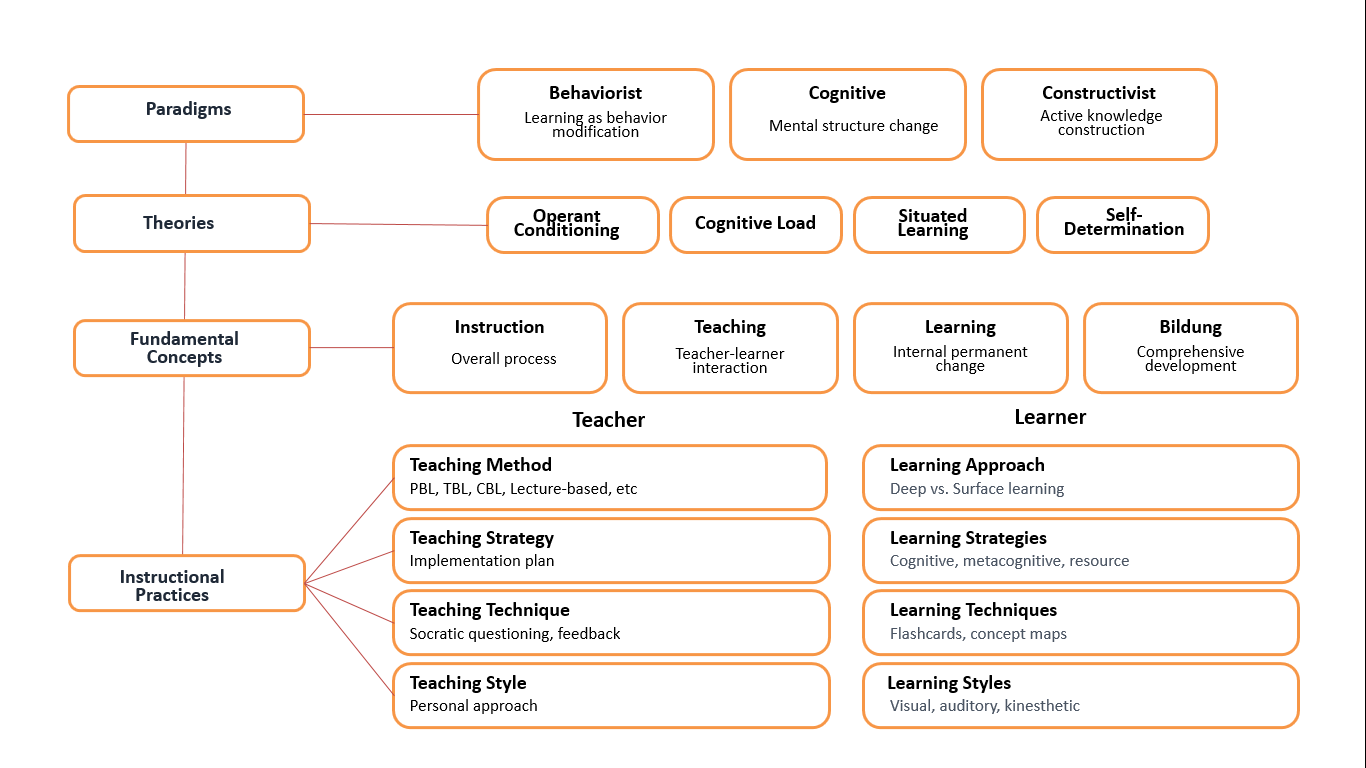
This conceptual diagram represents a model of the hierarchical relationships between concepts of education within the teaching-learning domain of medical education.
In particular, it presents a framework that shows four different levels of educational intervention, namely: [1] Educational Paradigms (behaviorist, cognitive, and constructivist) that are presented on a very abstract level, providing a philosophical base; [2] Learning Theories that operate within each of these paradigms, offering particular explanations of learning phenomena; [3] Two parallel streams of practical application, namely Teacher's concepts (methods, strategies, techniques, and styles) and Learner's concepts (approaches, strategies, techniques, and styles), that represent the interactive educational process; and [4] Fundamental concepts (instruction, teaching, learning, and Bildung) that are presented as fundamental elements of medical education (Figure1).
The conceptual differences discussed in this article provide implications for practice for different stakeholders in medical education:
For Clinical Educators: This framework may assist clinical educators in making more intentional decisions about matching teaching methods, strategies, and techniques to learning outcomes. For instance, when designing a clinical skills session, a clinical educator may decide to use a competency-based teaching method, employ a strategy that involves simulation followed by real patient contact, and utilize immediate feedback as a key teaching technique.
For Educational Administrators and Curriculum Planners: The map may assist in curriculum planning by ensuring consistency between educational paradigms, teaching methods, and assessment strategies. Administrators may utilize the map to design faculty development programs that improve educators' understanding of theoretical foundations, thus ensuring more consistent and effective teaching practices in programs.
For Researchers: This article poses several questions for research, including: How do clinical educators' conceptual understandings of teaching-learning terminology affect their teaching decisions? What is the effect of teaching these concepts to faculty members on educational outcomes? How can this framework be modified for use in different cultural settings?
Conclusion
As may be gleaned from this article, the teaching-learning domain of medical education has an elaborate conceptual depth. Understanding the nuances of difference between fundamental concepts such as instruction, teaching, learning, and bildung, as well as understanding the nuances of difference between levels of intervention such as method, strategy, and technique on one hand, and paradigms and theories on the other, may empower medical teachers not just in their choice of what to teach, but may also help them decide on the why, how, and what context their teaching activities occur. Such a conceptual framework may also be used as a base for designing tools such as an instructional design checklist or an evaluation framework for educational interventions, thereby transcending review and actually making an impact. This is the foundation of good teaching and competent and thoughtful physicians. In future issues of this series, other important domains of medical education will be discussed.
Ethical considerations
Not applicable
Use of artificial intelligence to write the article
For the purpose of English editing and linguistic polishing, artificial intelligence was employed in the preparation of this manuscript.
Acknowledgements
Not applicable
Conflict of interest statement
None
Authors' contributions
All steps of the article were carried out by the author.
Funding
None
Data access statement
The dataset used and/or analyzed during the study is available from the corresponding author upon reasonable request.
Understanding the specialized concepts and terminology of medical education is essential for medical sciences educators and researchers. This article is the first in a series of commentary articles aimed at outlining a conceptual map of the main domains in medical education and clarifying basic terminology for experts in the field. In this issue, the core domain of teaching-learning is examined, highlighting its central role in shaping effective educational processes and outcomes. Foundational concepts such as instruction, teaching, learning, and bildung are differentiated. Various levels of academic intervention, including teaching methods, strategies, and techniques, along with concrete examples in medical education, are explained. Corresponding concepts on the learner's side, such as learning strategies and techniques, are also addressed. Finally, key educational paradigms such as behaviorism, cognitivism, and constructivism, along with prominent learning theories like situated learning and self-determination theory, are introduced. Their applications in medical education are then elaborated. By providing a common language and a coherent framework, this conceptual framework enables medical educators to design and implement educational interventions based on clearer theoretical distinctions.
Introduction
As medical education has evolved into an independent scientific discipline [1], characterized by its own methodologies and research paradigms, it is increasingly necessary for all stakeholders to be aware of its foundational concepts and terminology. It is clear that educators and educational researchers, who have mostly focused their expertise in clinical or basic sciences, are not often enough aware of the terminology used in the area of medical education [2]. This may provoke a series of issues, such as an inefficient design of curricula, incorrect implementation of teaching methods, and consequently, an inefficient learning process [3]. A lack of clear differentiation between such concepts as instruction, teaching, and learning, or an incorrect understanding of levels of educational intervention, such as method, strategy, and technique, may have a strong impact on the selection and implementation of educational interventions. Providing clearp conceptual maps for major domains in medical education is both an educational necessity and a condition for developing a common language and enhancing quality in the medical education system. The basic concepts have been discussed in a sporadic fashion in the medical education literature, yet a gap has been observed in terms of a comprehensive conceptual map to show the levels of educational intervention in relation to specific theories. This article is the first in a series of commentaries that aims to provide comprehensive conceptual maps to help faculty, administrators, and non-specialist individuals in medical education understand medical education better, using authoritative international sources. The teaching-learning area, which is the core of all educational processes, will be explained, with basic concepts, classifications, and differences discussed. Future editions of this publication will cover important areas such as assessment, evaluation, curriculum planning, etc.Domain one: teaching-learning
This domain is the heart of education, where knowledge, skills, and attitudes are transferred from teacher to learner. The teacher's informed choice of methods, supported by empirical studies, directly affects learning and retention, as evidenced by research showing improved outcomes when teaching strategies are aligned with learning objectives [1]. Below, we describe the fundamental concepts of this domain.
1. Instruction
Instruction is the entire process of planning, designing, and structuring that is carefully thought out with the intention of promoting learning. This is the most general term that includes both actions of teachers (teaching) and pre-designed environments that can be used to promote learning even in the absence of teachers (for example, interactive learning software). Instruction is the process of designing learning environments with particular learning objectives in mind [4].
2. Teaching
Teaching is an individual's interaction with one or more learners to promote learning. It is one of the most common ways of carrying out an instructional plan. It is a key term that highlights the teacher's active, dynamic role in real-time. Teaching can be done in person or through virtual media. Teaching is a component of instruction, though not every instructional plan necessitates direct teaching [5]. For example, an internal medicine professor who asks residents questions based on physical findings in front of a patient is teaching within an instructional plan in an internal medicine residency program. This teaching is part of an instructional plan in an internal medicine residency program.
3. Learning
Learning is a personal, internal, and permanent process that leads to a permanent change in a person’s knowledge, skill, attitude, or behavior as a result of experience or practice.
The change has to be inferred on the basis of observable or measurable performance [6].
Learning is the ultimate goal of instruction and teaching processes.
However, learning can also take place completely without instruction and teaching. Learning is under the learner's control. Instruction and teaching can only facilitate learning.
For example, if a resident is finally able to perform a procedure independently, smoothly, and correctly after several attempts under supervision, then learning has occurred [7].
4. Bildung / education in a broader sense
This concept extends beyond instruction and teaching and includes the comprehensive development of a person’s character, ethical judgment, professionalism, sense of social responsibility, and thinking ability. Bildung has a long-term goal and includes becoming a whole person as a physician, rather than "learning" what it means to be a physician [8].
Effective instruction and teaching can lay the basis for Bildung, but Bildung is usually attained via broad experiences, modeling by instructors, reflection on practice, and participation in professional culture. A medical student, for example, is not only taught how to treat a certain disease but is also made aware of how to empathetically communicate bad news to a patient or how to understand the ethical implications of resource scarcity—this is part of their Bildung [9].
Essentially, any educational process is composed of two interrelated but contrasting aspects: the teacher's activity, which is teaching, and the student's activity, which is learning.
Though these two sets of concepts are interlinked, they are nevertheless differentiated.
The definitions and differentiation of these concepts will be briefly highlighted in the following section. These sets of concepts may be incorporated into your article’s teaching-learning section in a separate subsection entitled “Distinction Between Concepts Related to Teacher and Learner.”
Key concepts related to the teaching process
1. Teaching method
An all-encompassing and systematic approach for organizing the educational process, which is established based on a particular learning philosophy.
The method is accountable for the "why" and "what" of the educational process altogether [3]. Teaching
modalities are broadly classified into traditional, interactive, practical, and assessment-based modalities. However, with the progress of education in medical science and the development of new technologies, new and varied modalities have been developed, which are listed in the box below (Table 1).
Table 1. Example classification of common teaching methods in medical education
It must be remembered that all the above teaching modalities lie on the spectrum of two paradigms: learner-centered and teacher-centered.
This is a continuum where, on one side, teacher-centered education places the teacher at the center as the source of knowledge, the complete controller of the process, and the final authority (similar to the behaviorist paradigm). On the other hand, learner-centered education considers the learner as an active, autonomous, and a constructor of knowledge, where the teacher's role changes from a teacher to a facilitator, guide, and collaborator (similar to the constructivist paradigm).
Most of the modern teaching modalities in medical education (like PBL, CBL, and flipped classroom teaching) are planned to be more learner-centered. Recognition of this issue will help in a more informed and balanced choice of teaching modalities [7].
2. Teaching strategy
A general plan or blueprint for reaching a particular educational goal in the context of a selected teaching method.
Strategies are more flexible and provide guidance on "how" a teaching method is to be carried out in a particular situation [3]. To clarify the distinction between teaching method and teaching strategy, one might say that a teaching method is the "tool of instruction"—for example, lecture-based teaching or team-based learning—and that a teaching strategy defines the order and process of instruction.
For example, in the CBL teaching method, a strategy might be: "In the first class, the groups give only differential diagnoses, and in the second class, with the teacher's help, they move on to diagnostic evidence and treatment."
3. Teaching technique
A specific, observable educational action or skill carried out by the teacher in the classroom to promote learning. Techniques are the "practical tools of implementation." Examples include Socratic questioning, giving constructive feedback immediately after completing an OSCE station, or posing a multiple-choice question to provoke a class discussion [1, 10].
4. Teaching style
Teaching style is defined as a teacher's typical way of teaching, which can vary from instructor-centered (e.g., didactic lecturing) to learner-centered (e.g., facilitative coaching).
It is a manifestation of one's educational philosophy, interactional style, and teaching preference. Understanding one's own teaching style helps in intentional adaptation to various situations and learners. Notably, there is no empirical support for strictly assigning teaching styles to individual learning styles. Teaching styles can be blended flexibly according to the learning needs [5, 11].
Key concepts related to the learning process
1. Learning approach
It is a person's typical patterns and stable cognitive preferences for information processing and learning task engagement.
This construct is usually categorized into two types: deep learning and surface learning.
In deep learning, the learner seeks to comprehend meaning and relate concepts to prior knowledge and the real world—for instance, investigating the underlying causes of a clinical event.
In surface learning, the learner seeks to memorize the material for the sole purpose of passing an examination (e.g., memorizing a list of medications without knowing their mechanisms) [12].
One concept that is sometimes confused with the learning approach is learning styles.
While the learning approach is more related to teachable and changeable methods, learning styles are more related to innate and unchangeable traits (visual, auditory, etc.), for which there is not enough research evidence for adapting education.
For example, if a learner, while studying the pathophysiology of heart failure, tries to explain the mechanisms in their own words and make connections with clinical cases instead of memorizing, they are using a deep learning approach.
2. Learning strategies
A set of conscious, selective, and flexible actions taken by the learner to control and enhance their own learning process.
These are metacognitive abilities and are teachable. The major categories of learning strategies are:
Cognitive Strategies: These are those that directly influence information processing, such as mental rehearsal, elaboration, organization, and connecting.
Metacognitive Strategies: These are those that monitor and control the learning process, such as planning, self-checking for understanding, and regulating the speed of learning.
Resource Management Strategies: Where the learner strives to utilize all available resources to improve their learning process, such as time management, study environment management, and seeking help from others [13].
To illustrate learning strategies, let's consider an internal medicine resident who has decided, before a shift, to concentrate on the differential diagnosis of jaundice (metacognition).
He/she will write notes (cognition) and, at the end of the day, ask for feedback from his/her supervisor (resource management).
3. Learning techniques/tactics
Learning techniques (or tactics) are the specific, observable behaviors learners use to implement a learning strategy of choice.
They are the implementation of broader strategic plans and are a set of tools to engage with, process, and retain information.
Their usefulness is in their ability to convert passive reception into active cognitive processing [13].
For example, a cardiology resident may use the technique of analogy, comparing vascular blood flow to a citywide plumbing system, to gain a more intuitive understanding of hemodynamics.
Another example is a pharmacology student using digital flashcards to actively recall and organize drug types, using spaced repetition.
Other techniques include text annotation (for example, a nursing student highlighting important points) or summarization (for example, a midwifery student summarizing a lesson in her own words), both of which require the learner to identify important points and reconstruct them personally. These are the basic, doable actions that directly improve encoding, consolidation, and retrieval, making the abstract process of learning concrete and functional.
4. Learning style
Learning style refers to how individuals perceive, process, and respond to information. Learning styles include visual, auditory, reading/writing, and kinesthetic." Learning style has become a widely accepted concept, but there is little evidence for teaching methods based on learning style.
However, recognition of learning styles has caused teachers to think creatively and use multiple approaches. "One solution is a multi-channel approach, using multiple media and multiple channels per medium. This approach can be effective without invoking learning style" [11]. For clarity, all the concepts mentioned are presented in Table 2.
This is a continuum where, on one side, teacher-centered education places the teacher at the center as the source of knowledge, the complete controller of the process, and the final authority (similar to the behaviorist paradigm). On the other hand, learner-centered education considers the learner as an active, autonomous, and a constructor of knowledge, where the teacher's role changes from a teacher to a facilitator, guide, and collaborator (similar to the constructivist paradigm).
Most of the modern teaching modalities in medical education (like PBL, CBL, and flipped classroom teaching) are planned to be more learner-centered. Recognition of this issue will help in a more informed and balanced choice of teaching modalities [7].
2. Teaching strategy
A general plan or blueprint for reaching a particular educational goal in the context of a selected teaching method.
Strategies are more flexible and provide guidance on "how" a teaching method is to be carried out in a particular situation [3]. To clarify the distinction between teaching method and teaching strategy, one might say that a teaching method is the "tool of instruction"—for example, lecture-based teaching or team-based learning—and that a teaching strategy defines the order and process of instruction.
For example, in the CBL teaching method, a strategy might be: "In the first class, the groups give only differential diagnoses, and in the second class, with the teacher's help, they move on to diagnostic evidence and treatment."
3. Teaching technique
A specific, observable educational action or skill carried out by the teacher in the classroom to promote learning. Techniques are the "practical tools of implementation." Examples include Socratic questioning, giving constructive feedback immediately after completing an OSCE station, or posing a multiple-choice question to provoke a class discussion [1, 10].
4. Teaching style
Teaching style is defined as a teacher's typical way of teaching, which can vary from instructor-centered (e.g., didactic lecturing) to learner-centered (e.g., facilitative coaching).
It is a manifestation of one's educational philosophy, interactional style, and teaching preference. Understanding one's own teaching style helps in intentional adaptation to various situations and learners. Notably, there is no empirical support for strictly assigning teaching styles to individual learning styles. Teaching styles can be blended flexibly according to the learning needs [5, 11].
Key concepts related to the learning process
1. Learning approach
It is a person's typical patterns and stable cognitive preferences for information processing and learning task engagement.
This construct is usually categorized into two types: deep learning and surface learning.
In deep learning, the learner seeks to comprehend meaning and relate concepts to prior knowledge and the real world—for instance, investigating the underlying causes of a clinical event.
In surface learning, the learner seeks to memorize the material for the sole purpose of passing an examination (e.g., memorizing a list of medications without knowing their mechanisms) [12].
One concept that is sometimes confused with the learning approach is learning styles.
While the learning approach is more related to teachable and changeable methods, learning styles are more related to innate and unchangeable traits (visual, auditory, etc.), for which there is not enough research evidence for adapting education.
For example, if a learner, while studying the pathophysiology of heart failure, tries to explain the mechanisms in their own words and make connections with clinical cases instead of memorizing, they are using a deep learning approach.
2. Learning strategies
A set of conscious, selective, and flexible actions taken by the learner to control and enhance their own learning process.
These are metacognitive abilities and are teachable. The major categories of learning strategies are:
Cognitive Strategies: These are those that directly influence information processing, such as mental rehearsal, elaboration, organization, and connecting.
Metacognitive Strategies: These are those that monitor and control the learning process, such as planning, self-checking for understanding, and regulating the speed of learning.
Resource Management Strategies: Where the learner strives to utilize all available resources to improve their learning process, such as time management, study environment management, and seeking help from others [13].
To illustrate learning strategies, let's consider an internal medicine resident who has decided, before a shift, to concentrate on the differential diagnosis of jaundice (metacognition).
He/she will write notes (cognition) and, at the end of the day, ask for feedback from his/her supervisor (resource management).
3. Learning techniques/tactics
Learning techniques (or tactics) are the specific, observable behaviors learners use to implement a learning strategy of choice.
They are the implementation of broader strategic plans and are a set of tools to engage with, process, and retain information.
Their usefulness is in their ability to convert passive reception into active cognitive processing [13].
For example, a cardiology resident may use the technique of analogy, comparing vascular blood flow to a citywide plumbing system, to gain a more intuitive understanding of hemodynamics.
Another example is a pharmacology student using digital flashcards to actively recall and organize drug types, using spaced repetition.
Other techniques include text annotation (for example, a nursing student highlighting important points) or summarization (for example, a midwifery student summarizing a lesson in her own words), both of which require the learner to identify important points and reconstruct them personally. These are the basic, doable actions that directly improve encoding, consolidation, and retrieval, making the abstract process of learning concrete and functional.
4. Learning style
Learning style refers to how individuals perceive, process, and respond to information. Learning styles include visual, auditory, reading/writing, and kinesthetic." Learning style has become a widely accepted concept, but there is little evidence for teaching methods based on learning style.
However, recognition of learning styles has caused teachers to think creatively and use multiple approaches. "One solution is a multi-channel approach, using multiple media and multiple channels per medium. This approach can be effective without invoking learning style" [11]. For clarity, all the concepts mentioned are presented in Table 2.
Table2. Distinguishing concepts related to teaching and learning
As may be seen from the above table, for educational effectiveness, there needs to be a conscious match between the decisions made by the teacher at different levels (teaching method, teaching strategy, teaching technique) and the decisions and learning processes and strategies evoked and consolidated in learners. The medical educator's task is to establish conditions for deep and self-directed learning.
Educational Paradigms and Learning Theories
In the preceding sections, operational concepts related to the "how" of designing and implementing instruction (method, strategy, technique) and the "how" of learning occurrence (learning strategies) were discussed. But what are the basic beliefs upon which these practices are based?
This is the question we now answer, and in so answering, we move from the level of practice to the level of theory and philosophy. Not only will teachers understand various techniques, but they will also be able to articulate the reasons for their practices in an informed, critical, and coherent fashion. Two concepts are central here: "Educational Paradigm" and "Learning Theory." These are distinguished below.
a) Educational Paradigm
An educational paradigm is a broad framework, a set of beliefs, assumptions, and values, which define education, learning, the roles of teachers and learners, and the goals of education within a particular historical period or school of thought.
Paradigms function as a 'lens' or 'dominant perspective' which defines education and learning problems and provides the key for their solution [14, 15]. Examples of recognized paradigms in medical education are given below:
Behaviorist Paradigm: Learning as a modification in overt behavior. Emphasis on environment, stimulus, response, and reinforcement. Teacher's Role: Designer and controller of the environment for learning. Learner's Role: Passive learner.
Cognitive Paradigm: Learning as a modification in mental structures and internal information processing. Emphasis on memory, attention, perception, and problem-solving. Teacher's Role: Organizer and facilitator of cognitive processes.
Constructivist Paradigm: The learner actively constructs knowledge in their social and cultural environment. Emphasis on experience, interaction, collaboration, and meaning-making. Teacher's Role: Coach, guide, and collaborator with the learner. Learner's Role: Active participant and constructor of knowledge.
b) Learning Theory
An explanatory statement that, in the context of a particular paradigm, describes, explains, and predicts learning.
Theories are more specific and operational than paradigms and can be used as a foundation for designing educational interventions [6]. More than one theory can be associated with a particular paradigm. For instance, under the Cognitive Paradigm, theories such as Cognitive Load Theory or Information Processing Theory exist. Some of the major examples and their applications in medical education are given below:
Operant Conditioning Theory (Skinner): Under the Behaviorist Paradigm, describes how positive or negative reinforcement increases or decreases the probability of repetition of a behavior (e.g., a skill). It applied to developing a step-by-step approach for skill training with immediate feedback [16].
Situated Learning Theory: Under the Social Constructivist Paradigm, it stresses that learning is a function of participation in a Community of Practice and is therefore meaningless without a social context [17]. It applied to justifying the need for learning in real-world settings, working in therapeutic teams, and professional socialization.
Self-Determination Theory: A motivational approach, suggests that optimal learning occurs when learners' innate psychological needs for competence, autonomy, and relatedness are satisfied [18]. It applied to developing courses where learners are offered a choice, feedback on their competence, and a sense of belonging.
This conceptual diagram represents a model of the hierarchical relationships between concepts of education within the teaching-learning domain of medical education.
In particular, it presents a framework that shows four different levels of educational intervention, namely: [1] Educational Paradigms (behaviorist, cognitive, and constructivist) that are presented on a very abstract level, providing a philosophical base; [2] Learning Theories that operate within each of these paradigms, offering particular explanations of learning phenomena; [3] Two parallel streams of practical application, namely Teacher's concepts (methods, strategies, techniques, and styles) and Learner's concepts (approaches, strategies, techniques, and styles), that represent the interactive educational process; and [4] Fundamental concepts (instruction, teaching, learning, and Bildung) that are presented as fundamental elements of medical education (Figure1).
Figure1. Conceptual framework for teaching-learning domain
Implications for PracticeThe conceptual differences discussed in this article provide implications for practice for different stakeholders in medical education:
For Clinical Educators: This framework may assist clinical educators in making more intentional decisions about matching teaching methods, strategies, and techniques to learning outcomes. For instance, when designing a clinical skills session, a clinical educator may decide to use a competency-based teaching method, employ a strategy that involves simulation followed by real patient contact, and utilize immediate feedback as a key teaching technique.
For Educational Administrators and Curriculum Planners: The map may assist in curriculum planning by ensuring consistency between educational paradigms, teaching methods, and assessment strategies. Administrators may utilize the map to design faculty development programs that improve educators' understanding of theoretical foundations, thus ensuring more consistent and effective teaching practices in programs.
For Researchers: This article poses several questions for research, including: How do clinical educators' conceptual understandings of teaching-learning terminology affect their teaching decisions? What is the effect of teaching these concepts to faculty members on educational outcomes? How can this framework be modified for use in different cultural settings?
Conclusion
As may be gleaned from this article, the teaching-learning domain of medical education has an elaborate conceptual depth. Understanding the nuances of difference between fundamental concepts such as instruction, teaching, learning, and bildung, as well as understanding the nuances of difference between levels of intervention such as method, strategy, and technique on one hand, and paradigms and theories on the other, may empower medical teachers not just in their choice of what to teach, but may also help them decide on the why, how, and what context their teaching activities occur. Such a conceptual framework may also be used as a base for designing tools such as an instructional design checklist or an evaluation framework for educational interventions, thereby transcending review and actually making an impact. This is the foundation of good teaching and competent and thoughtful physicians. In future issues of this series, other important domains of medical education will be discussed.
Ethical considerations
Not applicable
Use of artificial intelligence to write the article
For the purpose of English editing and linguistic polishing, artificial intelligence was employed in the preparation of this manuscript.
Acknowledgements
Not applicable
Conflict of interest statement
None
Authors' contributions
All steps of the article were carried out by the author.
Funding
None
Data access statement
The dataset used and/or analyzed during the study is available from the corresponding author upon reasonable request.
Article Type : Editorial |
Subject:
Medical Education
Received: 2025/12/14 | Accepted: 2025/12/27 | Published: 2026/01/1
Received: 2025/12/14 | Accepted: 2025/12/27 | Published: 2026/01/1
Send email to the article author
| Rights and permissions | |
 |
This work is licensed under a Creative Commons Attribution-NonCommercial 4.0 International License. |