Tue, Sep 29, 2026
[Archive]
Volume 19, Issue 2 (2026)
J Med Edu Dev 2026, 19(2): 88-99 |
Back to browse issues page


Ethics code: The present study was approved by the National Agency for Strategic Research in Medical Education, T


Download citation:
BibTeX | RIS | EndNote | Medlars | ProCite | Reference Manager | RefWorks
Send citation to:


BibTeX | RIS | EndNote | Medlars | ProCite | Reference Manager | RefWorks
Send citation to:
Ghahramanian A, Bagheriyeh F, Aghajari P, Asghari Jafarabadi M, Abolfathpour P, Ghafourifard M, et al . Examining work-life balance and its impact on faculty intention to leave: a cross-sectional study. J Med Edu Dev 2026; 19 (2) :88-99
URL: http://edujournal.zums.ac.ir/article-1-2619-en.html
URL: http://edujournal.zums.ac.ir/article-1-2619-en.html
Akram Ghahramanian1  , Farzaneh Bagheriyeh *2 , Parvaneh Aghajari3 , Mohammad Asghari Jafarabadi4 , Pedram Abolfathpour5 , Mansour Ghafourifard6 , Azad Rahmani6 , Amirreza Nabighadim7 , Mani Mirfeizi8
, Farzaneh Bagheriyeh *2 , Parvaneh Aghajari3 , Mohammad Asghari Jafarabadi4 , Pedram Abolfathpour5 , Mansour Ghafourifard6 , Azad Rahmani6 , Amirreza Nabighadim7 , Mani Mirfeizi8
1- The National Agency for Strategic Research in Medical Education, Tehran, Iran & Department of Medical-Surgical Nursing, Faculty of Nursing and Midwifery, Tabriz University of Medical Sciences, Tabriz, Iran
2- Department of Nursing, Tabriz University of Medical Sciences, Tabriz, Iran ,Fbagheriyeh95@gmail.com
3- Department of Nursing, Maragheh University of Medical Sciences, Maragheh, Iran
4- 1School of Public Health and Preventative Medicine, Faculty of Medicine, Nursing and Health Sciences, Monash University, VIC, Australia-2Cabrini Research, Cabrini Health, Melbourne, VIC, Australia & 3Road Traffic Injury Research Center, Tabriz University of Medical Sciences, Tabriz, Iran-4Department of Psychiatry, School of Clinical Sciences, Faculty of Medicine, Nursing and Health Sciences, Monash University, Clayton, VIC, Australia
5- Student Research Committee, Faculty of Nursing and Midwifery, Urmia University of Medical Sciences, Urmia, Iran
6- Faculty of Nursing and Midwifery, Tabriz University of Medical Sciences, Tabriz, Iran
7- Pediatric Urology and Regenerative Medicine Research Center, Children's Medical Center, Tehran University of Medical Sciences, Tehran, Iran
8- Werribee Mercy Hospital, Werribee, Victoria, Australia
2- Department of Nursing, Tabriz University of Medical Sciences, Tabriz, Iran ,
3- Department of Nursing, Maragheh University of Medical Sciences, Maragheh, Iran
4- 1School of Public Health and Preventative Medicine, Faculty of Medicine, Nursing and Health Sciences, Monash University, VIC, Australia-2Cabrini Research, Cabrini Health, Melbourne, VIC, Australia & 3Road Traffic Injury Research Center, Tabriz University of Medical Sciences, Tabriz, Iran-4Department of Psychiatry, School of Clinical Sciences, Faculty of Medicine, Nursing and Health Sciences, Monash University, Clayton, VIC, Australia
5- Student Research Committee, Faculty of Nursing and Midwifery, Urmia University of Medical Sciences, Urmia, Iran
6- Faculty of Nursing and Midwifery, Tabriz University of Medical Sciences, Tabriz, Iran
7- Pediatric Urology and Regenerative Medicine Research Center, Children's Medical Center, Tehran University of Medical Sciences, Tehran, Iran
8- Werribee Mercy Hospital, Werribee, Victoria, Australia
Full-Text [PDF 473 kb]
(353 Downloads)
| Abstract (HTML) (977 Views)
Full-Text: (145 Views)
Abstract
Background & Objective: Faculty members in medical universities face high academic, research, and clinical workloads, which can negatively affect work–life balance. Imbalance between professional and personal roles is associated with burnout, reduced job satisfaction, and higher intention to leave. This study aimed to investigate work–life balance among faculty members at Urmia University of Medical Sciences and examine its relationship with intention to leave.
Materials & Methods: A cross-sectional study was carried out in eight faculties. Using stratified random sampling, 120 faculty members were selected from the faculties of Nursing and Midwifery, Medicine, Allied Health Professions, and Health Management and Medical Information Sciences. Data were collected using a socio-demographic questionnaire, Fisher’s Work–Life Balance Scale, and a Researcher-Made Intention to Leave Scale. Univariable and multivariable linear regression analyses identified predictors of intention to leave.
Results: The mean score for Work Interference with Personal Life (WIPL) was higher than other dimensions (23.71 ± 5.20). Univariable analysis showed WIPL and the total work–life balance score were positively associated with intention to leave, while Work–Personal Life Enhancement (WPLE) was inversely related (all p < 0.05). Multivariable analysis confirmed WIPL as a significant predictor of intention to leave (B = 0.52, R² = 0.33, 95% CI: 0.26 – 0.78, P < 0.001).
Conclusion: WIPL was the strongest predictor of faculty members’ intention to leave, whereas WPLE was inversely associated with intention to leave. These findings underscore the importance of workload management and organizational support to enhance work–life balance and potentially reduce turnover among academic staff.
Introduction
In today’s fast-paced society, achieving a balance between work and personal life has become increasingly challenging. Work-Life Balance (WLB) refers to the ability to use time and energy effectively between work-related responsibilities and personal, family, and community life, while maintaining physical, emotional, and social well-being without excessive stress or negative consequences [1, 2]. Maintaining WLB is essential for employee satisfaction, performance, and retention. However, its imbalance has been associated with stress, burnout, reduced productivity, and increased turnover intention [3, 4]. Faculty members in medical and paramedical universities face unique challenges in achieving WLB due to heavy workloads that include teaching, research, administrative duties, and clinical responsibilities. Extended working hours, pressure to meet research and teaching expectations, and the need to be available beyond official hours often disrupt the equilibrium between work and personal life. This contributes to job dissatisfaction and burnout [5, 6]. Studies show that women, in particular, face greater difficulty in balancing work and family responsibilities. This often results in higher levels of stress, anxiety, and intention to leave their positions [7, 8]. Intention to leave refers to an individual’s desire to discontinue current employment and pursue alternative career paths. It is influenced by job satisfaction, organizational support, and work-life balance, and serves as a predictor of actual turnover [9, 10]. Within academic institutions, faculty turnover poses a significant threat to organizational effectiveness, as faculty members play a central role in achieving the university’s mission of education, research, and community service [11, 12]. Retaining skilled faculty not only helps institutional goals but also improves student outcomes and overall academic quality [13, 14]. Although extensive research has examined WLB and turnover intention in general workplaces, studies focusing specifically on faculty members of medical sciences universities, particularly in Iran, are limited [15, 16]. Faculty in these settings experience complex and multifaceted roles that differ from other professional groups. Therefore, it is essential to understand how WLB affects their intention to leave [3, 17]. Previous international research has highlighted the link between work-life imbalance and increased turnover intention; however, there is a paucity of evidence examining these dynamics within Iranian medical universities [18, 19]. Urmia University of Medical Sciences, a major institution in northwest Iran, provides a context in which faculty members face substantial educational, research, and managerial responsibilities. Understanding WLB and its impact on faculty retention in such settings is crucial. It helps in developing policies and interventions that make easier well-being, job satisfaction, and organizational stability. This study aims to assess the level of WLB among faculty members at Urmia University of Medical Sciences and examine its association with their intention to leave the institution. This addresses a gap in the Iranian higher education literature and provides insights for strategies to improve faculty retention.
Materials & Methods
Design and setting(s)
The current study employed a cross-sectional design. It was conducted among faculty members affiliated with Urmia University of Medical Sciences, Urmia, Iran. Written informed consent was obtained from all participants. The study was carried out between June 4, 2022, and March 4, 2023.
Participants and sampling
We calculated the sample size of 145 participants using G Power software (version 3.1.9.7). We considered the following parameters: statistical test (correlation: point biserial), power of 0.80, significance level (α) of 0.05, and a correlation reported in a similar study by Bae et al [16]. A stratified random sampling technique was employed to ensure the sample accurately reflected the population structure. The sampling frame, consisting of all faculty members at Urmia University of Medical Sciences, was first divided into mutually exclusive strata based on their college affiliation. The sample size for each stratum (college) was then calculated to be proportional to the number of faculty members in that stratum relative to the total population. This guaranteed proportional representation of all colleges. Subsequently, within each stratum, participants were selected using a simple random sampling procedure. This was implemented by generating a unique random number list for each stratum using the random number generator function in Microsoft Excel, which was then applied to the respective list of faculty members in that college. This two-stage process (proportional allocation followed by random selection within strata) was designed to minimize selection bias and improve the generalizability of the findings across the university's diverse colleges. The inclusion criteria for the study were holding at least a master's degree and possessing a minimum of one year of work experience. Questionnaires were excluded if more than 10% of the total questionnaire items contained missing responses. Out of the 145 distributed questionnaires, after excluding incomplete responses, a total of 120 valid questionnaires were included. This resulted in a response rate of 82.75%. Although the final sample size was smaller than initially estimated, it remained adequate to detect medium effect sizes in the regression analysis with a statistical power close to 0.80 at a significance level of 0.05.
Tools/Instruments
The data collection tool comprised three main sections. The first section captured socio-demographic characteristics, including age, gender, educational degree, academic rank, employment status (full-time or part-time), discipline, and the number of teaching hours in undergraduate and postgraduate levels. The second part of the data collection tool assessed the level of work–life balance (WLB) using the 15-item modified version of Fisher’s Work–Life Balance Scale. The scale comprises three subscales: Work Interference with Personal Life (WIPL; 7 items), Personal Life Interference with Work (PLIW; 4 items), and Work–Personal Life Enhancement (WPLE; 4 items). All items were rated on a 7-point Likert scale ranging from 0 (never) to 7 (almost always). The scores for WIPL ranged from 7 to 49, with higher scores indicating lower levels of WLB. Similarly, the scores for PLIW ranged from 4 to 28, with higher scores indicating lower levels of WLB. For the WPLE dimension, the scores ranged from 4 to 28, with higher scores indicating higher levels of WLB [20]. The validity and reliability of the Revised Fisher’s Work–Life Balance Scale were examined by Jotare and colleagues. The validity of the scale was reported to be acceptable. The reliability of this scale, using the Cronbach’s alpha correlation coefficient for the three dimensions, ranged from 0.82 to 0.88 [21].
In this study, the Persian version of the Work–Life Balance Scale was developed using the forward–backward translation method. Linguistic and cultural equivalence was evaluated and confirmed by the supervisors, advisors, and 10 faculty members from the School of Nursing and Midwifery. For this purpose, following the forward and backward translation of the questionnaire by an expert proficient in English, the translated version was reviewed by ten nursing faculty members. They provided feedback regarding the linguistic and cultural compatibility of the Persian version with the original English scale. After collecting their comments and implementing the necessary revisions, the final Persian version of the scale was prepared and utilized. Prior to the main study, the reliability of the scale was assessed using Cronbach’s alpha in a pilot sample of 30 faculty members. The Cronbach’s alpha coefficient was 0.96 for the overall scale and ranged from 0.91 to 0.97 for the subscales. Additionally, the Content Validity Ratio (CVR) and Content Validity Index (CVI) were evaluated by a panel of eight experts. All items met the established acceptance thresholds, with CVR values ≥ 0.94 and CVI values ≥ 0.88. The intention to leave scale used in this study is an adapted instrument derived from previous research [22, 23], originally developed in English, with items focusing on faculty members’ work-life issues and the impact of these factors on their intention to leave the profession. The scale consists of four items assessing the likelihood of faculty members leaving their current position, their current institution, the teaching profession, and higher education. Responses were rated on a 6-point Likert scale ranging from 1 (Highly Unlikely) to 6 (Highly likely). The scores ranged from 4 to 24, with higher scores indicating a greater intention to leave. The Persian version of the scale was developed through a translation process and used after confirming linguistic and cultural equivalence. The CVR and CVI were rigorously evaluated by a panel of eight experts, with all items surpassing the recommended thresholds (CVR ≥ 0.96; CVI ≥ 0.94), indicating excellent content validity. The internal consistency of the scale was assessed using Cronbach’s alpha, yielding a high reliability coefficient of 0.92.
Data collection methods
Data were collected using self-administered questionnaires. After selecting participants through the stratified random sampling procedure, eligible faculty members were approached and informed about the purpose and procedures of the study. Written informed consent was obtained prior to participation. The questionnaires were then distributed to the selected participants and collected after completion. Participants were assured that their responses would remain confidential and anonymous. Data collection was conducted between June 2022 and March 2023.
Data analysis
Data analysis was performed using IBM SPSS Statistics software, version 20 (IBM Corp, Armonk, NY, USA). A two-tailed significance level of 0.05 was set for all statistical tests. Categorical socio-demographic variables were summarized using frequencies and percentages, while continuous variables were described using mean and standard deviation. The normality of the distribution for the main outcome variable (intention to leave) and other continuous variables was assessed both graphically and statistically. In addition to evaluating skewness (within ±1.5) and kurtosis (within ±2), the Shapiro–Wilk test was employed. The intention to leave score showed no significant deviation from normality (Shapiro–Wilk test, p > 0.05). Group comparisons were conducted using independent t-tests (for two groups) and one-way ANOVA followed by Tukey's post hoc test (for more than two groups). Associations between continuous variables were examined using Pearson's correlation coefficient. To identify predictors of intention to leave, univariable linear regression analyses were first performed. All independent variables with a p-value < 0.05 in the univariable analysis were considered candidates for entry into the multivariable linear regression model. To avoid multicollinearity, the total work-life balance score was not entered into the multivariable model alongside its three constituent subscales (WIPL, PLIW, WPLE). Consequently, only the three subscales were included as predictors. Before analysis, the categorical variable 'discipline' was converted into dummy variables. With 'Allied health professions' set as the reference category, four dummy variables were created for the remaining disciplines: Medicine, Nursing, Midwifery, and Health management & medical information. The multivariable linear regression model was constructed using the enter method. The key assumptions of linear regression were rigorously checked: 1) The normality of residuals was confirmed via the Shapiro–Wilk test and visual inspection of the Q-Q plot; 2) Homoscedasticity was verified by examining the scatterplot of standardized residuals against predicted values, which showed no funnel pattern; 3) The linearity of relationships was assessed using partial regression plots; and 4) The absence of multicollinearity was ensured, as all Variance Inflation Factor (VIF) values were below 5. The independence of residuals was supported by a Durbin–Watson statistic close to 2. The overall model fit was evaluated using the coefficient of determination (R²) and the adjusted R² [24].
Results
Table 1 summarizes the categorical socio-demographic characteristics of the participants and their associations with WLB subscales (WIPL, PLIW, and WPLE) and intention to leave. Most participants were male (60%), married (81.7%), held a Ph.D. degree (85.5%), and were assistant professors (50%). Regarding their involvement in education, 90% were involved in teaching undergraduate students, 75.8% in teaching Master's students, and 35% in teaching Ph.D. students. Most participants were full-time (90%) and involved in clinical education (65%).
The results indicated that the mean WIPL score for female faculty members was significantly higher than that of males (p < 0.05). Additionally, there was a significant difference in mean WIPL scores between faculty members with Master's degrees and those with Ph.D. degrees (3.75 ± 0.69 vs 3.32 ± 0.73). Faculty members who were more involved in undergraduate education had significantly higher mean WIPL scores compared to those who were not involved (3.42 ± 0.76 vs 3.05 ± 0.30).
Non-full-time faculty members, academic staff with the academic grade of Instructor, and nursing faculty members had significantly higher mean WIPL scores compared to other disciplines (p < 0.05). Married participants had significantly higher scores in the WPLE subscale (p < 0.05). Table 2 presents the continuous socio-demographic characteristics of the participants, including Mean age (43.18 ± 8.20 years), work experience (12.30 ± 8.77 years), and Mean income (225000000 ± 65200000 IRR). Table 3 presents the associations between continuous socio-demographic characteristics and WLB subscales (WIPL, PLIW, and WPLE) and intention to leave scale. The results show a statistically significant relationship between WIPL and the number of teaching units at the undergraduate level (r = 0.33, p = 0.001), the number of hours of clinical education (r = 0.28, p = 0.018), and the number of teaching units in the doctoral level (r = -0.31, p = 0.039).
There was a significant relationship between PLIW and the number of hours of practical/workshop training (r = -0.22, p = 0.021). WPLE showed significant relationships with the number of hours of practical/workshop training (r = 0.22, p = 0.029), the number of hours spent on clinical education (r = -0.33, p = 0.004), and research (r = -0.19, p = 0.037). The intention to leave was inversely related to age (r = -0.31, p = 0.001), work experience (r = -0.30, p = 0.001), and the hours spent on classroom education (r = -0.19, p = 0.035), indicating that higher scores on these variables were associated with a greater intention to leave.
Table 1. Categorical and work-related characteristics of participating faculty members and their relationship with work-life balance, its subscales, and intention to leave
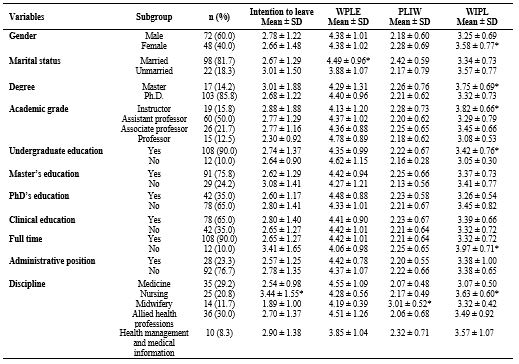
Note: The independent t-test was used to compare two groups (gender, marital status, degree, undergraduate education, master’s education, PhD’s education, clinical education, full time, administrative position). ANOVA with Tukey’s post-hoc test was used to compare more than two groups (academic grade and discipline). * p < 0.05 indicates a statistically significant difference between groups.
Abbreviations: WPLE, work and personal life enhancement; PLIW, personal life interference with work; WIPL, work interference with personal life; SD, standard deviation.
Table 2. Continuous characteristics of participating faculty members in study
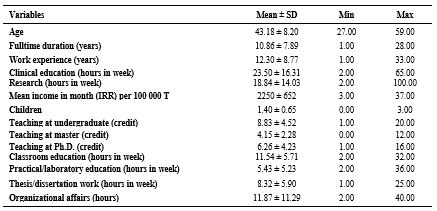
Note: Descriptive statistics (mean, standard deviation, minimum, and maximum) were calculated for continuous variables.
Abbreviations: SD, standard deviation; Min, minimum; Max, maximum; IRR, Iranian Rial; T, Toman; Ph.D., Doctor of Philosophy
Table 3. Correlation between work-life balance scale and intention to leave with some continuous characteristics of faculty members participating in study
Note: Pearson correlation test was used to examine the relationship between continuous variables. * p < 0.05, ** p < 0.01.
Abbreviations: WIPL, work interference with personal life; PLIW, personal life interference with work; WPLE, work and personal life enhancement; PhD, Doctor of Philosophy.
Table 4. Results of work-life balance, its subscales, and intention to leave scales
Note: The minimum and maximum values reported for the mean and sum scores represent both the observed values obtained in the current sample and the possible score ranges based on the number of items and the Likert scale.
Abbreviations: WIPL, work interference with personal life; PLIW, personal life interference with work; WPLE, work and personal life enhancement; SD, standard deviation.
Table 5. Uni- and multi-variable linear regression results of factors affecting intention to leave in faculty members
Note: Multi-variable model: R² = 0.33, P-value < 0.001. The total work-life balance score was excluded from the multi-variable model to avoid multicollinearity with its subscales.
Abbreviations: WIPL, work interference with personal life; PLIW, personal life interference with work; WPLE, work and personal life enhancement; CI, confidence interval; B, unstandardized coefficient.
Discussion
The present study aimed to investigate WLB and its relationship with intention to leave among faculty members at Urmia University of Medical Sciences. The results showed that the WIPL dimension scored higher than other WLB dimensions, with the highest score observed for the item related to the difficulty of managing work and non-work roles simultaneously. In contrast, in the PLIW dimension, the item “Personal life drains me of energy for work” received the highest score. These findings are consistent with the results of Boamah et al., who reported that increased work interference with personal life is associated with greater fatigue, lower job satisfaction, and higher intention to leave among faculty members [1, 25]. Therefore, elevated WIPL scores in the present study may have important implications for faculty members’ well-being and retention.
The results also indicated that female faculty members reported higher WIPL scores than males. This may be due to the simultaneous demands of professional roles and greater family and caregiving responsibilities. This finding is consistent with previous research showing that women in academic and professional settings often experience higher levels of work-life interference, especially when family responsibilities are involved [26, 27]. Although some studies have reported smaller or different gender differences, the present findings underscore the importance of organizational support and gender-sensitive policies to reduce work-life interference among female faculty members [19, 28]. Faculty members with a Master’s degree, instructors teaching undergraduates, part-time staff, and nursing faculty reported higher WIPL. These findings suggest that early-career faculty and those with clinical responsibilities experience greater work-life interference due to high teaching and administrative demands, limited support, and clinical duties. Previous studies have similarly shown that young faculty members and nursing faculty often face work-life conflict, which can increase the risk of job burnout and work-related errors [29, 30]. In this study, marital status was not significantly associated with WIPL; however, married faculty reported higher PLIW and WPLE scores compared to their single counterparts. This indicates that family responsibilities may interfere with work performance, but the emotional and social resources provided by family and marital life can enrich work experiences. These findings are consistent with previous research showing that while married individuals may experience greater work-life interference due to family obligations, social and family support can play a
reinforcing role and enhance WPLE [28, 31]. Univariable regression analysis showed that WIPL and the overall WLB score were positively associated with intention to leave, whereas WPLE was inversely associated. In the multivariable model, only WIPL remained a significant predictor of intention to leave. These findings indicate that high job demands, task multiplicity, and role overload require substantial energy expenditure, which may lead to fatigue and persistent difficulty in managing work and non-work responsibilities simultaneously. Compared to previous studies, Cankurtaran et al. [32] reported that more than one-third of faculty members experienced poor work-life balance, whereas Elifneh et al. [33] found that about half of Tehran University faculty achieved satisfactory WLB. Similarly, Helvaci et al. [34] reported that faculty at Usak University in Turkey had favorable WLB. The discrepancies between these findings and the present study may be attributed to differences in academic disciplines and work contexts, as Helvaci’s study included faculty from diverse non-clinical fields, while Cankurtaran focused only on radiologists. The present study also found that the WPLE dimension was inversely and significantly associated with intention to leave. This means that faculty who perceive their work as positively contributing to their personal life are less likely to consider leaving. This aligns with prior research; for example, Boccoli et al. [35] suggested that positive experiences at work can provide psychological, skill-based, and emotional resources that enhance personal life performance and satisfaction, thereby reducing negative work attitudes, including intention to leave. Moreover, WPLE was inversely associated with the negative WLB dimensions, WIPL and PLIW, indicating a protective role in maintaining work-life balance. This finding is consistent with Wei et al. [36] and Erasmus et al. [37] who demonstrated that work-personal life enrichment can mitigate the adverse effects of job stress and role conflict, leading to higher job satisfaction and lower burnout and turnover intention.
However, in the present study, WPLE did not remain a significant independent predictor in the multivariable analysis. This suggests that although positive work-personal life enhancement is protective, its effect is overshadowed by the dominant influence of WIPL. This finding aligns with Cankurtaran et al. [32] and Boccoli et al. [35], which reported that in high-pressure academic environments, the negative effects of work interference with personal life play a more decisive role in shaping turnover intention than positive factors. The study also
found that although variables such as teaching hours, research hours, and workload were associated with WLB and intention to leave in univariable analyses, in multivariable analysis, only WIPL remained a significant independent predictor. This indicates that the degree to which work demands intrude on personal life is more important than the volume or type of work activities. These results are consistent with Cankurtaran et al. [32] and Lindfelt et al. [33] who reported that work-life conflict and difficulty managing work-life boundaries are more strongly associated with faculty turnover intention than other factors. Regarding disciplinary differences, the present study found that nursing faculty reported higher intention to leave compared to other disciplines. This finding aligns with studies such as Moyer [38], which reported that nursing faculty, especially younger ones, experience higher WIPL due to heavy teaching and clinical responsibilities and staff shortages. Other studies have also shown that shortages of nursing faculty increase workload, burnout, and ultimately intention to leave in this group [39, 40].
The study provides valuable insights into the WLB and intention to leave among faculty members, highlighting the challenges faced by academic staff in maintaining a healthy work-life integration. The research included a diverse sample of faculty members from Urmia University of Medical Sciences, which enhances the contextual relevance of the findings. Quantitative methods were employed to statistically assess the relationship between WLB and intention to leave. Despite these strengths, the study has several methodological limitations.
First, the cross-sectional design prevents causal inferences between WLB and intention to leave. Second, the study was conducted in a single-center setting, limiting the generalizability of the results to other universities or academic contexts. Third, data were collected using self-report instruments, which may be subject to response biases. Future research is recommended to include faculty members from multiple universities to provide a more comprehensive understanding of WLB across different contexts. Additionally, qualitative studies could explore the underlying reasons for high intention to leave, particularly among nursing faculty. Finally, experimental or intervention-based studies could evaluate strategies aimed at enhancing WLB and reducing turnover intention, providing practical guidance for improving faculty well-being and retention in academic institutions.
Conclusion
The findings of this study indicate that WIPL is the primary predictor of turnover intention among faculty members. Individuals experiencing high levels of conflict between work and personal responsibilities expend considerable energy managing these roles simultaneously, which increases their likelihood of considering leaving their positions. These results highlight the critical importance of addressing work-life balance within academic settings. To reduce turnover intention and retain skilled faculty, universities should prioritize supportive policies and practical measures. Such measures may include reducing workload and task multiplicity, providing flexibility in working hours and arrangements, supporting faculty in managing role conflicts, and fostering a supportive work environment. Additionally, offering professional development opportunities and psychosocial support can help decrease burnout and enhance job satisfaction. Implementing these strategies not only contributes to maintaining the quality of education and research but also enhances faculty motivation and productivity while reducing turnover risk. Therefore, promoting work-life balance should be regarded as a strategic priority in university human resource management.
Ethical considerations
This study was reviewed and approved by the National Agency for Strategic Research in Medical Education (NASR), Tehran, Iran (Approval No. 990295). The study followed accepted ethical standards, as outlined in the Declaration of Helsinki. From March to June 2023, eligible faculty members were approached to participate in the study. Prior to their involvement, the purpose of the study and instructions for completing the questionnaire were explained to them, and informed consent was obtained from all participants. To ensure confidentiality, the survey was conducted anonymously, safeguarding the privacy of the respondents.
Artificial intelligence utilization for article writing
Artificial Intelligence (AI) has not been used for writing this article.
Acknowledgment
This study was derived from an approved research project funded by the National Agency for Strategic Research (NASR) in Medical Education, Tehran, Iran (Grant No. 990295). The authors would like to acknowledge and thank all participants for their valuable contributions to this study.
Conflict of interest statement
None of the authors had a conflict of interest.
Author contributions
AG, AN, PA, and FB conceived and designed the study and prepared the study protocol. PA and FB assisted with data collection. AG, AR, and MG supervised all data collection and study procedures. AG and MA analyzed the study data. AG, AN, MM, and MA interpreted the results. MA and MM edited the manuscript. All authors contributed to the preparation of the manuscript and approval of the final version.
Funding
This project was funded by the National Agency for Strategic Research in Medical Education, Tehran, Iran (Grant No. 990295).
Data availability statement
The datasets used and/or analyzed in the current study are available from the corresponding author upon reasonable request.
Background & Objective: Faculty members in medical universities face high academic, research, and clinical workloads, which can negatively affect work–life balance. Imbalance between professional and personal roles is associated with burnout, reduced job satisfaction, and higher intention to leave. This study aimed to investigate work–life balance among faculty members at Urmia University of Medical Sciences and examine its relationship with intention to leave.
Materials & Methods: A cross-sectional study was carried out in eight faculties. Using stratified random sampling, 120 faculty members were selected from the faculties of Nursing and Midwifery, Medicine, Allied Health Professions, and Health Management and Medical Information Sciences. Data were collected using a socio-demographic questionnaire, Fisher’s Work–Life Balance Scale, and a Researcher-Made Intention to Leave Scale. Univariable and multivariable linear regression analyses identified predictors of intention to leave.
Results: The mean score for Work Interference with Personal Life (WIPL) was higher than other dimensions (23.71 ± 5.20). Univariable analysis showed WIPL and the total work–life balance score were positively associated with intention to leave, while Work–Personal Life Enhancement (WPLE) was inversely related (all p < 0.05). Multivariable analysis confirmed WIPL as a significant predictor of intention to leave (B = 0.52, R² = 0.33, 95% CI: 0.26 – 0.78, P < 0.001).
Conclusion: WIPL was the strongest predictor of faculty members’ intention to leave, whereas WPLE was inversely associated with intention to leave. These findings underscore the importance of workload management and organizational support to enhance work–life balance and potentially reduce turnover among academic staff.
Introduction
In today’s fast-paced society, achieving a balance between work and personal life has become increasingly challenging. Work-Life Balance (WLB) refers to the ability to use time and energy effectively between work-related responsibilities and personal, family, and community life, while maintaining physical, emotional, and social well-being without excessive stress or negative consequences [1, 2]. Maintaining WLB is essential for employee satisfaction, performance, and retention. However, its imbalance has been associated with stress, burnout, reduced productivity, and increased turnover intention [3, 4]. Faculty members in medical and paramedical universities face unique challenges in achieving WLB due to heavy workloads that include teaching, research, administrative duties, and clinical responsibilities. Extended working hours, pressure to meet research and teaching expectations, and the need to be available beyond official hours often disrupt the equilibrium between work and personal life. This contributes to job dissatisfaction and burnout [5, 6]. Studies show that women, in particular, face greater difficulty in balancing work and family responsibilities. This often results in higher levels of stress, anxiety, and intention to leave their positions [7, 8]. Intention to leave refers to an individual’s desire to discontinue current employment and pursue alternative career paths. It is influenced by job satisfaction, organizational support, and work-life balance, and serves as a predictor of actual turnover [9, 10]. Within academic institutions, faculty turnover poses a significant threat to organizational effectiveness, as faculty members play a central role in achieving the university’s mission of education, research, and community service [11, 12]. Retaining skilled faculty not only helps institutional goals but also improves student outcomes and overall academic quality [13, 14]. Although extensive research has examined WLB and turnover intention in general workplaces, studies focusing specifically on faculty members of medical sciences universities, particularly in Iran, are limited [15, 16]. Faculty in these settings experience complex and multifaceted roles that differ from other professional groups. Therefore, it is essential to understand how WLB affects their intention to leave [3, 17]. Previous international research has highlighted the link between work-life imbalance and increased turnover intention; however, there is a paucity of evidence examining these dynamics within Iranian medical universities [18, 19]. Urmia University of Medical Sciences, a major institution in northwest Iran, provides a context in which faculty members face substantial educational, research, and managerial responsibilities. Understanding WLB and its impact on faculty retention in such settings is crucial. It helps in developing policies and interventions that make easier well-being, job satisfaction, and organizational stability. This study aims to assess the level of WLB among faculty members at Urmia University of Medical Sciences and examine its association with their intention to leave the institution. This addresses a gap in the Iranian higher education literature and provides insights for strategies to improve faculty retention.
Materials & Methods
Design and setting(s)
The current study employed a cross-sectional design. It was conducted among faculty members affiliated with Urmia University of Medical Sciences, Urmia, Iran. Written informed consent was obtained from all participants. The study was carried out between June 4, 2022, and March 4, 2023.
Participants and sampling
We calculated the sample size of 145 participants using G Power software (version 3.1.9.7). We considered the following parameters: statistical test (correlation: point biserial), power of 0.80, significance level (α) of 0.05, and a correlation reported in a similar study by Bae et al [16]. A stratified random sampling technique was employed to ensure the sample accurately reflected the population structure. The sampling frame, consisting of all faculty members at Urmia University of Medical Sciences, was first divided into mutually exclusive strata based on their college affiliation. The sample size for each stratum (college) was then calculated to be proportional to the number of faculty members in that stratum relative to the total population. This guaranteed proportional representation of all colleges. Subsequently, within each stratum, participants were selected using a simple random sampling procedure. This was implemented by generating a unique random number list for each stratum using the random number generator function in Microsoft Excel, which was then applied to the respective list of faculty members in that college. This two-stage process (proportional allocation followed by random selection within strata) was designed to minimize selection bias and improve the generalizability of the findings across the university's diverse colleges. The inclusion criteria for the study were holding at least a master's degree and possessing a minimum of one year of work experience. Questionnaires were excluded if more than 10% of the total questionnaire items contained missing responses. Out of the 145 distributed questionnaires, after excluding incomplete responses, a total of 120 valid questionnaires were included. This resulted in a response rate of 82.75%. Although the final sample size was smaller than initially estimated, it remained adequate to detect medium effect sizes in the regression analysis with a statistical power close to 0.80 at a significance level of 0.05.
Tools/Instruments
The data collection tool comprised three main sections. The first section captured socio-demographic characteristics, including age, gender, educational degree, academic rank, employment status (full-time or part-time), discipline, and the number of teaching hours in undergraduate and postgraduate levels. The second part of the data collection tool assessed the level of work–life balance (WLB) using the 15-item modified version of Fisher’s Work–Life Balance Scale. The scale comprises three subscales: Work Interference with Personal Life (WIPL; 7 items), Personal Life Interference with Work (PLIW; 4 items), and Work–Personal Life Enhancement (WPLE; 4 items). All items were rated on a 7-point Likert scale ranging from 0 (never) to 7 (almost always). The scores for WIPL ranged from 7 to 49, with higher scores indicating lower levels of WLB. Similarly, the scores for PLIW ranged from 4 to 28, with higher scores indicating lower levels of WLB. For the WPLE dimension, the scores ranged from 4 to 28, with higher scores indicating higher levels of WLB [20]. The validity and reliability of the Revised Fisher’s Work–Life Balance Scale were examined by Jotare and colleagues. The validity of the scale was reported to be acceptable. The reliability of this scale, using the Cronbach’s alpha correlation coefficient for the three dimensions, ranged from 0.82 to 0.88 [21].
In this study, the Persian version of the Work–Life Balance Scale was developed using the forward–backward translation method. Linguistic and cultural equivalence was evaluated and confirmed by the supervisors, advisors, and 10 faculty members from the School of Nursing and Midwifery. For this purpose, following the forward and backward translation of the questionnaire by an expert proficient in English, the translated version was reviewed by ten nursing faculty members. They provided feedback regarding the linguistic and cultural compatibility of the Persian version with the original English scale. After collecting their comments and implementing the necessary revisions, the final Persian version of the scale was prepared and utilized. Prior to the main study, the reliability of the scale was assessed using Cronbach’s alpha in a pilot sample of 30 faculty members. The Cronbach’s alpha coefficient was 0.96 for the overall scale and ranged from 0.91 to 0.97 for the subscales. Additionally, the Content Validity Ratio (CVR) and Content Validity Index (CVI) were evaluated by a panel of eight experts. All items met the established acceptance thresholds, with CVR values ≥ 0.94 and CVI values ≥ 0.88. The intention to leave scale used in this study is an adapted instrument derived from previous research [22, 23], originally developed in English, with items focusing on faculty members’ work-life issues and the impact of these factors on their intention to leave the profession. The scale consists of four items assessing the likelihood of faculty members leaving their current position, their current institution, the teaching profession, and higher education. Responses were rated on a 6-point Likert scale ranging from 1 (Highly Unlikely) to 6 (Highly likely). The scores ranged from 4 to 24, with higher scores indicating a greater intention to leave. The Persian version of the scale was developed through a translation process and used after confirming linguistic and cultural equivalence. The CVR and CVI were rigorously evaluated by a panel of eight experts, with all items surpassing the recommended thresholds (CVR ≥ 0.96; CVI ≥ 0.94), indicating excellent content validity. The internal consistency of the scale was assessed using Cronbach’s alpha, yielding a high reliability coefficient of 0.92.
Data collection methods
Data were collected using self-administered questionnaires. After selecting participants through the stratified random sampling procedure, eligible faculty members were approached and informed about the purpose and procedures of the study. Written informed consent was obtained prior to participation. The questionnaires were then distributed to the selected participants and collected after completion. Participants were assured that their responses would remain confidential and anonymous. Data collection was conducted between June 2022 and March 2023.
Data analysis
Data analysis was performed using IBM SPSS Statistics software, version 20 (IBM Corp, Armonk, NY, USA). A two-tailed significance level of 0.05 was set for all statistical tests. Categorical socio-demographic variables were summarized using frequencies and percentages, while continuous variables were described using mean and standard deviation. The normality of the distribution for the main outcome variable (intention to leave) and other continuous variables was assessed both graphically and statistically. In addition to evaluating skewness (within ±1.5) and kurtosis (within ±2), the Shapiro–Wilk test was employed. The intention to leave score showed no significant deviation from normality (Shapiro–Wilk test, p > 0.05). Group comparisons were conducted using independent t-tests (for two groups) and one-way ANOVA followed by Tukey's post hoc test (for more than two groups). Associations between continuous variables were examined using Pearson's correlation coefficient. To identify predictors of intention to leave, univariable linear regression analyses were first performed. All independent variables with a p-value < 0.05 in the univariable analysis were considered candidates for entry into the multivariable linear regression model. To avoid multicollinearity, the total work-life balance score was not entered into the multivariable model alongside its three constituent subscales (WIPL, PLIW, WPLE). Consequently, only the three subscales were included as predictors. Before analysis, the categorical variable 'discipline' was converted into dummy variables. With 'Allied health professions' set as the reference category, four dummy variables were created for the remaining disciplines: Medicine, Nursing, Midwifery, and Health management & medical information. The multivariable linear regression model was constructed using the enter method. The key assumptions of linear regression were rigorously checked: 1) The normality of residuals was confirmed via the Shapiro–Wilk test and visual inspection of the Q-Q plot; 2) Homoscedasticity was verified by examining the scatterplot of standardized residuals against predicted values, which showed no funnel pattern; 3) The linearity of relationships was assessed using partial regression plots; and 4) The absence of multicollinearity was ensured, as all Variance Inflation Factor (VIF) values were below 5. The independence of residuals was supported by a Durbin–Watson statistic close to 2. The overall model fit was evaluated using the coefficient of determination (R²) and the adjusted R² [24].
Results
Table 1 summarizes the categorical socio-demographic characteristics of the participants and their associations with WLB subscales (WIPL, PLIW, and WPLE) and intention to leave. Most participants were male (60%), married (81.7%), held a Ph.D. degree (85.5%), and were assistant professors (50%). Regarding their involvement in education, 90% were involved in teaching undergraduate students, 75.8% in teaching Master's students, and 35% in teaching Ph.D. students. Most participants were full-time (90%) and involved in clinical education (65%).
The results indicated that the mean WIPL score for female faculty members was significantly higher than that of males (p < 0.05). Additionally, there was a significant difference in mean WIPL scores between faculty members with Master's degrees and those with Ph.D. degrees (3.75 ± 0.69 vs 3.32 ± 0.73). Faculty members who were more involved in undergraduate education had significantly higher mean WIPL scores compared to those who were not involved (3.42 ± 0.76 vs 3.05 ± 0.30).
Non-full-time faculty members, academic staff with the academic grade of Instructor, and nursing faculty members had significantly higher mean WIPL scores compared to other disciplines (p < 0.05). Married participants had significantly higher scores in the WPLE subscale (p < 0.05). Table 2 presents the continuous socio-demographic characteristics of the participants, including Mean age (43.18 ± 8.20 years), work experience (12.30 ± 8.77 years), and Mean income (225000000 ± 65200000 IRR). Table 3 presents the associations between continuous socio-demographic characteristics and WLB subscales (WIPL, PLIW, and WPLE) and intention to leave scale. The results show a statistically significant relationship between WIPL and the number of teaching units at the undergraduate level (r = 0.33, p = 0.001), the number of hours of clinical education (r = 0.28, p = 0.018), and the number of teaching units in the doctoral level (r = -0.31, p = 0.039).
There was a significant relationship between PLIW and the number of hours of practical/workshop training (r = -0.22, p = 0.021). WPLE showed significant relationships with the number of hours of practical/workshop training (r = 0.22, p = 0.029), the number of hours spent on clinical education (r = -0.33, p = 0.004), and research (r = -0.19, p = 0.037). The intention to leave was inversely related to age (r = -0.31, p = 0.001), work experience (r = -0.30, p = 0.001), and the hours spent on classroom education (r = -0.19, p = 0.035), indicating that higher scores on these variables were associated with a greater intention to leave.
Table 1. Categorical and work-related characteristics of participating faculty members and their relationship with work-life balance, its subscales, and intention to leave
Note: The independent t-test was used to compare two groups (gender, marital status, degree, undergraduate education, master’s education, PhD’s education, clinical education, full time, administrative position). ANOVA with Tukey’s post-hoc test was used to compare more than two groups (academic grade and discipline). * p < 0.05 indicates a statistically significant difference between groups.
Abbreviations: WPLE, work and personal life enhancement; PLIW, personal life interference with work; WIPL, work interference with personal life; SD, standard deviation.
Table 2. Continuous characteristics of participating faculty members in study
Note: Descriptive statistics (mean, standard deviation, minimum, and maximum) were calculated for continuous variables.
Abbreviations: SD, standard deviation; Min, minimum; Max, maximum; IRR, Iranian Rial; T, Toman; Ph.D., Doctor of Philosophy
Table 3. Correlation between work-life balance scale and intention to leave with some continuous characteristics of faculty members participating in study
Note: Pearson correlation test was used to examine the relationship between continuous variables. * p < 0.05, ** p < 0.01.
Abbreviations: WIPL, work interference with personal life; PLIW, personal life interference with work; WPLE, work and personal life enhancement; PhD, Doctor of Philosophy.
Table 4 provides the frequency of responses to the items of WLB scale, as well as the mean and standard deviation for each item, subscale and scale. The mean score for the WIPL, PLIW and WPLE dimensions was 3.38 ± 0.74, 2.22 ± 0.64, and 4.38 ± 1.01, respectively. The mean score for the WLB scale also was 3.27 ± 0.61. Specifically, participants in the study had a mean score of 3.32 ± 0.93 for the item "Personal life suffers because of work," and a mean score of 2.03 ± 0.75 for the item "My work suffers because of my personal life.
" In the WIPL dimension, the mean score was 4.06 ± 1.28 for the item "Struggle to juggle work and non-work," and 2.51 ± 1.09 for the item "Put personal life on hold for work." In the PLIW dimension, the mean score was 2.47 ± 1.02 for the item "Personal life drains me of energy for work," and 2.03 ± 0.75 for the item "My work suffers because of my personal life." Additionally, the mean scores for the items "Personal life gives me energy for my job" and "Job gives me energy to pursue personal activities" were 4.38 ± 1.25 and 4.20 ± 1.32, respectively. The mean intention to leave score was 2.73 ± 1.33.
The item "How likely are you to leave your current institution?" received the highest mean score (2.89 ± 1.43). The analysis data shows significant associations between the different dimensions of WLB scale and the intention to leave. Specifically, a significant inverse relationship is observed between the WPLE dimension and both the WIPL (r = -0.23, p = 0.009) and the PLIW (r = -0.26, p = 0.004) dimensions. Higher scores in the WPLE dimension correspond to lower scores in WIPL and PLIW dimensions.
Furthermore, the study reveals a positive correlation between WIPL and intention to leave (r = 0.35, p < 0.001), indicating that higher WIPL scores are associated with a greater likelihood of intending to leave. Conversely, a negative correlation exists between WPLE and intention to leave (r = -0.35, p < 0.001), indicating that higher WPLE scores are associated with a decreased likelihood of intending to leave. These findings emphasize the crucial role of WLB, particularly the enhancement of work-personal life, in understanding faculty members' intention to leave. The results of the univariable linear regression analysis are presented in Table 5.
Within the work-life balance subscales, both the WIPL subscale (B = 0.68, 95% CI: 0.44 to 0.92, p < 0.001) and the total work-life balance score (B = 0.96, 95% CI: 0.60 to 1.31, p < 0.001) showed a significant positive association with the intention to leave. Conversely, the WPLE subscale displayed a significant inverse relationship with intention to leave (B = -0.46, 95% CI: -0.68 to -0.23, p < 0.001). Among demographic and background variables, greater age (B = -0.05, 95% CI: -0.07 to -0.02, p = 0.001), longer work experience (B = -0.05, 95% CI: -0.07 to -0.02, p = 0.001), and more hours per week spent on classroom education (B = -0.05, 95% CI: -0.08 to -0.003, p = 0.03) were associated with a lower intention to leave. In contrast, a higher number of weekly hours dedicated to research was positively correlated with intention to leave (B = 0.02, 95% CI: 0.000 to 0.03, p = 0.04). In the univariable linear regression analysis, using Allied health professions as the reference category, faculty members in Midwifery reported a significantly lower intention to leave (B = -0.82, 95% CI: -1.61 to -0.01, p = 0.04), while those in Nursing reported a significantly higher intention to leave (B = 0.73, 95% CI: 0.07 to 1.39, p = 0.03). Variables significant in the univariable analysis were included in a multivariable linear regression model. Due to potential multicollinearity, the total work-life balance score was excluded from the multivariable model, and only the three subscales (WIPL, PLIW, WPLE) were retained as predictors alongside other significant demographic variables. The overall model was statistically significant (p < 0.001) and explained approximately 33.7% of the variance in intention to leave. After adjusting for other variables, only the WIPL subscale retained a statistically significant positive association with intention to leave (B = 0.52, 95% CI: 0.26 to 0.78, p < 0.001). However, age, work experience, classroom education (hours in week), research (hours in week), and discipline were not associated with the intention to leave (all P-values > 0.05) (Table 5).
" In the WIPL dimension, the mean score was 4.06 ± 1.28 for the item "Struggle to juggle work and non-work," and 2.51 ± 1.09 for the item "Put personal life on hold for work." In the PLIW dimension, the mean score was 2.47 ± 1.02 for the item "Personal life drains me of energy for work," and 2.03 ± 0.75 for the item "My work suffers because of my personal life." Additionally, the mean scores for the items "Personal life gives me energy for my job" and "Job gives me energy to pursue personal activities" were 4.38 ± 1.25 and 4.20 ± 1.32, respectively. The mean intention to leave score was 2.73 ± 1.33.
The item "How likely are you to leave your current institution?" received the highest mean score (2.89 ± 1.43). The analysis data shows significant associations between the different dimensions of WLB scale and the intention to leave. Specifically, a significant inverse relationship is observed between the WPLE dimension and both the WIPL (r = -0.23, p = 0.009) and the PLIW (r = -0.26, p = 0.004) dimensions. Higher scores in the WPLE dimension correspond to lower scores in WIPL and PLIW dimensions.
Furthermore, the study reveals a positive correlation between WIPL and intention to leave (r = 0.35, p < 0.001), indicating that higher WIPL scores are associated with a greater likelihood of intending to leave. Conversely, a negative correlation exists between WPLE and intention to leave (r = -0.35, p < 0.001), indicating that higher WPLE scores are associated with a decreased likelihood of intending to leave. These findings emphasize the crucial role of WLB, particularly the enhancement of work-personal life, in understanding faculty members' intention to leave. The results of the univariable linear regression analysis are presented in Table 5.
Within the work-life balance subscales, both the WIPL subscale (B = 0.68, 95% CI: 0.44 to 0.92, p < 0.001) and the total work-life balance score (B = 0.96, 95% CI: 0.60 to 1.31, p < 0.001) showed a significant positive association with the intention to leave. Conversely, the WPLE subscale displayed a significant inverse relationship with intention to leave (B = -0.46, 95% CI: -0.68 to -0.23, p < 0.001). Among demographic and background variables, greater age (B = -0.05, 95% CI: -0.07 to -0.02, p = 0.001), longer work experience (B = -0.05, 95% CI: -0.07 to -0.02, p = 0.001), and more hours per week spent on classroom education (B = -0.05, 95% CI: -0.08 to -0.003, p = 0.03) were associated with a lower intention to leave. In contrast, a higher number of weekly hours dedicated to research was positively correlated with intention to leave (B = 0.02, 95% CI: 0.000 to 0.03, p = 0.04). In the univariable linear regression analysis, using Allied health professions as the reference category, faculty members in Midwifery reported a significantly lower intention to leave (B = -0.82, 95% CI: -1.61 to -0.01, p = 0.04), while those in Nursing reported a significantly higher intention to leave (B = 0.73, 95% CI: 0.07 to 1.39, p = 0.03). Variables significant in the univariable analysis were included in a multivariable linear regression model. Due to potential multicollinearity, the total work-life balance score was excluded from the multivariable model, and only the three subscales (WIPL, PLIW, WPLE) were retained as predictors alongside other significant demographic variables. The overall model was statistically significant (p < 0.001) and explained approximately 33.7% of the variance in intention to leave. After adjusting for other variables, only the WIPL subscale retained a statistically significant positive association with intention to leave (B = 0.52, 95% CI: 0.26 to 0.78, p < 0.001). However, age, work experience, classroom education (hours in week), research (hours in week), and discipline were not associated with the intention to leave (all P-values > 0.05) (Table 5).
Table 4. Results of work-life balance, its subscales, and intention to leave scales
Note: The minimum and maximum values reported for the mean and sum scores represent both the observed values obtained in the current sample and the possible score ranges based on the number of items and the Likert scale.
Abbreviations: WIPL, work interference with personal life; PLIW, personal life interference with work; WPLE, work and personal life enhancement; SD, standard deviation.
Table 5. Uni- and multi-variable linear regression results of factors affecting intention to leave in faculty members
Note: Multi-variable model: R² = 0.33, P-value < 0.001. The total work-life balance score was excluded from the multi-variable model to avoid multicollinearity with its subscales.
Abbreviations: WIPL, work interference with personal life; PLIW, personal life interference with work; WPLE, work and personal life enhancement; CI, confidence interval; B, unstandardized coefficient.
Discussion
The present study aimed to investigate WLB and its relationship with intention to leave among faculty members at Urmia University of Medical Sciences. The results showed that the WIPL dimension scored higher than other WLB dimensions, with the highest score observed for the item related to the difficulty of managing work and non-work roles simultaneously. In contrast, in the PLIW dimension, the item “Personal life drains me of energy for work” received the highest score. These findings are consistent with the results of Boamah et al., who reported that increased work interference with personal life is associated with greater fatigue, lower job satisfaction, and higher intention to leave among faculty members [1, 25]. Therefore, elevated WIPL scores in the present study may have important implications for faculty members’ well-being and retention.
The results also indicated that female faculty members reported higher WIPL scores than males. This may be due to the simultaneous demands of professional roles and greater family and caregiving responsibilities. This finding is consistent with previous research showing that women in academic and professional settings often experience higher levels of work-life interference, especially when family responsibilities are involved [26, 27]. Although some studies have reported smaller or different gender differences, the present findings underscore the importance of organizational support and gender-sensitive policies to reduce work-life interference among female faculty members [19, 28]. Faculty members with a Master’s degree, instructors teaching undergraduates, part-time staff, and nursing faculty reported higher WIPL. These findings suggest that early-career faculty and those with clinical responsibilities experience greater work-life interference due to high teaching and administrative demands, limited support, and clinical duties. Previous studies have similarly shown that young faculty members and nursing faculty often face work-life conflict, which can increase the risk of job burnout and work-related errors [29, 30]. In this study, marital status was not significantly associated with WIPL; however, married faculty reported higher PLIW and WPLE scores compared to their single counterparts. This indicates that family responsibilities may interfere with work performance, but the emotional and social resources provided by family and marital life can enrich work experiences. These findings are consistent with previous research showing that while married individuals may experience greater work-life interference due to family obligations, social and family support can play a
reinforcing role and enhance WPLE [28, 31]. Univariable regression analysis showed that WIPL and the overall WLB score were positively associated with intention to leave, whereas WPLE was inversely associated. In the multivariable model, only WIPL remained a significant predictor of intention to leave. These findings indicate that high job demands, task multiplicity, and role overload require substantial energy expenditure, which may lead to fatigue and persistent difficulty in managing work and non-work responsibilities simultaneously. Compared to previous studies, Cankurtaran et al. [32] reported that more than one-third of faculty members experienced poor work-life balance, whereas Elifneh et al. [33] found that about half of Tehran University faculty achieved satisfactory WLB. Similarly, Helvaci et al. [34] reported that faculty at Usak University in Turkey had favorable WLB. The discrepancies between these findings and the present study may be attributed to differences in academic disciplines and work contexts, as Helvaci’s study included faculty from diverse non-clinical fields, while Cankurtaran focused only on radiologists. The present study also found that the WPLE dimension was inversely and significantly associated with intention to leave. This means that faculty who perceive their work as positively contributing to their personal life are less likely to consider leaving. This aligns with prior research; for example, Boccoli et al. [35] suggested that positive experiences at work can provide psychological, skill-based, and emotional resources that enhance personal life performance and satisfaction, thereby reducing negative work attitudes, including intention to leave. Moreover, WPLE was inversely associated with the negative WLB dimensions, WIPL and PLIW, indicating a protective role in maintaining work-life balance. This finding is consistent with Wei et al. [36] and Erasmus et al. [37] who demonstrated that work-personal life enrichment can mitigate the adverse effects of job stress and role conflict, leading to higher job satisfaction and lower burnout and turnover intention.
However, in the present study, WPLE did not remain a significant independent predictor in the multivariable analysis. This suggests that although positive work-personal life enhancement is protective, its effect is overshadowed by the dominant influence of WIPL. This finding aligns with Cankurtaran et al. [32] and Boccoli et al. [35], which reported that in high-pressure academic environments, the negative effects of work interference with personal life play a more decisive role in shaping turnover intention than positive factors. The study also
found that although variables such as teaching hours, research hours, and workload were associated with WLB and intention to leave in univariable analyses, in multivariable analysis, only WIPL remained a significant independent predictor. This indicates that the degree to which work demands intrude on personal life is more important than the volume or type of work activities. These results are consistent with Cankurtaran et al. [32] and Lindfelt et al. [33] who reported that work-life conflict and difficulty managing work-life boundaries are more strongly associated with faculty turnover intention than other factors. Regarding disciplinary differences, the present study found that nursing faculty reported higher intention to leave compared to other disciplines. This finding aligns with studies such as Moyer [38], which reported that nursing faculty, especially younger ones, experience higher WIPL due to heavy teaching and clinical responsibilities and staff shortages. Other studies have also shown that shortages of nursing faculty increase workload, burnout, and ultimately intention to leave in this group [39, 40].
The study provides valuable insights into the WLB and intention to leave among faculty members, highlighting the challenges faced by academic staff in maintaining a healthy work-life integration. The research included a diverse sample of faculty members from Urmia University of Medical Sciences, which enhances the contextual relevance of the findings. Quantitative methods were employed to statistically assess the relationship between WLB and intention to leave. Despite these strengths, the study has several methodological limitations.
First, the cross-sectional design prevents causal inferences between WLB and intention to leave. Second, the study was conducted in a single-center setting, limiting the generalizability of the results to other universities or academic contexts. Third, data were collected using self-report instruments, which may be subject to response biases. Future research is recommended to include faculty members from multiple universities to provide a more comprehensive understanding of WLB across different contexts. Additionally, qualitative studies could explore the underlying reasons for high intention to leave, particularly among nursing faculty. Finally, experimental or intervention-based studies could evaluate strategies aimed at enhancing WLB and reducing turnover intention, providing practical guidance for improving faculty well-being and retention in academic institutions.
Conclusion
The findings of this study indicate that WIPL is the primary predictor of turnover intention among faculty members. Individuals experiencing high levels of conflict between work and personal responsibilities expend considerable energy managing these roles simultaneously, which increases their likelihood of considering leaving their positions. These results highlight the critical importance of addressing work-life balance within academic settings. To reduce turnover intention and retain skilled faculty, universities should prioritize supportive policies and practical measures. Such measures may include reducing workload and task multiplicity, providing flexibility in working hours and arrangements, supporting faculty in managing role conflicts, and fostering a supportive work environment. Additionally, offering professional development opportunities and psychosocial support can help decrease burnout and enhance job satisfaction. Implementing these strategies not only contributes to maintaining the quality of education and research but also enhances faculty motivation and productivity while reducing turnover risk. Therefore, promoting work-life balance should be regarded as a strategic priority in university human resource management.
Ethical considerations
This study was reviewed and approved by the National Agency for Strategic Research in Medical Education (NASR), Tehran, Iran (Approval No. 990295). The study followed accepted ethical standards, as outlined in the Declaration of Helsinki. From March to June 2023, eligible faculty members were approached to participate in the study. Prior to their involvement, the purpose of the study and instructions for completing the questionnaire were explained to them, and informed consent was obtained from all participants. To ensure confidentiality, the survey was conducted anonymously, safeguarding the privacy of the respondents.
Artificial intelligence utilization for article writing
Artificial Intelligence (AI) has not been used for writing this article.
Acknowledgment
This study was derived from an approved research project funded by the National Agency for Strategic Research (NASR) in Medical Education, Tehran, Iran (Grant No. 990295). The authors would like to acknowledge and thank all participants for their valuable contributions to this study.
Conflict of interest statement
None of the authors had a conflict of interest.
Author contributions
AG, AN, PA, and FB conceived and designed the study and prepared the study protocol. PA and FB assisted with data collection. AG, AR, and MG supervised all data collection and study procedures. AG and MA analyzed the study data. AG, AN, MM, and MA interpreted the results. MA and MM edited the manuscript. All authors contributed to the preparation of the manuscript and approval of the final version.
Funding
This project was funded by the National Agency for Strategic Research in Medical Education, Tehran, Iran (Grant No. 990295).
Data availability statement
The datasets used and/or analyzed in the current study are available from the corresponding author upon reasonable request.
Article Type : Orginal Research |
Subject:
Medical Education
Received: 2025/10/13 | Accepted: 2026/02/28 | Published: 2026/04/1
Received: 2025/10/13 | Accepted: 2026/02/28 | Published: 2026/04/1
Send email to the article author
| Rights and permissions | |
 |
This work is licensed under a Creative Commons Attribution-NonCommercial 4.0 International License. |