Mon, Sep 21, 2026
[Archive]
Volume 18, Issue 4 (2025)
J Med Edu Dev 2025, 18(4): 83-91 |
Back to browse issues page


Ethics code: IR.JMU.REC.1403.062


Download citation:
BibTeX | RIS | EndNote | Medlars | ProCite | Reference Manager | RefWorks
Send citation to:


BibTeX | RIS | EndNote | Medlars | ProCite | Reference Manager | RefWorks
Send citation to:
Pournarani R, Movahed E, Faryabi R, nasiri N. Psychological factors affecting self-regulated learning among students: an application of the health action process approach. J Med Edu Dev 2025; 18 (4) :83-91
URL: http://edujournal.zums.ac.ir/article-1-2549-en.html
URL: http://edujournal.zums.ac.ir/article-1-2549-en.html

1- Department of Public Health, School of Health, Jiroft University of Medical Sciences, Jiroft, Iran , rezanarani732@gmail.com
2- Department of Public Health, School of Health, Jiroft University of Medical Sciences, Jiroft, Iran & Social Determinants of Health Research Center, Institute for Future Studies in Health, Kerman University of Medical Science, Kerman, Iran
3- Department of Public Health, School of Health, Jiroft University of Medical Sciences, Jiroft, Iran
4- Bio Environmental Health Hazards Research Center, Jiroft Universiy of Medical Sciences, Jiroft, Iran
2- Department of Public Health, School of Health, Jiroft University of Medical Sciences, Jiroft, Iran & Social Determinants of Health Research Center, Institute for Future Studies in Health, Kerman University of Medical Science, Kerman, Iran
3- Department of Public Health, School of Health, Jiroft University of Medical Sciences, Jiroft, Iran
4- Bio Environmental Health Hazards Research Center, Jiroft Universiy of Medical Sciences, Jiroft, Iran
Full-Text [PDF 503 kb]
(419 Downloads)
| Abstract (HTML) (1177 Views)
Full-Text: (127 Views)
Abstract
Background & Objective: Self-Regulated Learning (SRL) helps students do better in school and stay more interested in learning. This study looked at mental factors that affect SRL among students using the Health Action Process Approach (HAPA).
Materials & Methods: This study used a method where data was collected at one point in time. We chose 194 students in 2025 using a multi-stage sampling method. We collected data using two main tools: a standard SRL questionnaire and a researcher-made questionnaire based on HAPA ideas related to SRL. We looked at the data using basic math and multiple regression analysis, with results considered important at p < 0.05.
Results: The analysis showed that risk awareness (Beta = 0.23) and action confidence (Beta = 0.46) strongly predicted SRL intention in the motivation phase, explaining 53% of changes. In the action phase, intention (Beta = 1.39), action planning (Beta = 0.80), and coping planning (Beta=0.60) predicted 49% of SRL strategy changes. In the maintenance phase, maintenance confidence (Beta = 1.44) predicted 56% of SRL changes.
Conclusion: HAPA ideas strongly predicted students' starting, using, and keeping up with SRL strategies. These findings suggest that HAPA's theory framework should be used to help students keep using SRL strategies in school settings.
Introduction
School success shows how well a person does in university settings. It shows their focused work toward reaching school goals through good performance [1]. It is one of the most important and basic school goals in learning places [2]. Looking at the factors that affect school performance is needed to make education better and reduce school failure [3]. Many factors lead to school failure, with one of the most important being poor learning skills and weak learning strategies [1]. Students' levels of motivation and the ways they control their learning may strongly affect students' success in school performance, including in online learning [4]. Self-control plays an important role in student interest in the classroom [5].
Self-Regulated Learning (SRL) can be defined as the ability to manage, watch, review, and check learning strategies during the learning process well [6]. Self-regulated learners have the skills to decide what and how to learn, know the role of motivation, use different strategies to reach their goals, and actively control their learning processes [7].
In the end, such learners show more efficient and better knowledge gain [8]. Medical students in clinical training must use key self-control skills that include special parts such as patient interaction, meaningful learning, critical thinking use, self-check of activities, and personal knowledge updating [9]. Students with SRL can check their performance and then use different strategies to control motivation in reaching set goals [10]. Also, teachers in school settings should use different ways to improve and use self-regulated learning strategies among students [11]. According to the study's findings and suggestions by Albelbisi and Yusop [12], looking at mental factors in students' SRL is needed. In Iran, few studies have been done to find factors that may improve motivation and self-control [13]. Such knowledge is helpful when designing courses and classes that make self-control easier, and can suggest good ways for teaching students to change their strategies according to context [14].
The mental idea of confidence, as shown in Maleki’s study [15] plays a key role in SRL within school settings. Students with high confidence show a greater ability to use learning strategies and control their learning experiences [15].
However, the process of learning is often blocked by unexpected barriers, which can lead to people going back to old behaviors. This shows the need to look beyond confidence to other important factors that affect not only the first starting but also the long-term keeping of learning behaviors.
The Health Action Process Approach (HAPA) gives a full model that clearly talks about both the starting and keeping phases of behavior [16].
Using this method has greatly helped in finding and studying factors affecting behavior formation and keeping [17, 18].
HAPA says there are three different types of confidence that are ideas in the starting and keeping of behavior. Telling apart these ideas is helpful across different areas of behavior change [19]. In the first motivation phase, task confidence, together with other motivation ideas such as risk awareness and outcome expectations, is a key predictor of a person's intention to start a behavior when faced with a hard demand. Later, in the action phase, coping confidence and recovery confidence, alongside action factors like action planning, are key in predicting the actual performance and long-term keeping of the behavior [20].
HAPA has been used for prediction, checking, design, and different actions [21]. Based on earlier studies' suggestions showing the need to find mental variables affecting students' use of SRL strategies [12]—and given the lack of such research both in Iran and worldwide, as well as limited studies into students' motivation factors in SRL—the researchers decided to do this study.
The aim was to look at the mental factors affecting SRL strategies using the HAPA framework.
The findings are meant to inform good student counseling programs for improving school performance and success.
Materials & Methods
Design and setting(s)
This cross-sectional study was carried out at the Jiroft University of Medical Sciences, from April 1, 2025, to June 31, 2025.
Participants and sampling
The study included students from areas of medicine, nursing, midwifery, public health, and environmental health. The sample size was determined based on key parameters from a previous study [22] using the following formula: α = 0.05, β=0.8, Z₁₋α = 1.96, Z₁₋β = 0.84, r = 0.2, C = 0.2027 (where C = 1/2 × Ln[(1+r)/(1-r)] = 1/2 × Ln[1.2/0.8] = 0.2027). The calculated sample size was n = [(Z₁₋α + Z₁₋β)/C] ² + 3 = 188. Accounting for potential attrition, 194 students were recruited.
The sampling process used a multi-stage way. First, the target group was divided into four groups based on the entry year of students (Faculties of Health, Nursing and Midwifery, and Medicine) from 2020 to 2023. Next, a matching random sampling method was used to each group. Using official enrollment lists from each school year, students were randomly picked from each group, with the sample size from each group being matching to its population size.
First-semester students, transfer students, and guest students were left out from participation.
Tools/Instruments
The data collection tool had three parts:
1. Basic information: age, gender, and school performance (Grade Point Average (GPA) of previous semester)
2. Pintrich and De Groot's Self-Regulated Learning Strategies Questionnaire (47 items) checking learning strategies (22 items) and motivation strategies (25 items) using a 5-point Likert scale
3. Researcher-made HAPA ideas questionnaire measuring: risk awareness (5 items), outcome expectations (5 items), task confidence (10 items), behavioral intention (10 items), action planning (3 items), coping planning (5 items), maintenance confidence (7 items), and recovery confidence (3 items). The self-regulated learning questionnaire showed Cronbach's alpha reliability numbers: confidence 0.75, inner value 0.83, thinking strategies 0.89, and self-control strategies 0.91 [23]. For the HAPA questionnaire, both exploratory and confirmatory factor analyses were used. Face validity was looked at through student feedback, and content validity was checked by 8 experts using CVR and CVI measures. Final reliability numbers were: risk awareness (α = 0.78, ICC = 0.76), outcome expectations (α = 0.79, ICC = 0.93), task confidence (α = 0.84, ICC = 0.73), behavioral intention (α = 0.94, ICC = 0.84), action planning (α = 0.96, ICC = 0.80), coping planning (α = 0.90, ICC = 0.75), maintenance confidence (α = 0.76, ICC = 0.75), and recovery confidence (α = 0.84, ICC = 0.83).
Data collection methods
Data were collected through unnamed self-given questionnaires to reduce self-report bias. The questionnaires were given to picked participants after getting informed consent.
Data analysis
Data analysis involved basic math (frequency, percentage, mean) and inferential math. The normality of error spread in number variables was looked at using the Kolmogorov-Smirnov test. Multiple regression analysis with the Enter method was used to explain how predictor variables relate to the standard variable. All tests were done at α = 0.05 importance level using SPSS version 22.
Results
From 194 participants, 92.3% (179 people) were under 25 years old, and 65.5% (127 people) were female. Most participants (107 people) reported good school performance (Table 1).
Table 1. Distribution of demographic and academic characteristics among study participants (n = 194)
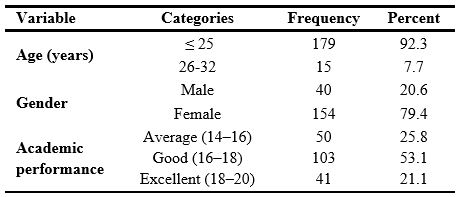
Note: Data are presented as frequency (percent). Academic performance is based on a grading scale from 0 to 20.
Abbreviations: n, number of participants.
Regression analysis showed the effect of risk awareness (Beta = 0.23) and action confidence (Beta = 0.46) on self-regulated learning intention in the motivation phase. These variables predicted 53% of the changes in students' self-regulated learning intention. In this phase, outcome expectations (Beta = 0.49) had no important effect on students' intention (Table 2).
Table 2. Multiple linear regression analysis predicting intention to perform self-regulated learning (n=194)
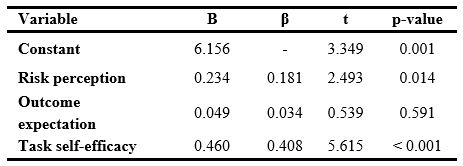
Note: The regression model was statistically significant, F(3, 190) = 18.92, p < 0.001. B represents unstandardized coefficients, β represents standardized coefficients.
Abbreviations: B, unstandardized coefficient; β, standardized coefficient; t, t-statistic; p, probability
In the action phase, intention (Beta = 1.39), action planning (Beta=0.80), and coping planning (Beta = 0.60) affected self-regulated learning and predicted 49% of the changes in self-regulated learning strategies (Table 3).
Table 3. Multiple linear regression analysis predicting self-regulated learning behavior (n = 194)
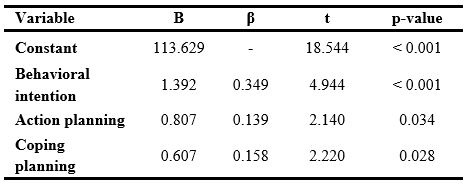
Note: The regression model was statistically significant, F(3, 190) = 19.87, p < 0.001. B represents unstandardized coefficients, β represents standardized coefficients.
Abbreviations: B, unstandardized coefficient; β, standardized coefficient; t, t-statistic; p, probability value.
In the maintenance phase, maintenance confidence (Beta = 1.44) was helpful in using self-regulated strategies and predicted 56% of the changes in self-regulated learning strategies. In this phase, recovery confidence (Beta=0.006) had no important effect on students' self-control (Table 4).
Table 4. Multiple linear regression analysis predicting maintenance of self-regulated learning behavior (n = 194)

Note: The regression model was statistically significant, F(2, 191) = 43.15, p < 0.001. B represents unstandardized coefficients, β represents standardized coefficients.
Abbreviations: B, unstandardized coefficient; β, standardized coefficient; t, t-statistic; p, probability value.
Discussion
In this study, motivational and volitional factors had a clear effect on students' self-regulated learning, and students with higher maintenance self-efficacy were better at predicting their behavior.
Motivation phase (53% of explained changes)
Action self-efficacy was the strongest predictor, showing how important efficacy beliefs are in shaping learning intentions.
The results about risk perception show that students who understand the negative results of unregulated learning are more motivated to plan. Our findings showed that both risk perception and self-efficacy affected students’ intention for self-regulated learning.
However, in the studies by Zhang et al. [24] and Mohammadi Zeidi et al. [25], self-efficacy, perceived need, risk perception, and outcome expectations all strongly predicted engagement intention. In the research by Zhang and Mohammadi Zeidi, the focus was on regular physical activity among hypertensive patients, while our study examined students’ intention to learn self-regulation.
Because the goals and participants were different, this may explain the difference in findings.
The results of Zhou et al.’s study in China [26] and Radtke et al.’s study in Switzerland and England [27] were in line with the findings of the present study. However, in those studies, the perceived risk factor did not have a significant link with behavioral intention. In our study, the participants were between 18 and 22 years old, while in the other studies, they were between 40 and 50 years old.
This age difference might explain why some constructs were significant in one study but not in the other.
Similar to our findings, Joveini et al. [28] showed that among university students, risk perception and self-efficacy were the most important predictors of hookah use. Based on our results and those of Joveini et al., it seems that risk perception and self-efficacy are key factors influencing behavior in university students.
Moghimi et al. also supported our findings, showing that risk perception and self-efficacy were important factors influencing medication adherence [29]. Beharu [30] also found a positive relationship between self-efficacy and behavioral intention. Similarly, Mohammadi Zeidi et al. [25] reported a significant link between intention, self-efficacy, and coping with physical activity. Schwarzer et al. [31] showed that risk perception, outcome expectations, and pre-action self-efficacy were predictors of intention.
Outcome expectations did not have a significant effect on students’ intention. Factors such as self-efficacy, which shows that students feel able to perform an action, and risk perception, which makes people more aware and careful about a behavior, seem to have a stronger effect on behavioral intention.
In young people, risk perception and self-efficacy are more powerful factors than outcome expectations. This means that in this age group, outcome expectations have a smaller influence on behavioral intention.
Findings show that people with higher self-efficacy have more motivation and a stronger intention to adopt healthy behaviors. In other words, their confidence grows because they believe their self-efficacy and skills will lead to successful results, which strengthens their behavioral intention.
However, Zhang et al’s study [32] found that risk perception had little effect on influenza prevention behaviors. Similarly, other studies [33, 34] showed that risk perception was a weak predictor of physical activity in patients.
It seems that improving risk perception and self-efficacy is more useful for self-regulated learning and reducing hookah use.
Role-playing with instant video feedback can effectively improve self-efficacy for preventing risky behaviors, planning, and academic progress.
Rouvere et al. [35], unlike our study, reported that risk perception had only a small role in predicting health behavior. Also, in the study by Baghiani Moghaddam et al. [36], none of the motivational phase factors predicted behavioral intention.
The lack of a significant relationship between perceived risk and behavioral intention in previous studies may be due to age differences among participants (since most studies were on adults) and differences in how variables were measured. Because the stages of the model differ across studies, intention usually acts as the predictor, planning as the mediator, self-efficacy as the regulator, and behavior as the outcome—showing that intention turns into behavior through planning [37]. Moghimi et al. [29] found that four educational sessions increased patients’ risk perception and their intention to do preventive behaviors. Finally, differences in when outcomes were measured and the use of self-report tools with different levels of validity and reliability may explain some of the variation in results.
Action phase (49% of explained changes)
The volitional phase includes action planning and coping planning, which act as links between intention and behavior.
Learning intention is the foundation for turning plans into real actions.
Action planning and coping planning highlight how important proactive strategies are for handling learning barriers.
In the volitional phase, our results showed that intention, action planning, and coping planning affected self-regulated learning and together explained 49% of the changes in self-regulated learning strategy variables. However, in the study by Rouvere et al. [35], health behavioral intention (83%) and action planning (59%) were reported as predictors in the volitional phase. The use of different questionnaires to measure the constructs may explain the difference in results.
In our study, behavioral intention was found to be the most effective construct in the volitional phase. Mazloomi Mahmoodabad et al. [38] also found a positive relationship between behavioral intention and preventive behaviors.
Their results showed that the stronger a person’s intention to perform a behavior, the more likely they are to perform it in the future—a finding that agrees with Mohammadi et al. [39]. In the study by Mohammadi Zeidi et al. [25], the HAPA constructs explained 45% of the variance in intention and 31% of the variance in physical activity behavior. These findings confirm that behavioral intention is one of the most important HAPA constructs for predicting healthy and goal-directed behaviors. Assessing conditions to enhance educational effectiveness: the inventory for student engagement and successAssessing conditions to enhance educational effectiveness: the inventory for student engagement and successSimilar to our results, other studies on health behaviors have also shown that action planning and coping planning have strong effects on behavior change [40–42]. However, the results of Rhodes et al. [43] did not match the findings of our study.
It seems that using motivational and learning strategies in action and coping planning made them more effective for self-regulated learning.
In contrast, Rouvere et al. [35] found that the HAPA model constructs explained only 0.14% of the variance in engagement with mental health tools, and action planning did not affect proper behavior performance. These differences may be due to the lack of motivational strategies, differences in the time periods used for applying model components, and variations in how the HAPA model constructs were defined and measured in other studies.
In Baghiani Moghaddam et al.’s study [36], within the volitional phase, coping self-efficacy and maintenance self-efficacy predicted parenting skills performance. To apply the HAPA model in instructional design and support deeper learning, start with a needs assessment to check trainers’ current knowledge and identify barriers.
Next, strengthen the motivational phase by boosting self-efficacy through practical workshops and successful examples, and improving outcome expectations with real data on intervention effects. In the practical planning phase, increase learners’ participation by including group discussions and open-ended questions. During the coping planning phase, use the if–then technique to prepare for challenges, and in training, apply methods like simulating difficult situations and role-playing to build skills, confidence, and self-regulated learning. All the model’s constructs explained 53–71% of the differences in parenting behavior. Schwarzer et al. [31] found that recovery self-efficacy and action planning were predictors of behavior. However, Labudek et al. [44] found that action planning had a weak link with behavior and did not predict walking in inactive middle-aged women, obese adults, or older adults. These differences may be because some studies used self-report measures while others used objective measures.
Maintenance phase (56% of explained changes)
Maintenance self-efficacy was the only significant predictor, showing how important it is to keep positive beliefs over time. In this phase, maintenance self-efficacy helped students use self-regulation strategies and explained 56% of the changes in self-regulated learning strategies. The third part of the model, which included past behavior, explained more variance than the motivational and volitional phases. Hamilton et al. [41] in Australia also found that self-efficacy strongly affects behavior and predicts intention, which matches our study. Xu et al. [45] showed that maintenance self-efficacy indirectly predicts physical activity through planning, suggesting that HAPA is useful for predicting behavior changes. Schwarzer et al. [31] reported that maintenance self-efficacy and intention predict action planning. Moodi et al. [46] highlighted the importance of self-efficacy: even when university staff saw more benefits than barriers, no behavior change occurred because they had low self-efficacy in overcoming obstacles. In the current studies, perceived self-efficacy was the strongest predictor of behavior. Similarly, Mohammadi et al. [39] in skin cancer and Jasemzadeh et al. [47] found that self-efficacy predicted protective behaviors. These findings support the stage-based self-regulated learning framework. The different contributions of variables in each phase show that self-regulation is dynamic and multidimensional. Consistency with Wang et al. [48] on cognitive-motivational learning predictors also strengthens the study’s validity.
Conclusion
Based on the results of data analysis, the ideas of the Health Action Process Approach were predictive and helpful in the starting, using, and keeping of students' self-regulated learning strategies.
Therefore, it is suggested to use the theory framework of HAPA along with its practical and guiding methods to make real and overcome barriers and challenges in keeping students' self-regulated learning strategies.
These findings give a full framework for designing school actions that at the same time target improving confidence beliefs, developing preventive planning skills, and supporting behavioral maintenance.
Ethical considerations
The present study was approved by the Ethics Committee in Biomedical Research of Jiroft University of Medical Sciences with the code IR.JMU.REC.1403.062.
Artificial intelligence utilization for article writing
No Artificial Intelligence (AI) tools were used in the writing of this manuscript.
Acknowledgment
The present study is based on a research project with the number p-1403-1056, sponsored by Jiroft University of Medical Sciences. We would like to express our sincere thanks and appreciation to all the officials and students who worked with us in carrying out this research project.
Conflict of interest statement
The authors declare no conflict of interest.
Author contributions
Conceptualization and Planning: RP, EM; Data Collection: RP, EM; Data Analysis: RP, RF, NN; Project Administration: RP, RF; Resources: RP, NN; Writing - Original Draft: RP, EM, RF, NN; Writing - Review & Editing: RP, EM.
Funding
The author declares that they received no financial support for this article's research, authorship, and publication.
Data availability statement
The data are available from the corresponding author.
Background & Objective: Self-Regulated Learning (SRL) helps students do better in school and stay more interested in learning. This study looked at mental factors that affect SRL among students using the Health Action Process Approach (HAPA).
Materials & Methods: This study used a method where data was collected at one point in time. We chose 194 students in 2025 using a multi-stage sampling method. We collected data using two main tools: a standard SRL questionnaire and a researcher-made questionnaire based on HAPA ideas related to SRL. We looked at the data using basic math and multiple regression analysis, with results considered important at p < 0.05.
Results: The analysis showed that risk awareness (Beta = 0.23) and action confidence (Beta = 0.46) strongly predicted SRL intention in the motivation phase, explaining 53% of changes. In the action phase, intention (Beta = 1.39), action planning (Beta = 0.80), and coping planning (Beta=0.60) predicted 49% of SRL strategy changes. In the maintenance phase, maintenance confidence (Beta = 1.44) predicted 56% of SRL changes.
Conclusion: HAPA ideas strongly predicted students' starting, using, and keeping up with SRL strategies. These findings suggest that HAPA's theory framework should be used to help students keep using SRL strategies in school settings.
Introduction
Self-Regulated Learning (SRL) can be defined as the ability to manage, watch, review, and check learning strategies during the learning process well [6]. Self-regulated learners have the skills to decide what and how to learn, know the role of motivation, use different strategies to reach their goals, and actively control their learning processes [7].
In the end, such learners show more efficient and better knowledge gain [8]. Medical students in clinical training must use key self-control skills that include special parts such as patient interaction, meaningful learning, critical thinking use, self-check of activities, and personal knowledge updating [9]. Students with SRL can check their performance and then use different strategies to control motivation in reaching set goals [10]. Also, teachers in school settings should use different ways to improve and use self-regulated learning strategies among students [11]. According to the study's findings and suggestions by Albelbisi and Yusop [12], looking at mental factors in students' SRL is needed. In Iran, few studies have been done to find factors that may improve motivation and self-control [13]. Such knowledge is helpful when designing courses and classes that make self-control easier, and can suggest good ways for teaching students to change their strategies according to context [14].
The mental idea of confidence, as shown in Maleki’s study [15] plays a key role in SRL within school settings. Students with high confidence show a greater ability to use learning strategies and control their learning experiences [15].
However, the process of learning is often blocked by unexpected barriers, which can lead to people going back to old behaviors. This shows the need to look beyond confidence to other important factors that affect not only the first starting but also the long-term keeping of learning behaviors.
The Health Action Process Approach (HAPA) gives a full model that clearly talks about both the starting and keeping phases of behavior [16].
Using this method has greatly helped in finding and studying factors affecting behavior formation and keeping [17, 18].
HAPA says there are three different types of confidence that are ideas in the starting and keeping of behavior. Telling apart these ideas is helpful across different areas of behavior change [19]. In the first motivation phase, task confidence, together with other motivation ideas such as risk awareness and outcome expectations, is a key predictor of a person's intention to start a behavior when faced with a hard demand. Later, in the action phase, coping confidence and recovery confidence, alongside action factors like action planning, are key in predicting the actual performance and long-term keeping of the behavior [20].
HAPA has been used for prediction, checking, design, and different actions [21]. Based on earlier studies' suggestions showing the need to find mental variables affecting students' use of SRL strategies [12]—and given the lack of such research both in Iran and worldwide, as well as limited studies into students' motivation factors in SRL—the researchers decided to do this study.
The aim was to look at the mental factors affecting SRL strategies using the HAPA framework.
The findings are meant to inform good student counseling programs for improving school performance and success.
Materials & Methods
Design and setting(s)
This cross-sectional study was carried out at the Jiroft University of Medical Sciences, from April 1, 2025, to June 31, 2025.
Participants and sampling
The study included students from areas of medicine, nursing, midwifery, public health, and environmental health. The sample size was determined based on key parameters from a previous study [22] using the following formula: α = 0.05, β=0.8, Z₁₋α = 1.96, Z₁₋β = 0.84, r = 0.2, C = 0.2027 (where C = 1/2 × Ln[(1+r)/(1-r)] = 1/2 × Ln[1.2/0.8] = 0.2027). The calculated sample size was n = [(Z₁₋α + Z₁₋β)/C] ² + 3 = 188. Accounting for potential attrition, 194 students were recruited.
The sampling process used a multi-stage way. First, the target group was divided into four groups based on the entry year of students (Faculties of Health, Nursing and Midwifery, and Medicine) from 2020 to 2023. Next, a matching random sampling method was used to each group. Using official enrollment lists from each school year, students were randomly picked from each group, with the sample size from each group being matching to its population size.
First-semester students, transfer students, and guest students were left out from participation.
Tools/Instruments
The data collection tool had three parts:
1. Basic information: age, gender, and school performance (Grade Point Average (GPA) of previous semester)
2. Pintrich and De Groot's Self-Regulated Learning Strategies Questionnaire (47 items) checking learning strategies (22 items) and motivation strategies (25 items) using a 5-point Likert scale
3. Researcher-made HAPA ideas questionnaire measuring: risk awareness (5 items), outcome expectations (5 items), task confidence (10 items), behavioral intention (10 items), action planning (3 items), coping planning (5 items), maintenance confidence (7 items), and recovery confidence (3 items). The self-regulated learning questionnaire showed Cronbach's alpha reliability numbers: confidence 0.75, inner value 0.83, thinking strategies 0.89, and self-control strategies 0.91 [23]. For the HAPA questionnaire, both exploratory and confirmatory factor analyses were used. Face validity was looked at through student feedback, and content validity was checked by 8 experts using CVR and CVI measures. Final reliability numbers were: risk awareness (α = 0.78, ICC = 0.76), outcome expectations (α = 0.79, ICC = 0.93), task confidence (α = 0.84, ICC = 0.73), behavioral intention (α = 0.94, ICC = 0.84), action planning (α = 0.96, ICC = 0.80), coping planning (α = 0.90, ICC = 0.75), maintenance confidence (α = 0.76, ICC = 0.75), and recovery confidence (α = 0.84, ICC = 0.83).
Data collection methods
Data were collected through unnamed self-given questionnaires to reduce self-report bias. The questionnaires were given to picked participants after getting informed consent.
Data analysis
Data analysis involved basic math (frequency, percentage, mean) and inferential math. The normality of error spread in number variables was looked at using the Kolmogorov-Smirnov test. Multiple regression analysis with the Enter method was used to explain how predictor variables relate to the standard variable. All tests were done at α = 0.05 importance level using SPSS version 22.
Results
From 194 participants, 92.3% (179 people) were under 25 years old, and 65.5% (127 people) were female. Most participants (107 people) reported good school performance (Table 1).
Table 1. Distribution of demographic and academic characteristics among study participants (n = 194)
Note: Data are presented as frequency (percent). Academic performance is based on a grading scale from 0 to 20.
Abbreviations: n, number of participants.
Regression analysis showed the effect of risk awareness (Beta = 0.23) and action confidence (Beta = 0.46) on self-regulated learning intention in the motivation phase. These variables predicted 53% of the changes in students' self-regulated learning intention. In this phase, outcome expectations (Beta = 0.49) had no important effect on students' intention (Table 2).
Table 2. Multiple linear regression analysis predicting intention to perform self-regulated learning (n=194)
Note: The regression model was statistically significant, F(3, 190) = 18.92, p < 0.001. B represents unstandardized coefficients, β represents standardized coefficients.
Abbreviations: B, unstandardized coefficient; β, standardized coefficient; t, t-statistic; p, probability
In the action phase, intention (Beta = 1.39), action planning (Beta=0.80), and coping planning (Beta = 0.60) affected self-regulated learning and predicted 49% of the changes in self-regulated learning strategies (Table 3).
Table 3. Multiple linear regression analysis predicting self-regulated learning behavior (n = 194)
Note: The regression model was statistically significant, F(3, 190) = 19.87, p < 0.001. B represents unstandardized coefficients, β represents standardized coefficients.
Abbreviations: B, unstandardized coefficient; β, standardized coefficient; t, t-statistic; p, probability value.
In the maintenance phase, maintenance confidence (Beta = 1.44) was helpful in using self-regulated strategies and predicted 56% of the changes in self-regulated learning strategies. In this phase, recovery confidence (Beta=0.006) had no important effect on students' self-control (Table 4).
Table 4. Multiple linear regression analysis predicting maintenance of self-regulated learning behavior (n = 194)
Note: The regression model was statistically significant, F(2, 191) = 43.15, p < 0.001. B represents unstandardized coefficients, β represents standardized coefficients.
Abbreviations: B, unstandardized coefficient; β, standardized coefficient; t, t-statistic; p, probability value.
Discussion
In this study, motivational and volitional factors had a clear effect on students' self-regulated learning, and students with higher maintenance self-efficacy were better at predicting their behavior.
Motivation phase (53% of explained changes)
Action self-efficacy was the strongest predictor, showing how important efficacy beliefs are in shaping learning intentions.
The results about risk perception show that students who understand the negative results of unregulated learning are more motivated to plan. Our findings showed that both risk perception and self-efficacy affected students’ intention for self-regulated learning.
However, in the studies by Zhang et al. [24] and Mohammadi Zeidi et al. [25], self-efficacy, perceived need, risk perception, and outcome expectations all strongly predicted engagement intention. In the research by Zhang and Mohammadi Zeidi, the focus was on regular physical activity among hypertensive patients, while our study examined students’ intention to learn self-regulation.
Because the goals and participants were different, this may explain the difference in findings.
The results of Zhou et al.’s study in China [26] and Radtke et al.’s study in Switzerland and England [27] were in line with the findings of the present study. However, in those studies, the perceived risk factor did not have a significant link with behavioral intention. In our study, the participants were between 18 and 22 years old, while in the other studies, they were between 40 and 50 years old.
This age difference might explain why some constructs were significant in one study but not in the other.
Similar to our findings, Joveini et al. [28] showed that among university students, risk perception and self-efficacy were the most important predictors of hookah use. Based on our results and those of Joveini et al., it seems that risk perception and self-efficacy are key factors influencing behavior in university students.
Moghimi et al. also supported our findings, showing that risk perception and self-efficacy were important factors influencing medication adherence [29]. Beharu [30] also found a positive relationship between self-efficacy and behavioral intention. Similarly, Mohammadi Zeidi et al. [25] reported a significant link between intention, self-efficacy, and coping with physical activity. Schwarzer et al. [31] showed that risk perception, outcome expectations, and pre-action self-efficacy were predictors of intention.
Outcome expectations did not have a significant effect on students’ intention. Factors such as self-efficacy, which shows that students feel able to perform an action, and risk perception, which makes people more aware and careful about a behavior, seem to have a stronger effect on behavioral intention.
In young people, risk perception and self-efficacy are more powerful factors than outcome expectations. This means that in this age group, outcome expectations have a smaller influence on behavioral intention.
Findings show that people with higher self-efficacy have more motivation and a stronger intention to adopt healthy behaviors. In other words, their confidence grows because they believe their self-efficacy and skills will lead to successful results, which strengthens their behavioral intention.
However, Zhang et al’s study [32] found that risk perception had little effect on influenza prevention behaviors. Similarly, other studies [33, 34] showed that risk perception was a weak predictor of physical activity in patients.
It seems that improving risk perception and self-efficacy is more useful for self-regulated learning and reducing hookah use.
Role-playing with instant video feedback can effectively improve self-efficacy for preventing risky behaviors, planning, and academic progress.
Rouvere et al. [35], unlike our study, reported that risk perception had only a small role in predicting health behavior. Also, in the study by Baghiani Moghaddam et al. [36], none of the motivational phase factors predicted behavioral intention.
The lack of a significant relationship between perceived risk and behavioral intention in previous studies may be due to age differences among participants (since most studies were on adults) and differences in how variables were measured. Because the stages of the model differ across studies, intention usually acts as the predictor, planning as the mediator, self-efficacy as the regulator, and behavior as the outcome—showing that intention turns into behavior through planning [37]. Moghimi et al. [29] found that four educational sessions increased patients’ risk perception and their intention to do preventive behaviors. Finally, differences in when outcomes were measured and the use of self-report tools with different levels of validity and reliability may explain some of the variation in results.
Action phase (49% of explained changes)
The volitional phase includes action planning and coping planning, which act as links between intention and behavior.
Learning intention is the foundation for turning plans into real actions.
Action planning and coping planning highlight how important proactive strategies are for handling learning barriers.
In the volitional phase, our results showed that intention, action planning, and coping planning affected self-regulated learning and together explained 49% of the changes in self-regulated learning strategy variables. However, in the study by Rouvere et al. [35], health behavioral intention (83%) and action planning (59%) were reported as predictors in the volitional phase. The use of different questionnaires to measure the constructs may explain the difference in results.
In our study, behavioral intention was found to be the most effective construct in the volitional phase. Mazloomi Mahmoodabad et al. [38] also found a positive relationship between behavioral intention and preventive behaviors.
Their results showed that the stronger a person’s intention to perform a behavior, the more likely they are to perform it in the future—a finding that agrees with Mohammadi et al. [39]. In the study by Mohammadi Zeidi et al. [25], the HAPA constructs explained 45% of the variance in intention and 31% of the variance in physical activity behavior. These findings confirm that behavioral intention is one of the most important HAPA constructs for predicting healthy and goal-directed behaviors. Assessing conditions to enhance educational effectiveness: the inventory for student engagement and successAssessing conditions to enhance educational effectiveness: the inventory for student engagement and successSimilar to our results, other studies on health behaviors have also shown that action planning and coping planning have strong effects on behavior change [40–42]. However, the results of Rhodes et al. [43] did not match the findings of our study.
It seems that using motivational and learning strategies in action and coping planning made them more effective for self-regulated learning.
In contrast, Rouvere et al. [35] found that the HAPA model constructs explained only 0.14% of the variance in engagement with mental health tools, and action planning did not affect proper behavior performance. These differences may be due to the lack of motivational strategies, differences in the time periods used for applying model components, and variations in how the HAPA model constructs were defined and measured in other studies.
In Baghiani Moghaddam et al.’s study [36], within the volitional phase, coping self-efficacy and maintenance self-efficacy predicted parenting skills performance. To apply the HAPA model in instructional design and support deeper learning, start with a needs assessment to check trainers’ current knowledge and identify barriers.
Next, strengthen the motivational phase by boosting self-efficacy through practical workshops and successful examples, and improving outcome expectations with real data on intervention effects. In the practical planning phase, increase learners’ participation by including group discussions and open-ended questions. During the coping planning phase, use the if–then technique to prepare for challenges, and in training, apply methods like simulating difficult situations and role-playing to build skills, confidence, and self-regulated learning. All the model’s constructs explained 53–71% of the differences in parenting behavior. Schwarzer et al. [31] found that recovery self-efficacy and action planning were predictors of behavior. However, Labudek et al. [44] found that action planning had a weak link with behavior and did not predict walking in inactive middle-aged women, obese adults, or older adults. These differences may be because some studies used self-report measures while others used objective measures.
Maintenance phase (56% of explained changes)
Maintenance self-efficacy was the only significant predictor, showing how important it is to keep positive beliefs over time. In this phase, maintenance self-efficacy helped students use self-regulation strategies and explained 56% of the changes in self-regulated learning strategies. The third part of the model, which included past behavior, explained more variance than the motivational and volitional phases. Hamilton et al. [41] in Australia also found that self-efficacy strongly affects behavior and predicts intention, which matches our study. Xu et al. [45] showed that maintenance self-efficacy indirectly predicts physical activity through planning, suggesting that HAPA is useful for predicting behavior changes. Schwarzer et al. [31] reported that maintenance self-efficacy and intention predict action planning. Moodi et al. [46] highlighted the importance of self-efficacy: even when university staff saw more benefits than barriers, no behavior change occurred because they had low self-efficacy in overcoming obstacles. In the current studies, perceived self-efficacy was the strongest predictor of behavior. Similarly, Mohammadi et al. [39] in skin cancer and Jasemzadeh et al. [47] found that self-efficacy predicted protective behaviors. These findings support the stage-based self-regulated learning framework. The different contributions of variables in each phase show that self-regulation is dynamic and multidimensional. Consistency with Wang et al. [48] on cognitive-motivational learning predictors also strengthens the study’s validity.
Conclusion
Based on the results of data analysis, the ideas of the Health Action Process Approach were predictive and helpful in the starting, using, and keeping of students' self-regulated learning strategies.
Therefore, it is suggested to use the theory framework of HAPA along with its practical and guiding methods to make real and overcome barriers and challenges in keeping students' self-regulated learning strategies.
These findings give a full framework for designing school actions that at the same time target improving confidence beliefs, developing preventive planning skills, and supporting behavioral maintenance.
Ethical considerations
The present study was approved by the Ethics Committee in Biomedical Research of Jiroft University of Medical Sciences with the code IR.JMU.REC.1403.062.
Artificial intelligence utilization for article writing
No Artificial Intelligence (AI) tools were used in the writing of this manuscript.
Acknowledgment
The present study is based on a research project with the number p-1403-1056, sponsored by Jiroft University of Medical Sciences. We would like to express our sincere thanks and appreciation to all the officials and students who worked with us in carrying out this research project.
Conflict of interest statement
The authors declare no conflict of interest.
Author contributions
Conceptualization and Planning: RP, EM; Data Collection: RP, EM; Data Analysis: RP, RF, NN; Project Administration: RP, RF; Resources: RP, NN; Writing - Original Draft: RP, EM, RF, NN; Writing - Review & Editing: RP, EM.
Funding
The author declares that they received no financial support for this article's research, authorship, and publication.
Data availability statement
The data are available from the corresponding author.
Article Type : Orginal Research |
Subject:
Education
Received: 2025/07/29 | Accepted: 2025/11/8 | Published: 2025/11/19
Received: 2025/07/29 | Accepted: 2025/11/8 | Published: 2025/11/19
References
1. Hadi Alsherify MJ, Hassani M. The effectiveness of self-regulated learning strategies on academic self-efficacy, academic motivation, concern and academic achievement. J Psychol Sci. 2025;24(151):77-94.
2. Ozcan M. Factors affecting students' academic achievement according to the teachers' opinion. Educ Reform J. 2021;6(1):1-18 [DOI:10.22596/erj2021.06.01.1.18]
3. Bisri A, Heryatun Y, Navira A. Educational data mining model using support vector machine for student academic performance evaluation. J Educ Learn (EduLearn). 2025;19(1):478-86. [DOI:10.11591/edulearn.v19i1.21609]
4. Hidayatullah A, Csíkos C. Association between psychological need satisfaction and online self-regulated learning. Asia Pac Educ Rev. 2025;26(3):609-19. [DOI:10.1007/s12564-023-09910-9]
5. Abdelhalim SM. An investigation into English majors' self-regulated writing strategies in an online learning context. Lang Teach Res. 2025;29(4):1715-52. [DOI:10.1177/13621688221100296]
6. Dignath C, Veenman MV. The role of direct strategy instruction and indirect activation of self-regulated learning-Evidence from classroom observation studies. Educ Psychol Rev. 2021;33(2):489-533. [DOI:10.1007/s10648-020-09534-0]
7. Zimmerman BJ, Schunk DH. Self-regulated learning and performance. In: Zimmerman BJ, Schunk DH, editors. Handbook of self-regulation of learning and performance. 2nd ed. New York: Routledge; 2011. p. 1-12.
8. Torrington J, Bower M, Burns EC. Elementary students' self‐regulation in computer‐based learning environments: How do self‐report measures, observations and teacher rating relate to task performance?. Br J Educ Technol. 2024;55(1):231-58. [DOI:10.1111/bjet.13338]
9. Woods NN, Mylopoulos M, Brydges R. Informal self-regulated learning on a surgical rotation: uncovering student experiences in context. Adv Health Sci Educ. 2011;16:643-53. [DOI:10.1007/s10459-011-9285-4] [PMID]
10. Schunk DH. Self-regulated learning: the educational legacy of Paul R. Pintrich. Educ Psychol. 2005;40:85-94. [DOI:10.1207/s15326985ep4002_3]
11. Li L, Zhu ML, Shi YQ, Yang LL. Influencing factors of self-regulated learning of medical-related students in a traditional Chinese medical university: a cross-sectional study. BMC Med Educ. 2023;23(1):87. [DOI:10.1186/s12909-023-04051-4] [PMID] []
12. Albelbisi NA, Yusop FD. Factors influencing learners' self-regulated learning skills in a massive open online course (MOOC) environment. Turk Online J Distance Educ. 2021;20(3):1-16. [DOI:10.17718/tojde.598191]
13. Jouhari Z, Haghani F, Changiz T. Factors affecting self-regulated learning in medical students: a qualitative study. Med Educ Online. 2015;20(1):28694. [DOI:10.3402/meo.v20.28694] [PMID] []
14. Schunk DH. Commentary on self-regulation in school contexts. Learn Instr. 2005;15:173-7. [DOI:10.1016/j.learninstruc.2005.04.013]
15. Maleki B, Hosseini SA. The causal model of self-regulated learning in students based on academic self-efficacy and motivational beliefs: the mediating role of psychological capital. J Mod Psychol Res. 2024;18(72):267-77.
16. Schwarzer R. Modeling health behavior change: how to predict and modify the adoption and maintenance of health behaviors. Appl Psychol. 2008;57(1):1-29.
https://doi.org/10.1111/j.1464-0597.2008.00361.x [DOI:10.1111/j.1464-0597.2007.00325.x]
17. Faryabi R, Pournarani R, Movahed E. Adherence of hypertension patients to self-care behaviors based on the health action process approach in Southern Iran. Health Educ Health Promot. 2025;13(2):357-62.
18. Mei J, Xie Y, Huang P, Jin Y, Wang X, Chen Y. The effects of HAPA theory-based case management in patients with metabolic dysfunction-associated steatotic liver disease. Ann Hepatol. 2025;30(2):101790. [DOI:10.1016/j.aohep.2025.101790] [PMID]
19. Pournarani R, Movahed E, Faryabi R, Mehralizadeh A. Investigating factors related to the self-efficacy of parenting skills among mothers in Jiroft City, Kerman Province, Iran. J Health Syst Res. 2025;21(2):183-90.
20. Pournarani R, Faryabi R, Mehralizadeh SD, Yoshany N. Factors influencing substance use relapse in people referring to addiction recovery centers in Jiroft, Kerman. J Educ Community Health. 2023;10(3):173-8. [DOI:10.34172/jech.2147]
21. Liang W, Liu G, Su N, Rhodes RE, Duan Y, Zhang CQ, et al. Understanding parental support for children's 24-hour movement behaviors based on an adapted HAPA framework: a three-wave prospective study. Appl Psychol Health Well-Being. 2025;17(3):e70034. [DOI:10.1111/aphw.70034] [PMID] []
22. Rezaei Rad M, Zarofian F, Majani N, Rezaei Rad M. The relationship of self-efficacy with self-regulated learning in the virtual education of students during the Covid-19 epidemic. J Nurs Educ. 2023;12(2):15-24.
23. Moradi Doliskani M, Yonespour Z, Poya M. The effect of flipped classroom teaching on self-regulatory learning strategies and learning motivation components in research method course among the staff of AJA research center. New Educ Approaches. 2021;16(2):99-116.Zhang CQ, Zhang R, Schwarzer R, Hagger MS. A meta-analysis of the health action process approach. Health Psychol. 2019;38(7):623-37. [DOI:10.1037/hea0000728] [PMID]
24. Mohammadi Zeidi I, Morshedi H, Shokohi A. Predicting psychological factors affecting regular physical activity in hypertensive patients: application of health action process approach model. Nurs Open. 2021;8(1):442-52. [DOI:10.1002/nop2.645] [PMID] []
25. Zhou G, Gan Y, Knoll N, Schwarzer R. Proactive coping moderates the dietary intention-planning-behavior path. Appetite. 2013;70:127-33.Radtke T, Kaklamanou D, Scholz U, Hornung R, Armitage CJ. Are diet-specific compensatory health beliefs predictive of dieting intentions and behaviour? Appetite. 2014;76:36-43. [DOI:10.1016/j.appet.2013.06.097] [PMID]
26. Joveini H, Dehdari T, Hashemian M, Maheri M, Shahrabadi R, Rohban A, et al. Effects of an educational intervention on male students' intention to quit water pipe smoking: an application of the theory of planned behavior (TPB) and health action process approach (HAPA). J Educ Community Health. 2020;7(2):73-80. [DOI:10.29252/jech.7.2.73]
27. Moghimi S, Payandeh A, Seraji M. The effect of educational intervention based on the health behavior process approach model in medication adherence of patients with type two diabetes. Iran J Health Educ Health Promot. 2024;12(2):142-54.
28. Beharu WT. Psychological factors affecting students academic performance among freshman psychology students in Dire Dawa University. J Educ Pract. 2018;9(4):59-65.
29. Schwarzer R, Luszczynska A. How to overcome health-compromising behaviors: the health action process approach. Eur Psychol. 2008;13(2):141-51. [DOI:10.1027/1016-9040.13.2.141]
30. Zhang CQ, Chung PK, Liu JD, Chan DK, Hagger MS, Hamilton K. Health beliefs of wearing facemasks for influenza A/H1N1 prevention: a qualitative investigation of Hong Kong older adults. Asia Pac J Public Health. 2019;31(3):246-56. [DOI:10.1177/1010539519844082] [PMID]
31. Vornanen M, Konttinen H, Peltonen M, Haukkala A. Diabetes and cardiovascular disease risk perception and risk indicators: a 5-year follow-up. Int J Behav Med. 2021;28(3):337-48. [DOI:10.1007/s12529-020-09924-2] [PMID] []
32. Gholami M, Knoll N, Schwarzer R. A meta-analysis of the health action process approach to physical activity. In: Gellert P, editor. Self-regulation and health behavior across the lifespan. 1st ed. Gottingen: Hogrefe Publishing; 2014. p. 71-88.
33. Rouvere J, Blanchard BE, Johnson M, Griffith Fillipo I, Mosser B, Romanelli M, et al. Application of an adapted health action process approach model to predict engagement with a digital mental health website: cross-sectional study. JMIR Hum Factors. 2024;11:e57082. [DOI:10.2196/57082] [PMID] []
34. Baghiani Moghaddam MH, Norouzi S, Morowatisharifabad MA, Norouzi A. Evaluation of the health action process approach to improve mothers' parenting skills. J Health Syst Res. 2014;9(14):1815-28. Available from:
35. Schwarzer R, Richert J, Kreausukon P, Remme L, Wiedemann AU, Reuter T. Translating intentions into nutrition behaviors via planning requires self-efficacy: evidence from Thailand and Germany. Int J Psychol. 2010;45(4):260-8. [DOI:10.1080/00207591003674479] [PMID]
36. Mazloomy Mahmoodabad SS, Gerayllo S, Khaleghi Moori M, Yoshany N, Mizani N. Determinants of skin cancer prevention behaviors in Yazd students: an application of the extended parallel process model. Tolooe Behdasht. 2020;19(5):21-32. [DOI:10.18502/tbj.v19i5.5176]
37. Mohammadi S, Baghiani Moghadam MH, Noorbala MT, Mazloomi SS, Fallahzadeh H, Daya A. Survey about the role of appearance concern with skin cancer prevention behavior based on protection motivation theory. J Dermatol Cosmet. 2010;1(2):70-7. Available from:
38. Joveini H, Rohban A, Eftekhar Ardebili H, Dehdari T, Maheri M, Hashemian M. The effects of an education program on hookah smoking cessation in university students: an application of the Health Action Process Approach (HAPA). J Subst Use. 2020;25(1):62-9. [DOI:10.1080/14659891.2019.1664655]
39. Hamilton K, Smith SR, Keech JJ, Moyers SA, Hagger MS. Application of the health action process approach to social distancing behavior during COVID-19. Appl Psychol Health Well-Being. 2020;12(4):1244-69. [DOI:10.1111/aphw.12231] [PMID] []
40. Mohammadi Zeidi B, Kariman N, Kashi Z, Mohammadi Zeidi I, Alavi Majd H. Predictors of physical activity following gestational diabetes: application of health action process approach. Nurs Open. 2020;7(4):1060-6. [DOI:10.1002/nop2.486] [PMID] []
41. Rhodes RE, Grant S, de Bruijn GJ. Planning and implementation intention interventions. In: Hagger MS, Cameron LD, Hamilton K, Hankonen N, Lintunen T, editors. The handbook of behavior change. Cambridge: Cambridge University Press; 2020. p. 478-94.
42. Labudek S, Fleig L, Jansen CP, Kramer-Gmeiner F, Nerz C, Becker C, et al. Applying social cognition models to explain walking duration in older adults: the role of intrinsic motivation. J Aging Phys Act. 2021;29(5):744-52. [DOI:10.1123/japa.2020-0296] [PMID]
43. Xu H, Su C, Ji Y, Yin F, Yang Y, Yang S, et al. Predicting physical exercise changes in Chinese rural adolescents: the application of the health action process approach model. Psychol Health Med. 2020;25(5):639-51. [DOI:10.1080/13548506.2019.1709653] [PMID]
44. Moodi M, Sharifzadeh G. Factors affecting physical activity behavior based on Transtheoretical Model in the employees of Birjand universities in 2014. J Birjand Univ Med Sci. 2014;21(3):352-61. Available from:
45. Jasemzadeh M, Jaafarzadeh N, Khafaie MA, Malehi AS, Araban M. Predicator of pregnant women's self-care behavior against air pollution: an explanation based on the extended parallel process model (EPPM). Electron Physician. 2016;8(9):2871-7. [DOI:10.19082/2871] [PMID] []
46. Ng B, Wang CJ, Liu WC. Motivational-cognitive profiles of learners: cluster movement. Pers Individ Dif. 2015;85:128-33. [DOI:10.1016/j.paid.2015.04.047]
Send email to the article author
| Rights and permissions | |
 |
This work is licensed under a Creative Commons Attribution-NonCommercial 4.0 International License. |