Tue, Sep 29, 2026
[Archive]
Volume 19, Issue 1 (2026)
J Med Edu Dev 2026, 19(1): 66-73 |
Back to browse issues page


Ethics code: IR.ZUMS.REC.1403.362


Download citation:
BibTeX | RIS | EndNote | Medlars | ProCite | Reference Manager | RefWorks
Send citation to:


BibTeX | RIS | EndNote | Medlars | ProCite | Reference Manager | RefWorks
Send citation to:
Namdari S, Mollaei F, Kamali M, Mousavi S K. The relationship between clinical instructors’ leadership styles and nursing students’ self-efficacy. J Med Edu Dev 2026; 19 (1) :66-73
URL: http://edujournal.zums.ac.ir/article-1-2602-en.html
URL: http://edujournal.zums.ac.ir/article-1-2602-en.html
The relationship between clinical instructors’ leadership styles and nursing students’ self-efficacy

1- Behbahan Faculty of Medical Sciences, Behbahan, Iran, PhD student of Nursing, School of Nursing and Midwifery, Guilan University of Medical Sciences, Rasht, Iran
2- 2. Department of Nursing, Behshahr Faculty of Nursing, Mazandaran University of Medical Sciences, Behshahr, Iran ,kazemmoosavi69@gmail.com
3- Department of Nursing, Abhar School of Nursing, Zanjan University of Medical Sciences, Zanjan, Iran
2- 2. Department of Nursing, Behshahr Faculty of Nursing, Mazandaran University of Medical Sciences, Behshahr, Iran ,
3- Department of Nursing, Abhar School of Nursing, Zanjan University of Medical Sciences, Zanjan, Iran
Full-Text [PDF 465 kb]
(508 Downloads)
| Abstract (HTML) (833 Views)
Full-Text: (159 Views)
Abstract
Background & Objective: In clinical nursing education, students' attainment of self-efficacy represents the pinnacle of professional competence. This study aimed to determine the relationship between clinical instructors' leadership styles and the self-efficacy of undergraduate nursing students.
Materials & Methods: In this cross-sectional study conducted from January to February 2025, 274 undergraduate nursing students who had completed at least two semesters of clinical training were selected via convenience sampling. Data collection tools included demographic questionnaires, the Multifactor Leadership Questionnaire (MLQ), and the Nursing Profession Self-Efficacy Scale (NPSES), completed through self-report. Data were analyzed using descriptive (mean and standard deviation) and inferential statistics (independent t-test, ANOVA, Pearson correlation, and regression) in SPSS software version 26, with a significance level set at 0.05.
Results: From the students' perspective, the most and least frequently used leadership styles by clinical instructors were transactional and laissez-faire, respectively. The students' mean total self-efficacy score was 56.67 ± 18.17. Data analysis revealed a significant relationship between both transformational and transactional leadership styles and self-efficacy. Together, these two styles explained 34.1% of the variance in students' self-efficacy.
Conclusion: The findings indicate a significant relationship between clinical instructors' leadership styles and nursing students' self-efficacy. Given the central importance of self-efficacy in training competent nurses, it is suggested that targeted workshops be held to enhance clinical instructors' awareness of various leadership styles and their distinct impacts on student self-efficacy, thereby encouraging the adoption of styles that foster its development.
Introduction
Management, heightened adaptability, greater confidence, and improved physical and psychological well-being [15]. Furthermore, such students demonstrate a propensity for setting more challenging objectives, which facilitates higher academic and clinical achievement.
Note: Data are presented as mean (M) and standard deviation (SD).
Abbreviations: M, mean; SD, standard deviation; Min, minimum; Max, maximum.
Table 2. Correlation between clinical instructors' leadership styles and nursing students' self-efficacy

Note: Pearson correlation coefficient (r) was used for analysis.
Abbreviations: r, Pearson correlation coefficient.
Note: p-values and corresponding test statistics are reported for each association. Pearson's correlation coefficient (r), independent samples t-test (t), and one-way analysis of variance (F) were used as appropriate.
Abbreviations: r, Pearson correlation coefficient; t, t-test statistic; F, ANOVA F-statistic.
Table 4. Multiple linear regression analysis: predicting nursing students' self-efficacy from clinical instructors' leadership styles
Discussion
This study examined the relationship between clinical instructors' leadership styles and nursing students' self-efficacy. The findings revealed that, from the students' perspective, the transactional leadership style was the most frequently used by clinical instructors. This result aligns with studies conducted in Iran [20, 21], Qatar [22], Jordan [23], and the Netherlands [24]. However, it contrasts with other research reporting transformational [25, 26] or laissez-faire [27] styles as dominant. This discrepancy may be attributed to the traditional pedagogical and evaluative culture within Iranian nursing education. In this context, where clinical instructors solely conduct student assessments, grades may be utilized more as a punitive tool than a motivational one [21]. Furthermore, a traditional emphasis on strict adherence to rules and procedures is prevalent [24]. Given that contingent reward, corrective action, and a focus on structured transactions are hallmarks of transactional leadership, its perceived dominance among Iranian clinical instructors is a plausible finding [8, 9].
Analysis of demographic correlates revealed that a transformational leadership style was associated with higher student GPA and greater interest in the nursing profession, while a laissez-faire style was linked to younger student age and earlier academic semesters. This suggests that students with stronger academic performance and professional interest may be more responsive or may more often encounter—instructors who motivate skill development and foster positive change, which are hallmarks of transformational leadership [8]. Conversely, the association between laissez-faire leadership and younger, less advanced students may reflect these students' greater need for guidance and structure in the initial phases of clinical training, making a passive leadership style less preferable or effective for their development.
The nursing students in this study reported a moderate level of self-efficacy. This finding aligns with several Iranian studies [28–30]. In contrast, other research from Iran [31, 32], Turkey [33], and Saudi Arabia [34] has reported above-average self-efficacy among nursing students. Discrepancies may be attributed to methodological differences, such as the use of varying measurement instruments. Furthermore, the academic progression of participants likely plays a role; the present study included students from semesters 4–8, whereas others focused on senior students (e.g., semesters 7–8) [32], who typically possess greater clinical experience. Broader contextual factors—including the clinical learning environment, opportunities for hands-on practice, instructional approaches, and situational variables—may also contribute to differing self-efficacy levels across studies [11–14].
Analysis of demographic correlates indicated that higher self-efficacy was associated with older age, later academic semesters, a higher GPA, and a strong interest in the nursing profession. This pattern aligns with previous findings that link advanced academic standing and superior academic performance to elevated self-efficacy [29]. The observed associations are conceptually sound: greater age and clinical experience (gained in later semesters) likely enhance students' readiness for challenges, professional judgment, and independent clinical decision-making [14]. Furthermore, a high GPA may reflect a stronger command of nursing knowledge, which can directly foster self-efficacy [11]. Similarly, a deep interest in the profession can increase learning motivation and reinforce beliefs in one's capabilities, thereby improving clinical performance and, ultimately, self-efficacy [13].
The core finding of this study was a significant positive relationship between student self-efficacy and two leadership styles: transformational and transactional. The correlation was stronger for transformational leadership. No significant relationship was found between the laissez-faire style and self-efficacy. These results are corroborated by Agarwal et al., who reported significant correlations for transformational and transactional leadership, but not for laissez-faire, with self-efficacy [35]. Similarly, Sohrabi et al. in Iran found that most midwifery students with high self-efficacy perceived their instructors as transformational leaders [36]. While Ramezanpoor et al. found significant relationships with all three styles among operating room staff, self-efficacy scores were notably higher under transformational and transactional leadership compared to laissez-faire [37]. In a related vein, a Saudi Arabian study linked both transactional and transformational styles to higher work engagement among nurses [38].
Theoretically, transformational leaders likely enhance self-efficacy by fostering a positive vision, addressing individual needs, and stimulating intellectual engagement, thereby helping students overcome challenges [9]. Transactional leaders may boost self-efficacy by establishing clear expectations and providing structured feedback, which promotes a sense of control and task mastery [8]. Conversely, the passivity, lack of support, and role ambiguity characteristic of laissez-faire leadership can generate confusion and undermine a student's belief in their capabilities [9].
Furthermore, regression analysis revealed that the combination of transformational and transactional leadership styles explained a substantial portion (over one-third) of the variance in student self-efficacy. This aligns with Agarwal et al., where these styles accounted for 36.5% and 28.9% of the variance, respectively [35]. This finding underscores that while transformational leadership builds efficacy through inspiration and individualized consideration, and transactional leadership does so through contingent reward and clear structures, both pathways are potent predictors of students' belief in their clinical competence [8, 9].
This study has several limitations. First, the reliance on self-report measures may introduce common method bias. Second, participants' psychological states at the time of data collection, which could influence responses, were not assessed or controlled for. Third, the generalizability of the findings is limited by the specific sampling criteria; the study population consisted solely of nursing students who had completed at least two semesters of hospital-based clinical training.
Conclusion
The findings of this study demonstrate a significant relationship between clinical instructors' leadership styles and undergraduate nursing students' self-efficacy. Based on this, two primary recommendations are proposed. First, it is recommended that nursing faculty administrators implement targeted professional development workshops. These workshops should educate clinical instructors on the full spectrum of leadership styles, with a specific emphasis on the application of transformational and transactional strategies that have been shown to foster student self-efficacy. Second, to advance the understanding of these complex, multifaceted constructs, future research should be theory-driven and employ robust methodologies. Utilizing qualitative or mixed-methods approaches would provide richer, contextual insights into the dynamics between leadership and self-efficacy in clinical education.
Ethical considerations
Ethical approval for this study was granted by the Research Ethics Committee of Zanjan University of Medical Sciences (Approval Code: IR.ZUMS.REC.1403.362; URL: https://ethics.research.ac.ir/). All participants were fully informed of the study's purpose, the confidentiality of their data, and their right to withdraw voluntarily. Informed consent was obtained from each student prior to their participation.
Artificial intelligence utilization for article writing
None
Acknowledgment
The authors would like to express their sincere gratitude to all the nursing students who participated in this study.
Conflict of interest statement
The authors declare that they have no competing interests.
Author contributions
SN, SKM, MK, and FM contributed to the study conception and design. Data collection was performed by SKM and MK. Data analysis and interpretation were conducted by SN and SKM. The first draft of the manuscript was written by SN and all authors (SN, SKM, MK, FM) commented on previous versions of the manuscript. All authors read and approved the final manuscript.
Funding
This study was supported by Zanjan University of Medical Sciences (Grant No: A-11-1159-17). The funder had no role in the study design, data collection and analysis, decision to publish, or preparation of the manuscript.
Data availability statement
The datasets generated and analyzed during the current study are available from the corresponding author upon reasonable request.
Background & Objective: In clinical nursing education, students' attainment of self-efficacy represents the pinnacle of professional competence. This study aimed to determine the relationship between clinical instructors' leadership styles and the self-efficacy of undergraduate nursing students.
Materials & Methods: In this cross-sectional study conducted from January to February 2025, 274 undergraduate nursing students who had completed at least two semesters of clinical training were selected via convenience sampling. Data collection tools included demographic questionnaires, the Multifactor Leadership Questionnaire (MLQ), and the Nursing Profession Self-Efficacy Scale (NPSES), completed through self-report. Data were analyzed using descriptive (mean and standard deviation) and inferential statistics (independent t-test, ANOVA, Pearson correlation, and regression) in SPSS software version 26, with a significance level set at 0.05.
Results: From the students' perspective, the most and least frequently used leadership styles by clinical instructors were transactional and laissez-faire, respectively. The students' mean total self-efficacy score was 56.67 ± 18.17. Data analysis revealed a significant relationship between both transformational and transactional leadership styles and self-efficacy. Together, these two styles explained 34.1% of the variance in students' self-efficacy.
Conclusion: The findings indicate a significant relationship between clinical instructors' leadership styles and nursing students' self-efficacy. Given the central importance of self-efficacy in training competent nurses, it is suggested that targeted workshops be held to enhance clinical instructors' awareness of various leadership styles and their distinct impacts on student self-efficacy, thereby encouraging the adoption of styles that foster its development.
Introduction
This progression culminates in the development of more knowledgeable and clinically proficient nurses—a direct outcome that enhances healthcare quality and increases patient satisfaction [13–15]. Despite the significant impact of clinical instructors' leadership styles on educational effectiveness, this subject remains underexplored within nursing education research. Concurrently, self-efficacy serves as a vital metric for evaluating clinical education quality, underscoring the necessity of identifying its determinants.
These critical gaps have prompted the present investigation into the relationship between clinical instructors' leadership styles and nursing students' self-efficacy.
Materials & Methods
Design and setting(s)
This study utilized a cross-sectional design and was carried out at two nursing faculties affiliated with Zanjan University of Medical Sciences, Zanjan, Iran, between January 5 and February 28, 2025.
Participants and sampling
The study population comprised all undergraduate nursing students who had completed a minimum of two semesters of clinical training. Participants were selected via convenience sampling. Inclusion criteria were: 1) willingness to participate, 2) enrollment as a full-time nursing student, 3) no prior clinical work experience, and 4) no self-reported history of psychiatric illness or related medication use. The sole exclusion criterion was incomplete submission of the questionnaires (defined as failing to complete >5% of items).
Tools/Instruments
Data collection instruments comprised a demographic form, the Multifactor Leadership Questionnaire (MLQ-5F), and the Nursing Profession Self-Efficacy Scale (NPSES). The demographic form recorded participant characteristics including age, gender, marital status, cumulative grade point average (GPA), internship type, the clinical instructor's highest academic degree, level of satisfaction with the internship, and interest in the nursing profession.
MLQ-5F, originally developed by Bass and Avolio, was employed.
This 21-item instrument measures three leadership styles: transformational (12 items), transactional (6 items), and laissez-faire (3 items). Respondents rate the frequency of specific leadership behaviors on a five-point Likert scale ranging from 1 (Not at all) to 5 (Frequently, if not always) [16]. The Persian version of the MLQ-5F, validated for Iranian educational contexts by Bagheri et al. [17], was used. In the present study, its internal consistency was assessed using Cronbach's alpha. A pilot test with 20 students yielded a coefficient of 0.89, which was confirmed in the main study with an alpha of 0.89.
NPSES is a 19-item self-report instrument developed by Caruso et al. based on Bandura's social cognitive theory [18]. Responses are recorded on a five-point Likert scale ranging from 1 (Not at all confident) to 5 (Completely confident), yielding a total possible score range of 19 to 95. The validated Persian version, adapted by Lazemi et al., comprises three subscales: Professional Situation (8 items), Care Situation (6 items), and Support Situation (5 items) [19]. In the current study, the internal consistency (Cronbach's alpha) for the full scale was 0.91. A prior pilot assessment (n = 20) yielded a comparable alpha coefficient of 0.91.
Data collection methods
Data were collected via an online platform. Initially, an electronic package containing the informed consent form, study questionnaires, and researcher contact details was created using the Porsline system (www.porsline.ir). Following administrative coordination with the two participating faculties, student contact information was obtained.
The survey link was subsequently distributed to all eligible students via SMS, WhatsApp, and Telegram. The survey remained active for one month. Dedicated groups were also established on the messaging platforms, where the research team addressed participant inquiries in real-time and provided reminders to encourage completion.
Data analysis
The collected data were analyzed using SPSS software (version 26). Descriptive statistics, including frequency, percentage, mean, and standard deviation, were calculated. Inferential analyses were performed using independent t-tests, one-way ANOVA, Pearson correlation, and multiple regression, with the statistical significance level set at p < 0.05.
Results
Of the 274 students who participated, 23 were excluded due to incomplete questionnaires, resulting in a final analytic sample of 251. The mean age of participants was 23.13 years (SD = 5.45).
The majority were female (n = 153, 60.9%), single (n = 201, 80.0%), and reported an interest in the nursing profession (n = 203, 80.8%). Nearly half (n = 120, 47.8%,) had a cumulative GPA between 14 and 16.
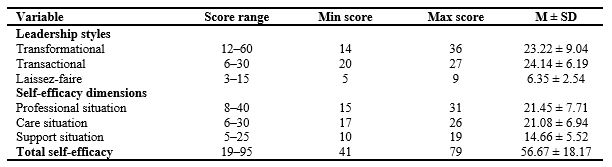
From the students' perspective, the highest and lowest mean scores for leadership styles were for transactional leadership (24.14 ± 6.19) and laissez-faire leadership (6.35 ± 2.54), respectively. The mean total self-efficacy score among students was 56.67 ± 18.17. Scores for individual leadership styles and self-efficacy dimensions are detailed in Table 1.
Table 1. Mean and standard deviation of instructors' leadership styles and self-efficacy scores among nursing studentsThese critical gaps have prompted the present investigation into the relationship between clinical instructors' leadership styles and nursing students' self-efficacy.
Materials & Methods
Design and setting(s)
This study utilized a cross-sectional design and was carried out at two nursing faculties affiliated with Zanjan University of Medical Sciences, Zanjan, Iran, between January 5 and February 28, 2025.
Participants and sampling
The study population comprised all undergraduate nursing students who had completed a minimum of two semesters of clinical training. Participants were selected via convenience sampling. Inclusion criteria were: 1) willingness to participate, 2) enrollment as a full-time nursing student, 3) no prior clinical work experience, and 4) no self-reported history of psychiatric illness or related medication use. The sole exclusion criterion was incomplete submission of the questionnaires (defined as failing to complete >5% of items).
Tools/Instruments
Data collection instruments comprised a demographic form, the Multifactor Leadership Questionnaire (MLQ-5F), and the Nursing Profession Self-Efficacy Scale (NPSES). The demographic form recorded participant characteristics including age, gender, marital status, cumulative grade point average (GPA), internship type, the clinical instructor's highest academic degree, level of satisfaction with the internship, and interest in the nursing profession.
MLQ-5F, originally developed by Bass and Avolio, was employed.
This 21-item instrument measures three leadership styles: transformational (12 items), transactional (6 items), and laissez-faire (3 items). Respondents rate the frequency of specific leadership behaviors on a five-point Likert scale ranging from 1 (Not at all) to 5 (Frequently, if not always) [16]. The Persian version of the MLQ-5F, validated for Iranian educational contexts by Bagheri et al. [17], was used. In the present study, its internal consistency was assessed using Cronbach's alpha. A pilot test with 20 students yielded a coefficient of 0.89, which was confirmed in the main study with an alpha of 0.89.
NPSES is a 19-item self-report instrument developed by Caruso et al. based on Bandura's social cognitive theory [18]. Responses are recorded on a five-point Likert scale ranging from 1 (Not at all confident) to 5 (Completely confident), yielding a total possible score range of 19 to 95. The validated Persian version, adapted by Lazemi et al., comprises three subscales: Professional Situation (8 items), Care Situation (6 items), and Support Situation (5 items) [19]. In the current study, the internal consistency (Cronbach's alpha) for the full scale was 0.91. A prior pilot assessment (n = 20) yielded a comparable alpha coefficient of 0.91.
Data collection methods
Data were collected via an online platform. Initially, an electronic package containing the informed consent form, study questionnaires, and researcher contact details was created using the Porsline system (www.porsline.ir). Following administrative coordination with the two participating faculties, student contact information was obtained.
The survey link was subsequently distributed to all eligible students via SMS, WhatsApp, and Telegram. The survey remained active for one month. Dedicated groups were also established on the messaging platforms, where the research team addressed participant inquiries in real-time and provided reminders to encourage completion.
Data analysis
The collected data were analyzed using SPSS software (version 26). Descriptive statistics, including frequency, percentage, mean, and standard deviation, were calculated. Inferential analyses were performed using independent t-tests, one-way ANOVA, Pearson correlation, and multiple regression, with the statistical significance level set at p < 0.05.
Results
Of the 274 students who participated, 23 were excluded due to incomplete questionnaires, resulting in a final analytic sample of 251. The mean age of participants was 23.13 years (SD = 5.45).
The majority were female (n = 153, 60.9%), single (n = 201, 80.0%), and reported an interest in the nursing profession (n = 203, 80.8%). Nearly half (n = 120, 47.8%,) had a cumulative GPA between 14 and 16.
From the students' perspective, the highest and lowest mean scores for leadership styles were for transactional leadership (24.14 ± 6.19) and laissez-faire leadership (6.35 ± 2.54), respectively. The mean total self-efficacy score among students was 56.67 ± 18.17. Scores for individual leadership styles and self-efficacy dimensions are detailed in Table 1.
Note: Data are presented as mean (M) and standard deviation (SD).
Abbreviations: M, mean; SD, standard deviation; Min, minimum; Max, maximum.
The relationship between clinical instructors' leadership styles and student self-efficacy was analyzed. Preliminary analysis confirmed the normality of the data distribution via the Kolmogorov-Smirnov test (p > 0.05), justifying the use of parametric tests. Pearson correlation analysis revealed a statistically significant positive relationship between student self-efficacy and both transformational leadership (r = 0.69, p < 0.001) and transactional leadership (r = 0.36, p =0.037). The correlation with laissez-faire leadership was not significant (r = 0.04, p = 0.412). Detailed results are presented in Table 2.
Then, the relationship between leadership styles and self-efficacy with demographic variables was examined using parametric independent t-tests, Pearson correlation coefficient, and ANOVA.
Then, the relationship between leadership styles and self-efficacy with demographic variables was examined using parametric independent t-tests, Pearson correlation coefficient, and ANOVA.
Table 2. Correlation between clinical instructors' leadership styles and nursing students' self-efficacy
Note: Pearson correlation coefficient (r) was used for analysis.
Abbreviations: r, Pearson correlation coefficient.
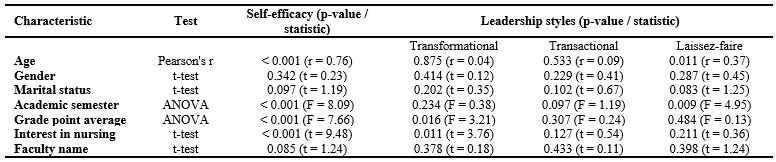
Further analysis identified several demographic and academic factors associated with the key study variables. Student self-efficacy showed statistically significant correlations with age, academic semester, GPA, and interest in the nursing profession (p < 0.05). Furthermore, a transformational leadership style was significantly associated with higher student GPA and greater interest in nursing, while a laissez-faire leadership style was linked to younger student age and earlier academic semesters (p < 0.05). Complete details of these analyses are provided in Table 3.
A multiple linear regression analysis (simultaneous entry method) was conducted to examine the predictive power of leadership styles for student self-efficacy. The model was statistically significant, F =10.19 <0.05 =0.341 R =0.569 <0.05
Table 3. Association of demographic and academic characteristics with self-efficacy and leadership stylesNote: p-values and corresponding test statistics are reported for each association. Pearson's correlation coefficient (r), independent samples t-test (t), and one-way analysis of variance (F) were used as appropriate.
Abbreviations: r, Pearson correlation coefficient; t, t-test statistic; F, ANOVA F-statistic.
Table 4. Multiple linear regression analysis: predicting nursing students' self-efficacy from clinical instructors' leadership styles

Note: The table presents the results of a simultaneous multiple linear regression analysis.
Abbreviations: B, unstandardized regression coefficient; SE, standard error; β, standardized regression coefficient (Beta); t, t-test statistic.
Abbreviations: B, unstandardized regression coefficient; SE, standard error; β, standardized regression coefficient (Beta); t, t-test statistic.
Discussion
This study examined the relationship between clinical instructors' leadership styles and nursing students' self-efficacy. The findings revealed that, from the students' perspective, the transactional leadership style was the most frequently used by clinical instructors. This result aligns with studies conducted in Iran [20, 21], Qatar [22], Jordan [23], and the Netherlands [24]. However, it contrasts with other research reporting transformational [25, 26] or laissez-faire [27] styles as dominant. This discrepancy may be attributed to the traditional pedagogical and evaluative culture within Iranian nursing education. In this context, where clinical instructors solely conduct student assessments, grades may be utilized more as a punitive tool than a motivational one [21]. Furthermore, a traditional emphasis on strict adherence to rules and procedures is prevalent [24]. Given that contingent reward, corrective action, and a focus on structured transactions are hallmarks of transactional leadership, its perceived dominance among Iranian clinical instructors is a plausible finding [8, 9].
Analysis of demographic correlates revealed that a transformational leadership style was associated with higher student GPA and greater interest in the nursing profession, while a laissez-faire style was linked to younger student age and earlier academic semesters. This suggests that students with stronger academic performance and professional interest may be more responsive or may more often encounter—instructors who motivate skill development and foster positive change, which are hallmarks of transformational leadership [8]. Conversely, the association between laissez-faire leadership and younger, less advanced students may reflect these students' greater need for guidance and structure in the initial phases of clinical training, making a passive leadership style less preferable or effective for their development.
The nursing students in this study reported a moderate level of self-efficacy. This finding aligns with several Iranian studies [28–30]. In contrast, other research from Iran [31, 32], Turkey [33], and Saudi Arabia [34] has reported above-average self-efficacy among nursing students. Discrepancies may be attributed to methodological differences, such as the use of varying measurement instruments. Furthermore, the academic progression of participants likely plays a role; the present study included students from semesters 4–8, whereas others focused on senior students (e.g., semesters 7–8) [32], who typically possess greater clinical experience. Broader contextual factors—including the clinical learning environment, opportunities for hands-on practice, instructional approaches, and situational variables—may also contribute to differing self-efficacy levels across studies [11–14].
Analysis of demographic correlates indicated that higher self-efficacy was associated with older age, later academic semesters, a higher GPA, and a strong interest in the nursing profession. This pattern aligns with previous findings that link advanced academic standing and superior academic performance to elevated self-efficacy [29]. The observed associations are conceptually sound: greater age and clinical experience (gained in later semesters) likely enhance students' readiness for challenges, professional judgment, and independent clinical decision-making [14]. Furthermore, a high GPA may reflect a stronger command of nursing knowledge, which can directly foster self-efficacy [11]. Similarly, a deep interest in the profession can increase learning motivation and reinforce beliefs in one's capabilities, thereby improving clinical performance and, ultimately, self-efficacy [13].
The core finding of this study was a significant positive relationship between student self-efficacy and two leadership styles: transformational and transactional. The correlation was stronger for transformational leadership. No significant relationship was found between the laissez-faire style and self-efficacy. These results are corroborated by Agarwal et al., who reported significant correlations for transformational and transactional leadership, but not for laissez-faire, with self-efficacy [35]. Similarly, Sohrabi et al. in Iran found that most midwifery students with high self-efficacy perceived their instructors as transformational leaders [36]. While Ramezanpoor et al. found significant relationships with all three styles among operating room staff, self-efficacy scores were notably higher under transformational and transactional leadership compared to laissez-faire [37]. In a related vein, a Saudi Arabian study linked both transactional and transformational styles to higher work engagement among nurses [38].
Theoretically, transformational leaders likely enhance self-efficacy by fostering a positive vision, addressing individual needs, and stimulating intellectual engagement, thereby helping students overcome challenges [9]. Transactional leaders may boost self-efficacy by establishing clear expectations and providing structured feedback, which promotes a sense of control and task mastery [8]. Conversely, the passivity, lack of support, and role ambiguity characteristic of laissez-faire leadership can generate confusion and undermine a student's belief in their capabilities [9].
Furthermore, regression analysis revealed that the combination of transformational and transactional leadership styles explained a substantial portion (over one-third) of the variance in student self-efficacy. This aligns with Agarwal et al., where these styles accounted for 36.5% and 28.9% of the variance, respectively [35]. This finding underscores that while transformational leadership builds efficacy through inspiration and individualized consideration, and transactional leadership does so through contingent reward and clear structures, both pathways are potent predictors of students' belief in their clinical competence [8, 9].
This study has several limitations. First, the reliance on self-report measures may introduce common method bias. Second, participants' psychological states at the time of data collection, which could influence responses, were not assessed or controlled for. Third, the generalizability of the findings is limited by the specific sampling criteria; the study population consisted solely of nursing students who had completed at least two semesters of hospital-based clinical training.
Conclusion
The findings of this study demonstrate a significant relationship between clinical instructors' leadership styles and undergraduate nursing students' self-efficacy. Based on this, two primary recommendations are proposed. First, it is recommended that nursing faculty administrators implement targeted professional development workshops. These workshops should educate clinical instructors on the full spectrum of leadership styles, with a specific emphasis on the application of transformational and transactional strategies that have been shown to foster student self-efficacy. Second, to advance the understanding of these complex, multifaceted constructs, future research should be theory-driven and employ robust methodologies. Utilizing qualitative or mixed-methods approaches would provide richer, contextual insights into the dynamics between leadership and self-efficacy in clinical education.
Ethical considerations
Ethical approval for this study was granted by the Research Ethics Committee of Zanjan University of Medical Sciences (Approval Code: IR.ZUMS.REC.1403.362; URL: https://ethics.research.ac.ir/). All participants were fully informed of the study's purpose, the confidentiality of their data, and their right to withdraw voluntarily. Informed consent was obtained from each student prior to their participation.
Artificial intelligence utilization for article writing
None
Acknowledgment
The authors would like to express their sincere gratitude to all the nursing students who participated in this study.
Conflict of interest statement
The authors declare that they have no competing interests.
Author contributions
SN, SKM, MK, and FM contributed to the study conception and design. Data collection was performed by SKM and MK. Data analysis and interpretation were conducted by SN and SKM. The first draft of the manuscript was written by SN and all authors (SN, SKM, MK, FM) commented on previous versions of the manuscript. All authors read and approved the final manuscript.
Funding
This study was supported by Zanjan University of Medical Sciences (Grant No: A-11-1159-17). The funder had no role in the study design, data collection and analysis, decision to publish, or preparation of the manuscript.
Data availability statement
The datasets generated and analyzed during the current study are available from the corresponding author upon reasonable request.
Article Type : Orginal Research |
Subject:
Medical Education
Received: 2025/09/22 | Accepted: 2025/12/2 | Published: 2026/01/1
Received: 2025/09/22 | Accepted: 2025/12/2 | Published: 2026/01/1
Send email to the article author
| Rights and permissions | |
 |
This work is licensed under a Creative Commons Attribution-NonCommercial 4.0 International License. |