Sat, Oct 3, 2026
[Archive]
Volume 19, Issue 1 (2026)
J Med Edu Dev 2026, 19(1): 97-104 |
Back to browse issues page

Ethics code: IR.ZUMS.REC.1397.278


Download citation:
BibTeX | RIS | EndNote | Medlars | ProCite | Reference Manager | RefWorks
Send citation to:


BibTeX | RIS | EndNote | Medlars | ProCite | Reference Manager | RefWorks
Send citation to:
Tirgari Seraji H, Rasouli A, Ramzi F, Saed O. Predictors of academic procrastination in Iran: distinguishing between problematic use, intensity, and procrastinatory use of social media. J Med Edu Dev 2026; 19 (1) :97-104
URL: http://edujournal.zums.ac.ir/article-1-2589-en.html
URL: http://edujournal.zums.ac.ir/article-1-2589-en.html

1- Department of Psychology, Faculty of Educational Sciences and Psychology, University of Mohaghegh Ardabili, Ardabil, Iran
2- Department of Clinical Psychology, School of Medicine, Shahid Beheshti, University of Medical Sciences, Tehran, Iran
3- Department of Clinical Psychology, School of Medicine, Zanjan University of Medical Sciences, Zanjan, Iran
4- Department of Clinical Psychology, School of Medicine, Zanjan University of Medical Sciences, Zanjan, Iran ,o.saed@zums.ac.ir
2- Department of Clinical Psychology, School of Medicine, Shahid Beheshti, University of Medical Sciences, Tehran, Iran
3- Department of Clinical Psychology, School of Medicine, Zanjan University of Medical Sciences, Zanjan, Iran
4- Department of Clinical Psychology, School of Medicine, Zanjan University of Medical Sciences, Zanjan, Iran ,
Keywords: academic procrastination, social media, digital distraction, self-regulation, medical education
Full-Text [PDF 446 kb]
(410 Downloads)
| Abstract (HTML) (1039 Views)
Full-Text: (250 Views)
Abstract
Background & Objective: Academic procrastination is a common self-control failure among university students. It is increasingly affected by digital behaviors. With the rise of social media, there is a growing need to tell apart different forms of online engagement. This study aimed to look at the predictive roles of problematic social media use, intensity of social media use, and social media-related procrastination on academic procrastination among Iranian university students.
Materials & Methods: This study used a cross-sectional design. A convenience sampling method was employed to recruit a sample of 665 undergraduate students. Participants completed a series of previously validated instruments, including the Procrastination Assessment Scale–Students (PASS), the Problematic Social Media Use Scale, the Intensity of Social Media Use Scale, and the Social Media-Related Procrastination Scale. The data were analyzed using multiple linear regression to look at the associations between the variables.
Results: The multiple regression model was statistically significant, F (3, 661) = 30.736, p < 0.001, and explained 12.2% of the variance in academic procrastination (R² = 0.122). Social media-related procrastination (β = 0.269, p < 0.001) and intensity of social media use (β = 0.098, p = 0.027) were significant positive predictors. However, problematic social media use was not a significant predictor (β = 0.036, p = 0.485). Multicollinearity diagnostics and assumption checks confirmed the robustness of the model.
Conclusion: Social media-related procrastination and the intensity of use are key behavioral predictors of academic procrastination, while problematic social media use, despite its conceptual relevance, did not independently predict procrastination in this sample. These findings highlight the importance of targeting specific maladaptive behaviors, particularly task-avoidant use of social media—in interventions aimed at improving academic self-control.
Introduction
Academic procrastination, defined as the voluntary delay of intended academic tasks despite awareness of potential negative consequences [1], remains a widespread and negative behavior among university students. It has significant implications for academic performance, psychological well-being, and long-term educational outcomes [2]. Once seen as a time management issue, it is now understood as a behavioral response driven by emotional avoidance, low self-efficacy, and impaired impulse control [3, 4].
Table 1. Descriptive statistics and correlations among study variables (n = 665)
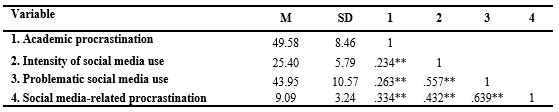
Table 2. Results of multiple linear regression analysis for predictors of academic procrastination
Discussion
The current study looked at the predictive roles of problematic social media use, intensity of social media use, and social media-related procrastination on academic procrastination among Iranian university students. The findings show that social media-related procrastination and the intensity of social media use are significant positive predictors of academic procrastination. However, problematic social media use did not emerge as a significant independent predictor in this study.
Social media-related procrastination emerged as the strongest predictor of academic procrastination in this study. This finding aligns with the view that procrastination is not simply about poor time management, but a deliberate act of self-control where individuals knowingly delay important tasks in favor of more immediately rewarding activities [2]. In this context, choosing to browse social media instead of studying shows a behavioral pattern of avoidance, driven by the instant gratification these platforms offer. This is not passive distraction, but an active substitution of academic work with digital engagement. This distinction is supported by prior research showing that students explicitly use social media to postpone tasks, particularly under pressure such as before exams, which in turn increases anxiety and reduces task completion [25]. This suggests that the direct behavioral act of using social media to delay academic work is a more potent immediate predictor than a general problematic relationship with social media. Our findings can be effectively interpreted through the lens of Steel's Temporal Motivation Theory (TMT), which posits that the decision to procrastinate is a function of the perceived usefulness of a task. According to TMT, usefulness is calculated based on a task's expectancy (probability of success), value (reward), and its immediacy (delay). Social media platforms are engineered to offer high, immediate rewards with minimal effort (high usefulness), while academic tasks often have delayed, uncertain outcomes and need sustained effort (low usefulness). Thus, the choice to procrastinate is a rational, albeit harmful, utility-maximizing decision in the moment. Our results strongly support this model [26].
How much students use social media is also positively predicts academic procrastination. This shows that even normal, non-addictive use can make it harder for students to manage their schoolwork. The Intensity of Social Media Use Scale measures daily time, number of online friends, and overall involvement. It shows how deeply students are part of digital life. More use seems to create more distractions. It can overload a student's attention and reduce their ability to focus on school tasks. This often leads to worse grades [27]. This is very relevant because many students say they get distracted by phones and laptops in class. This frequent time online uses up valuable study hours. It breaks focus and encourages putting things off. All of this adds up to more academic procrastination. New studies confirm this, showing that heavier social media use leads to more procrastination for college students [28].
PSMU did not directly predict academic procrastination in our final model. This was true even though it showed a clear link when looked at alone. What does this mean? PSMU might not directly cause delay. Instead, it could affect it indirectly. This might happen through actions like using social media to avoid work or having low self-control. In simple terms, people with PSMU may procrastinate because they use social media to escape, not just because they use it a lot [2]. This result shows how complicated academic procrastination really is. It is caused by many different things our model did not include. Key factors likely encompass personality traits like conscientiousness, impulsiveness, and perfectionism [1, 2, 4]. Motivational factors like self-efficacy, fear of failure, and goal orientation also play a big part [3]. Also, our way of measuring social media use was specific but may not catch everything. It might miss the subtle thoughts and feelings, like the Fear of Missing Out (FoMO), that connect use with procrastination [29]. This matches newer research. Those studies also found no direct link between social media addiction and procrastination. The following idea is gaining support: broad terms like "addiction" are less helpful than specific actions, like choosing to scroll instead of study [29, 30].
These differences show the complex ways social media influences behavior [31]. They suggest that actively using social media to avoid schoolwork has a stronger direct link to procrastination than a general "problematic use" label. This is especially true when we look at specific behaviors. We need to tell the difference between general heavy use and the specific choice of social media over studying [32].
The non-significant result for PSMU suggests its link to procrastination is not simple. It is probably explained by other mental and behavioral factors. Looking at other research, a likely path comes into view. PSMU may wear down a student's self-control and grit. It could also hurt their belief in their academic skills. This weaker self-regulation then makes students more likely to choose specific avoidance behaviors. The main behavior is social media-related procrastination—the deliberate choice to use social media to delay school tasks [2, 33]. So, we think problematic use creates a risk. But the next step, the act of using social media to avoid work—is what most directly predicts academic delay. Future research overtime should test this idea. It should check if PSMU affects academic procrastination through weaker self-control and more social media-related procrastination.
Academic procrastination is a complex problem. It is rooted in motivation, emotion, and thought [34]. Strong self-regulation is the ability to manage behavior, feelings, and thoughts to reach goals. It is consistently tied to less procrastination [35]. This means that helping students build self-regulation skills could be very effective. Methods could include mindfulness or self-compassion writing. This approach may work better than just trying to reduce screen time [36]. This study's findings come from Iranian university students. They give us a useful look at how social media use affects academic procrastination. This is important in a world where education is quickly becoming more digital. These behaviors are also shaped by unique cultural norms and student lifestyles.
This study has a few limitations. First, its design was cross-sectional. This means we cannot prove cause and effect. Future studies that track people over time or run experiments are needed to clarify the order of events. Second, we relied on self-reported surveys. These can sometimes be biased. Future work should combine this with objective data or track real behavior. Third, we used a convenience sample from only two universities. This makes it hard to apply the results to everyone. Future work should employ random sampling across multiple universities.
Fourth, our adapted surveys were reliable, but we did not fully confirm their validity for general social media use. We suggest future researchers fully validate these adjusted tools. Finally, our model only explained a modest amount of variance. This shows we missed other key factors. Future models should include personality traits, motivation, and details about the academic setting.
We also investigated possible confounding variables like age, gender, and education level. Early tests (correlations and t-tests) confirmed these factors were not strongly linked to academic procrastination in our sample. All p-values were greater than 0.05. As a result, it is unlikely that these demographic variables confused the relationships we saw. They probably do not make up a big part of the results we could not explain. The predictive power of social media-related procrastination and use intensity seems strong. This holds true across different ages and genders in our student group.
Conclusion
In conclusion, this study demonstrates that among Iranian university students, the specific behavior of using social media to avoid academic tasks is the strongest predictor of academic procrastination, followed by the overall intensity of use. Problematic or addictive use patterns did not offer unique predictive power. These results suggest that interventions should move beyond broad concepts of addiction and instead target the core self-regulatory failure of task-avoidance by promoting mindful engagement with digital platforms and strengthening students' self-control in academic settings.
Ethical considerations
This study was approved by the Research Ethics Committee of Zanjan University of Medical Sciences (ZUMS), Zanjan, Iran (Approval ID: IR.ZUMS.REC.1397.278). All participants provided written informed consent.
Artificial intelligence utilization for article writing
The authors did not use generative Artificial Intelligence (AI) or AI-assisted technologies in writing this manuscript.
Acknowledgment
The authors thank all individuals who participated in this study.
Conflict of interest statement
The authors declared no potential conflicts of interest with respect to the research, authorship, and/or publication of this article.
Author contributions
HTS and OS designed and conducted the study, performed the statistical analyses, and wrote the manuscript. AR and FR participated in the study design and coordination and helped to draft the manuscript. All authors read and approved of the final manuscript.
Funding
The authors received no financial support for the research, authorship, and/or publication of this article.
Data availability statement
The data that support the findings of this study are available from the corresponding author upon reasonable request.
Background & Objective: Academic procrastination is a common self-control failure among university students. It is increasingly affected by digital behaviors. With the rise of social media, there is a growing need to tell apart different forms of online engagement. This study aimed to look at the predictive roles of problematic social media use, intensity of social media use, and social media-related procrastination on academic procrastination among Iranian university students.
Materials & Methods: This study used a cross-sectional design. A convenience sampling method was employed to recruit a sample of 665 undergraduate students. Participants completed a series of previously validated instruments, including the Procrastination Assessment Scale–Students (PASS), the Problematic Social Media Use Scale, the Intensity of Social Media Use Scale, and the Social Media-Related Procrastination Scale. The data were analyzed using multiple linear regression to look at the associations between the variables.
Results: The multiple regression model was statistically significant, F (3, 661) = 30.736, p < 0.001, and explained 12.2% of the variance in academic procrastination (R² = 0.122). Social media-related procrastination (β = 0.269, p < 0.001) and intensity of social media use (β = 0.098, p = 0.027) were significant positive predictors. However, problematic social media use was not a significant predictor (β = 0.036, p = 0.485). Multicollinearity diagnostics and assumption checks confirmed the robustness of the model.
Conclusion: Social media-related procrastination and the intensity of use are key behavioral predictors of academic procrastination, while problematic social media use, despite its conceptual relevance, did not independently predict procrastination in this sample. These findings highlight the importance of targeting specific maladaptive behaviors, particularly task-avoidant use of social media—in interventions aimed at improving academic self-control.
Introduction
As internet access and technology continue to advance rapidly, digital platforms have become increasingly popular, especially among younger generations [5]. Smartphones and online networks now serve as constant sources of distraction. They offer immediate rewards that often override long-term academic goals [6]. Excessive and unregulated use of these technologies, particularly through social media, is strongly linked to delayed task starting and reduced academic performance [7].
This relationship goes beyond correlation. Problematic internet use and smartphone addiction are recognized as behavioral mechanisms that worsen procrastination by disrupting focus, consuming study time, and reinforcing avoidance [6, 8]. Of particular relevance is social media-related procrastination—the deliberate replacement of academic tasks with social media browsing—emerging as a direct behavioral sign of self-control failure in digital learning environments [9].
The intensity of social media use, measured by frequency and duration of engagement, has also been positively linked with academic procrastination. This suggests that even non-addictive, but high-volume use can impair time management and task prioritization [10]. Given these connections, recent models identify smartphone and social media addiction as among the top predictors of academic procrastination, particularly when mediated by negative emotional states such as anxiety [6].
The impact of excessive internet and social media use on academic performance is mediated by several related mechanisms. These include time mismanagement, cognitive distraction, and disrupted sleep patterns [11–14]. These mechanisms are often activated by specific patterns of social media engagement. For instance, the sheer volume of engagement, captured by the intensity of social media use, directly consumes time that would otherwise be allocated to studying and contributes to cognitive fragmentation and distraction [11, 15]. The deliberate choice to use social media to avoid academic tasks—a behavior defined as social media-related procrastination—directly embodies the mechanism of task avoidance and can lead to last-minute cramming and increased stress [11]. Also, prolonged and late-night social media use, a key aspect of both intensive and problematic use, is a primary driver of the sleep disruptions that impair next-day alertness and academic performance [12, 13]. The relationship is complex, as empirical findings on the link between digital use and academic performance remain mixed [16]. This suggests that the quality and purpose of use may matter more than mere time spent online.
Building on this evidence, the present study aims to look at the predictive power of three distinct social media constructs on academic procrastination among Iranian university students. Based on the literature, we hypothesize that (1) social media-related procrastination will be the strongest positive predictor of academic procrastination; (2) the intensity of social media use will be a significant positive predictor; and (3) problematic social media use will also be a significant, though likely weaker, positive predictor of academic procrastination.
Materials & Methods
Design and setting(s)
This study employed a cross-sectional correlational design to examine the predictive relationships between social media-related variables and academic procrastination. The research was conducted among university students in Zanjan, Iran. The study protocol was approved by the ethics committee of Zanjan University of Medical Sciences (approval ID: IR.ZUMS.REC.1397.278). Data were collected between 15 January 2019 and 15 June 2019. Data collection occurred in an academic setting, with questionnaires distributed to participants during their time on campus.
Participants and sampling
The target population consisted of all students enrolled at Zanjan University of Medical Sciences and Zanju University. The minimum required sample size for the study, as determined using a priori power analysis for multiple regression with an anticipated effect size of 0.15, desired statistical power of 0.80, number of predictors of 3, and a significance level of 0.01, was calculated to be 109 [17]. The study recruited a total of 665 participants, going beyond the minimum requirement. Inclusion criteria were age between 18 and 40 years, current enrollment as a student, and willingness to participate. Exclusion criteria included incomplete responses to all questionnaires and a history of academic suspension. Participants were approached on campus using convenience sampling across multiple faculties (e.g., medical sciences, dentistry, humanities) at both universities. Selection was proportional to faculty sizes, with participants selected during class sessions or common areas to ensure representation from diverse academic disciplines. The sample consisted of university students who voluntarily agreed to participate after providing informed consent.
Tools/Instruments
Procrastination Assessment Scale-Students (PASS): The 44-item PASS is the most widely used domain-specific measure of academic procrastination. The instrument is divided into two sections. Section A has 18 items that evaluate procrastination across six academic domains. Section B contains 26 items that assess procrastination in specific academic tasks. All items are rated on a 5-point Likert scale (1 = never procrastinate, 5 = always procrastinate). To calculate the total score, the three items (frequency of procrastination and degree to which it is a problem) from each of the six domains in Section A were summed, totaling 18 items, with higher scores showing greater levels of academic procrastination. In the original validation study, the scale yielded strong internal consistency (α = 0.89) [18]. The Persian adaptation has shown comparable reliability among Iranian university students (α = 0.71), showing the cross-cultural stability of the PASS scores [2].
Social Media Related Procrastination Scale (SMRPS): The 3-item SMRPS is an adaptation of Tuckman's Procrastination Scale [19], refined by Reinecke et al. [20] to capture irrational delay specifically triggered by social-network sites. Respondents rate how often they have postponed important tasks because of social-media use during the past six months on a 5-point Likert scale (1 = never, 5 = always). Mayer et al. reported Cronbach's α values of .90 and .94 across two independent samples. Consistent with prior translations, the generic term "social media" replaced every reference to ‘Facebook’ [21]. In this study, the scale showed good internal consistency (Cronbach's α = 0.83).
The Intensity of Social Media Use Scale (ISMUS): ISMUS is an 8-item questionnaire that measures how actively people use social media, based on daily time spent, number of online connections, and overall involvement. Respondents rate each item on a 5-point Likert scale. Ellison et al. reported high internal consistency (Cronbach's α = 0.83). In this study, all references to "Facebook" were updated to the broader term "social media" to reflect general social media use [22]. In this study, the scale showed good internal consistency (α = 0.79).
Problematic Social Media Use Scale (PSMU): The 15-item PSMU is a social-media-specific revision of Caplan's (2010) Generalized Problematic Internet Use Scale [23]. Five 3-item subscales assess (a) preference for virtual social interaction, (b) mood regulation, (c) cognitive preoccupation, (d) compulsive use, and (e) negative outcomes [24]. All items are rated 1 = strongly disagree to 5 = strongly agree. Rasouli et al. replaced every reference to "Facebook" with the generic term "social media" and documented strong internal consistency among Iranian university students (Cronbach's α = 0.87) [2]. In this study, the scale showed good internal consistency (α = 0.85).
Data collection methods
After getting informed consent and confirming eligibility based on inclusion/exclusion criteria, questionnaires were distributed in paper format. Participants completed the instruments anonymously in a single session, with instructions provided to ensure clarity. Data collection emphasized voluntary participation and confidentiality, and incomplete responses were excluded.
Data analysis
Data analysis was conducted using SPSS Statistics version 27. Descriptive statistics, including means and standard deviations, were computed to summarize the distribution of scores for the key variables. Pearson correlation coefficients were calculated to examine the bivariate relationships among variables and assess the strength and direction of their associations.
To address the primary objective of the study, a multiple linear regression analysis was performed with academic procrastination as the dependent variable and social media-related procrastination, problematic social media use, and intensity of social media use as independent variables.
This model allowed for the evaluation of the combined and unique contributions of each predictor to the variance in academic procrastination. Prior to interpreting the regression results, all statistical assumptions were checked to ensure the validity of the model. Normality of residuals was assessed using histograms and normal Q-Q plots. Linearity and homoscedasticity were evaluated through scatterplots of standardized residuals versus standardized predicted values, which displayed a random dispersion pattern, supporting the assumption of homoscedasticity. Multicollinearity was examined using Variance Inflation Factors (VIF) and tolerance values; all VIFs were below 2.05 (ranging from 1.471 to 2.021) and tolerance values went beyond 0.49, showing no significant multicollinearity among the predictors. The Durbin-Watson statistics were about 2.00, as typically generated in SPSS output, suggesting no evidence of autocorrelation in the residuals.
The overall significance of the regression model was assessed using the F-test, and the proportion of variance in academic procrastination explained by the predictors was determined by the R² and adjusted R² values. Statistical significance was set at p < 0.05 for all analyses.
Results
The participants in this study ranged in age from 18 to 45 years (M = 21.72, SD = 2.73), with 50.8% identifying as female. Among the participants, 11.1% were married, while 88.7% were single. Regarding educational attainment, 93.3% were undergraduates, and 6.7% were postgraduates. Descriptive statistics and correlations for all study variables are presented in Table 1.
The mean score for academic procrastination was 49.58 (SD = 8.46). For the predictor variables, the mean scores were as follows: social media-related procrastination was 9.09 (SD = 3.24), problematic social media use was 43.95 (SD = 10.57), and intensity of social media use was 25.40 (SD = 5.79). Pearson correlation analysis revealed significant positive associations between academic procrastination and all three predictors: social media-related procrastination (r = 0.334, p < 0.001), problematic social media use (r = 0.263, p < 0.001), and intensity of social media use (r = 0.234, p < 0.001).
Among the predictor variables, moderate correlations were observed, with the strongest between problematic social media use and social media-related procrastination (r = 0.639, p < 0.001), followed by problematic social media use and intensity of social media use (r = 0.557, p < 0.001), and social media-related procrastination and intensity of social media use (r = 0.432, p < 0.001). These intercorrelations were all below 0.80, suggesting no concerns regarding multicollinearity.
This relationship goes beyond correlation. Problematic internet use and smartphone addiction are recognized as behavioral mechanisms that worsen procrastination by disrupting focus, consuming study time, and reinforcing avoidance [6, 8]. Of particular relevance is social media-related procrastination—the deliberate replacement of academic tasks with social media browsing—emerging as a direct behavioral sign of self-control failure in digital learning environments [9].
The intensity of social media use, measured by frequency and duration of engagement, has also been positively linked with academic procrastination. This suggests that even non-addictive, but high-volume use can impair time management and task prioritization [10]. Given these connections, recent models identify smartphone and social media addiction as among the top predictors of academic procrastination, particularly when mediated by negative emotional states such as anxiety [6].
The impact of excessive internet and social media use on academic performance is mediated by several related mechanisms. These include time mismanagement, cognitive distraction, and disrupted sleep patterns [11–14]. These mechanisms are often activated by specific patterns of social media engagement. For instance, the sheer volume of engagement, captured by the intensity of social media use, directly consumes time that would otherwise be allocated to studying and contributes to cognitive fragmentation and distraction [11, 15]. The deliberate choice to use social media to avoid academic tasks—a behavior defined as social media-related procrastination—directly embodies the mechanism of task avoidance and can lead to last-minute cramming and increased stress [11]. Also, prolonged and late-night social media use, a key aspect of both intensive and problematic use, is a primary driver of the sleep disruptions that impair next-day alertness and academic performance [12, 13]. The relationship is complex, as empirical findings on the link between digital use and academic performance remain mixed [16]. This suggests that the quality and purpose of use may matter more than mere time spent online.
Building on this evidence, the present study aims to look at the predictive power of three distinct social media constructs on academic procrastination among Iranian university students. Based on the literature, we hypothesize that (1) social media-related procrastination will be the strongest positive predictor of academic procrastination; (2) the intensity of social media use will be a significant positive predictor; and (3) problematic social media use will also be a significant, though likely weaker, positive predictor of academic procrastination.
Materials & Methods
Design and setting(s)
This study employed a cross-sectional correlational design to examine the predictive relationships between social media-related variables and academic procrastination. The research was conducted among university students in Zanjan, Iran. The study protocol was approved by the ethics committee of Zanjan University of Medical Sciences (approval ID: IR.ZUMS.REC.1397.278). Data were collected between 15 January 2019 and 15 June 2019. Data collection occurred in an academic setting, with questionnaires distributed to participants during their time on campus.
Participants and sampling
The target population consisted of all students enrolled at Zanjan University of Medical Sciences and Zanju University. The minimum required sample size for the study, as determined using a priori power analysis for multiple regression with an anticipated effect size of 0.15, desired statistical power of 0.80, number of predictors of 3, and a significance level of 0.01, was calculated to be 109 [17]. The study recruited a total of 665 participants, going beyond the minimum requirement. Inclusion criteria were age between 18 and 40 years, current enrollment as a student, and willingness to participate. Exclusion criteria included incomplete responses to all questionnaires and a history of academic suspension. Participants were approached on campus using convenience sampling across multiple faculties (e.g., medical sciences, dentistry, humanities) at both universities. Selection was proportional to faculty sizes, with participants selected during class sessions or common areas to ensure representation from diverse academic disciplines. The sample consisted of university students who voluntarily agreed to participate after providing informed consent.
Tools/Instruments
Procrastination Assessment Scale-Students (PASS): The 44-item PASS is the most widely used domain-specific measure of academic procrastination. The instrument is divided into two sections. Section A has 18 items that evaluate procrastination across six academic domains. Section B contains 26 items that assess procrastination in specific academic tasks. All items are rated on a 5-point Likert scale (1 = never procrastinate, 5 = always procrastinate). To calculate the total score, the three items (frequency of procrastination and degree to which it is a problem) from each of the six domains in Section A were summed, totaling 18 items, with higher scores showing greater levels of academic procrastination. In the original validation study, the scale yielded strong internal consistency (α = 0.89) [18]. The Persian adaptation has shown comparable reliability among Iranian university students (α = 0.71), showing the cross-cultural stability of the PASS scores [2].
Social Media Related Procrastination Scale (SMRPS): The 3-item SMRPS is an adaptation of Tuckman's Procrastination Scale [19], refined by Reinecke et al. [20] to capture irrational delay specifically triggered by social-network sites. Respondents rate how often they have postponed important tasks because of social-media use during the past six months on a 5-point Likert scale (1 = never, 5 = always). Mayer et al. reported Cronbach's α values of .90 and .94 across two independent samples. Consistent with prior translations, the generic term "social media" replaced every reference to ‘Facebook’ [21]. In this study, the scale showed good internal consistency (Cronbach's α = 0.83).
The Intensity of Social Media Use Scale (ISMUS): ISMUS is an 8-item questionnaire that measures how actively people use social media, based on daily time spent, number of online connections, and overall involvement. Respondents rate each item on a 5-point Likert scale. Ellison et al. reported high internal consistency (Cronbach's α = 0.83). In this study, all references to "Facebook" were updated to the broader term "social media" to reflect general social media use [22]. In this study, the scale showed good internal consistency (α = 0.79).
Problematic Social Media Use Scale (PSMU): The 15-item PSMU is a social-media-specific revision of Caplan's (2010) Generalized Problematic Internet Use Scale [23]. Five 3-item subscales assess (a) preference for virtual social interaction, (b) mood regulation, (c) cognitive preoccupation, (d) compulsive use, and (e) negative outcomes [24]. All items are rated 1 = strongly disagree to 5 = strongly agree. Rasouli et al. replaced every reference to "Facebook" with the generic term "social media" and documented strong internal consistency among Iranian university students (Cronbach's α = 0.87) [2]. In this study, the scale showed good internal consistency (α = 0.85).
Data collection methods
After getting informed consent and confirming eligibility based on inclusion/exclusion criteria, questionnaires were distributed in paper format. Participants completed the instruments anonymously in a single session, with instructions provided to ensure clarity. Data collection emphasized voluntary participation and confidentiality, and incomplete responses were excluded.
Data analysis
Data analysis was conducted using SPSS Statistics version 27. Descriptive statistics, including means and standard deviations, were computed to summarize the distribution of scores for the key variables. Pearson correlation coefficients were calculated to examine the bivariate relationships among variables and assess the strength and direction of their associations.
To address the primary objective of the study, a multiple linear regression analysis was performed with academic procrastination as the dependent variable and social media-related procrastination, problematic social media use, and intensity of social media use as independent variables.
This model allowed for the evaluation of the combined and unique contributions of each predictor to the variance in academic procrastination. Prior to interpreting the regression results, all statistical assumptions were checked to ensure the validity of the model. Normality of residuals was assessed using histograms and normal Q-Q plots. Linearity and homoscedasticity were evaluated through scatterplots of standardized residuals versus standardized predicted values, which displayed a random dispersion pattern, supporting the assumption of homoscedasticity. Multicollinearity was examined using Variance Inflation Factors (VIF) and tolerance values; all VIFs were below 2.05 (ranging from 1.471 to 2.021) and tolerance values went beyond 0.49, showing no significant multicollinearity among the predictors. The Durbin-Watson statistics were about 2.00, as typically generated in SPSS output, suggesting no evidence of autocorrelation in the residuals.
The overall significance of the regression model was assessed using the F-test, and the proportion of variance in academic procrastination explained by the predictors was determined by the R² and adjusted R² values. Statistical significance was set at p < 0.05 for all analyses.
Results
The participants in this study ranged in age from 18 to 45 years (M = 21.72, SD = 2.73), with 50.8% identifying as female. Among the participants, 11.1% were married, while 88.7% were single. Regarding educational attainment, 93.3% were undergraduates, and 6.7% were postgraduates. Descriptive statistics and correlations for all study variables are presented in Table 1.
The mean score for academic procrastination was 49.58 (SD = 8.46). For the predictor variables, the mean scores were as follows: social media-related procrastination was 9.09 (SD = 3.24), problematic social media use was 43.95 (SD = 10.57), and intensity of social media use was 25.40 (SD = 5.79). Pearson correlation analysis revealed significant positive associations between academic procrastination and all three predictors: social media-related procrastination (r = 0.334, p < 0.001), problematic social media use (r = 0.263, p < 0.001), and intensity of social media use (r = 0.234, p < 0.001).
Among the predictor variables, moderate correlations were observed, with the strongest between problematic social media use and social media-related procrastination (r = 0.639, p < 0.001), followed by problematic social media use and intensity of social media use (r = 0.557, p < 0.001), and social media-related procrastination and intensity of social media use (r = 0.432, p < 0.001). These intercorrelations were all below 0.80, suggesting no concerns regarding multicollinearity.
Table 1. Descriptive statistics and correlations among study variables (n = 665)
Notes: **p < .001. Possible score ranges: Academic procrastination: 18–90; Intensity of social media use: 8–40; Problematic social media use: 15–75; Social media-related procrastination: 3–15.
Abbreviations: M, mean; SD, standard deviation.
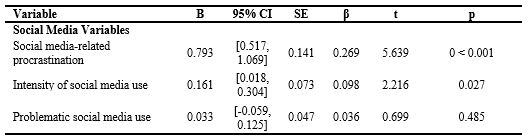
A multiple linear regression analysis was conducted to examine the extent to which social media-related procrastination, problematic social media use, and intensity of social media use predicted academic procrastination. The overall model was statistically significant, F (3, 661) = 30.736, p < 0.001, R² = 0.122, showing that the three predictors collectively explained 12.2% of the variance in academic procrastination (adjusted R² = 0.118). As shown in Table 2, social media-related procrastination emerged as a significant and strongest predictor (β = 0.269, t = 5.639, p < 0.001, 95% CI [0.517, 1.069]), such that a one-unit increase in social media-related procrastination was associated with a 0.793-unit increase in academic procrastination. Intensity of social media use was also a significant predictor (β = 0.098, t = 2.216, p = 0.027, 95% CI [0.018, 0.304]), with a one-unit increase linked to a 0.161-unit increase in academic procrastination. In contrast, problematic social media use did not significantly predict academic procrastination (β = 0.036, t = 0.699, p = 0.485, 95% CI [-0.059, 0.125]), with a one-unit increase associated with only a negligible 0.033-unit increase.
Abbreviations: M, mean; SD, standard deviation.
A multiple linear regression analysis was conducted to examine the extent to which social media-related procrastination, problematic social media use, and intensity of social media use predicted academic procrastination. The overall model was statistically significant, F (3, 661) = 30.736, p < 0.001, R² = 0.122, showing that the three predictors collectively explained 12.2% of the variance in academic procrastination (adjusted R² = 0.118). As shown in Table 2, social media-related procrastination emerged as a significant and strongest predictor (β = 0.269, t = 5.639, p < 0.001, 95% CI [0.517, 1.069]), such that a one-unit increase in social media-related procrastination was associated with a 0.793-unit increase in academic procrastination. Intensity of social media use was also a significant predictor (β = 0.098, t = 2.216, p = 0.027, 95% CI [0.018, 0.304]), with a one-unit increase linked to a 0.161-unit increase in academic procrastination. In contrast, problematic social media use did not significantly predict academic procrastination (β = 0.036, t = 0.699, p = 0.485, 95% CI [-0.059, 0.125]), with a one-unit increase associated with only a negligible 0.033-unit increase.
Table 2. Results of multiple linear regression analysis for predictors of academic procrastination
Note: Model summary for the final step: R = .350, R² = .122, Adjusted R² = .118, F(3, 661) = 30.736, p < 0.001.
Abbreviations: B, unstandardized regression coefficient; CI, confidence interval; SE, standard error; β, standardized regression coefficient (Beta); t, t-test statistic; p, probability value.
Abbreviations: B, unstandardized regression coefficient; CI, confidence interval; SE, standard error; β, standardized regression coefficient (Beta); t, t-test statistic; p, probability value.
Discussion
The current study looked at the predictive roles of problematic social media use, intensity of social media use, and social media-related procrastination on academic procrastination among Iranian university students. The findings show that social media-related procrastination and the intensity of social media use are significant positive predictors of academic procrastination. However, problematic social media use did not emerge as a significant independent predictor in this study.
Social media-related procrastination emerged as the strongest predictor of academic procrastination in this study. This finding aligns with the view that procrastination is not simply about poor time management, but a deliberate act of self-control where individuals knowingly delay important tasks in favor of more immediately rewarding activities [2]. In this context, choosing to browse social media instead of studying shows a behavioral pattern of avoidance, driven by the instant gratification these platforms offer. This is not passive distraction, but an active substitution of academic work with digital engagement. This distinction is supported by prior research showing that students explicitly use social media to postpone tasks, particularly under pressure such as before exams, which in turn increases anxiety and reduces task completion [25]. This suggests that the direct behavioral act of using social media to delay academic work is a more potent immediate predictor than a general problematic relationship with social media. Our findings can be effectively interpreted through the lens of Steel's Temporal Motivation Theory (TMT), which posits that the decision to procrastinate is a function of the perceived usefulness of a task. According to TMT, usefulness is calculated based on a task's expectancy (probability of success), value (reward), and its immediacy (delay). Social media platforms are engineered to offer high, immediate rewards with minimal effort (high usefulness), while academic tasks often have delayed, uncertain outcomes and need sustained effort (low usefulness). Thus, the choice to procrastinate is a rational, albeit harmful, utility-maximizing decision in the moment. Our results strongly support this model [26].
How much students use social media is also positively predicts academic procrastination. This shows that even normal, non-addictive use can make it harder for students to manage their schoolwork. The Intensity of Social Media Use Scale measures daily time, number of online friends, and overall involvement. It shows how deeply students are part of digital life. More use seems to create more distractions. It can overload a student's attention and reduce their ability to focus on school tasks. This often leads to worse grades [27]. This is very relevant because many students say they get distracted by phones and laptops in class. This frequent time online uses up valuable study hours. It breaks focus and encourages putting things off. All of this adds up to more academic procrastination. New studies confirm this, showing that heavier social media use leads to more procrastination for college students [28].
PSMU did not directly predict academic procrastination in our final model. This was true even though it showed a clear link when looked at alone. What does this mean? PSMU might not directly cause delay. Instead, it could affect it indirectly. This might happen through actions like using social media to avoid work or having low self-control. In simple terms, people with PSMU may procrastinate because they use social media to escape, not just because they use it a lot [2]. This result shows how complicated academic procrastination really is. It is caused by many different things our model did not include. Key factors likely encompass personality traits like conscientiousness, impulsiveness, and perfectionism [1, 2, 4]. Motivational factors like self-efficacy, fear of failure, and goal orientation also play a big part [3]. Also, our way of measuring social media use was specific but may not catch everything. It might miss the subtle thoughts and feelings, like the Fear of Missing Out (FoMO), that connect use with procrastination [29]. This matches newer research. Those studies also found no direct link between social media addiction and procrastination. The following idea is gaining support: broad terms like "addiction" are less helpful than specific actions, like choosing to scroll instead of study [29, 30].
These differences show the complex ways social media influences behavior [31]. They suggest that actively using social media to avoid schoolwork has a stronger direct link to procrastination than a general "problematic use" label. This is especially true when we look at specific behaviors. We need to tell the difference between general heavy use and the specific choice of social media over studying [32].
The non-significant result for PSMU suggests its link to procrastination is not simple. It is probably explained by other mental and behavioral factors. Looking at other research, a likely path comes into view. PSMU may wear down a student's self-control and grit. It could also hurt their belief in their academic skills. This weaker self-regulation then makes students more likely to choose specific avoidance behaviors. The main behavior is social media-related procrastination—the deliberate choice to use social media to delay school tasks [2, 33]. So, we think problematic use creates a risk. But the next step, the act of using social media to avoid work—is what most directly predicts academic delay. Future research overtime should test this idea. It should check if PSMU affects academic procrastination through weaker self-control and more social media-related procrastination.
Academic procrastination is a complex problem. It is rooted in motivation, emotion, and thought [34]. Strong self-regulation is the ability to manage behavior, feelings, and thoughts to reach goals. It is consistently tied to less procrastination [35]. This means that helping students build self-regulation skills could be very effective. Methods could include mindfulness or self-compassion writing. This approach may work better than just trying to reduce screen time [36]. This study's findings come from Iranian university students. They give us a useful look at how social media use affects academic procrastination. This is important in a world where education is quickly becoming more digital. These behaviors are also shaped by unique cultural norms and student lifestyles.
This study has a few limitations. First, its design was cross-sectional. This means we cannot prove cause and effect. Future studies that track people over time or run experiments are needed to clarify the order of events. Second, we relied on self-reported surveys. These can sometimes be biased. Future work should combine this with objective data or track real behavior. Third, we used a convenience sample from only two universities. This makes it hard to apply the results to everyone. Future work should employ random sampling across multiple universities.
Fourth, our adapted surveys were reliable, but we did not fully confirm their validity for general social media use. We suggest future researchers fully validate these adjusted tools. Finally, our model only explained a modest amount of variance. This shows we missed other key factors. Future models should include personality traits, motivation, and details about the academic setting.
We also investigated possible confounding variables like age, gender, and education level. Early tests (correlations and t-tests) confirmed these factors were not strongly linked to academic procrastination in our sample. All p-values were greater than 0.05. As a result, it is unlikely that these demographic variables confused the relationships we saw. They probably do not make up a big part of the results we could not explain. The predictive power of social media-related procrastination and use intensity seems strong. This holds true across different ages and genders in our student group.
Conclusion
In conclusion, this study demonstrates that among Iranian university students, the specific behavior of using social media to avoid academic tasks is the strongest predictor of academic procrastination, followed by the overall intensity of use. Problematic or addictive use patterns did not offer unique predictive power. These results suggest that interventions should move beyond broad concepts of addiction and instead target the core self-regulatory failure of task-avoidance by promoting mindful engagement with digital platforms and strengthening students' self-control in academic settings.
Ethical considerations
This study was approved by the Research Ethics Committee of Zanjan University of Medical Sciences (ZUMS), Zanjan, Iran (Approval ID: IR.ZUMS.REC.1397.278). All participants provided written informed consent.
Artificial intelligence utilization for article writing
The authors did not use generative Artificial Intelligence (AI) or AI-assisted technologies in writing this manuscript.
Acknowledgment
The authors thank all individuals who participated in this study.
Conflict of interest statement
The authors declared no potential conflicts of interest with respect to the research, authorship, and/or publication of this article.
Author contributions
HTS and OS designed and conducted the study, performed the statistical analyses, and wrote the manuscript. AR and FR participated in the study design and coordination and helped to draft the manuscript. All authors read and approved of the final manuscript.
Funding
The authors received no financial support for the research, authorship, and/or publication of this article.
Data availability statement
The data that support the findings of this study are available from the corresponding author upon reasonable request.
Article Type : Brief Report |
Subject:
Medical Education
Received: 2025/09/13 | Accepted: 2025/12/3 | Published: 2026/01/1
Received: 2025/09/13 | Accepted: 2025/12/3 | Published: 2026/01/1
Send email to the article author
| Rights and permissions | |
 |
This work is licensed under a Creative Commons Attribution-NonCommercial 4.0 International License. |