Tue, Oct 13, 2026
[Archive]
Volume 19, Issue 1 (2026)
J Med Edu Dev 2026, 19(1): 83-91 |
Back to browse issues page


Ethics code: A-12-2152-2


Download citation:
BibTeX | RIS | EndNote | Medlars | ProCite | Reference Manager | RefWorks
Send citation to:


BibTeX | RIS | EndNote | Medlars | ProCite | Reference Manager | RefWorks
Send citation to:
Sahu P K, Jurawan M, Ramdeen K, Seeram A, Dookie B, Gould M. Medical students' perceptions of the impact of problem-based learning on critical thinking and collaborative learning. J Med Edu Dev 2026; 19 (1) :83-91
URL: http://edujournal.zums.ac.ir/article-1-2568-en.html
URL: http://edujournal.zums.ac.ir/article-1-2568-en.html
Pradeep Kumar Sahu *1  , Maya Jurawan2 , Kristin Ramdeen3 , Aimee Seeram3 , Britney Dookie3 , Mya Gould3
, Maya Jurawan2 , Kristin Ramdeen3 , Aimee Seeram3 , Britney Dookie3 , Mya Gould3
1- The University of the West Indies , Pradeep.sahu@sta.uwi.edu
2- The University of the West Indies
3- Department of Paraclinical Sciences, Faculty of Medical Sciences, The University of the West Indies, St. Augustine, Trinidad and Tobago
2- The University of the West Indies
3- Department of Paraclinical Sciences, Faculty of Medical Sciences, The University of the West Indies, St. Augustine, Trinidad and Tobago
Full-Text [PDF 472 kb]
(255 Downloads)
| Abstract (HTML) (822 Views)
Full-Text: (133 Views)
Abstract
Background & Objective: Over the past few decades, researchers and teachers have focused more on the role of Problem-Based Learning (PBL) in improving critical thinking and encouraging collaborative learning in medical education. This study looks at medical students' views of PBL's impact on critical thinking and collaborative learning based on age, gender and year of study.
Materials & Methods: A descriptive cross-sectional study was done among 269 MBBS students (years 1–3) at the University of the West Indies, St. Augustine, using convenience sampling. Data were collected using a validated questionnaire, created through expert review and pilot testing, which included demographic items and a 5-point Likert scale measuring views of PBL's impact on critical thinking and collaborative learning. Data analysis involved descriptive statistics and inferential tests (t-tests, ANOVA, Post-hoc Tukey) using IBM SPSS.
Results: Participants were mostly second-year students (42.01%), with a majority being female (70.26%). Most students (84%) agreed that PBL creates curiosity and encourages exploration of different solutions, while 84.4% agreed on PBL's role in developing interpersonal skills. Age strongly affected views of critical thinking (p = 0.003), with younger students reporting less positive views. First-year and second-year students also differed strongly in their views of critical thinking (p = 0.002). However, gender had no big impact. For collaborative learning, no big differences were found across age, gender, or year of study.
Conclusion: Students generally expressed positive views of PBL, recognizing its meaningful contribution to critical thinking and collaborative learning. These findings stress the importance of adjusting PBL approaches to consider students' age and academic progress, which could further improve their development of these key skills.
Introduction
Problem Based Learning (PBL) is a student-centered teaching approach where learning is driven by active group participation using real-world problems as the foundation for knowledge gain [1, 2]. It encourages independent inquiry and collaborative learning, aiming to develop important skills for healthcare professionals, such as critical thinking and problem solving, and teamwork [3–6]. This approach's reliance on small-group discussion and peer learning makes it particularly relevant for building these skills [7]. A large body of international research shows that PBL benefits medical students by improving thinking and interpersonal skills that are important for healthcare professionals [8–10]. Systematic reviews and meta-analyses further highlight PBL's role in strengthening critical thinking and problem-solving abilities [11–13], though findings remain mixed, with some studies reporting limited effects. Research also shows that PBL encourages collaborative skills such as communication and teamwork, though students' experiences may vary across contexts [4, 14–17].
Within the Caribbean context, the University of the West Indies (UWI), St. Augustine uses a hybrid PBL-lecture model in its MBBS programme. While a prior local study showed positive student attitudes towards PBL [15], there is limited evidence on how students view its specific contribution to the development of critical thinking and collaborative learning. It also remains unclear whether these views differ based on key student characteristics such as gender, age, and year of study. This gap leaves uncertainty about how well PBL supports skill development within this Caribbean context.
To address this gap, the present study aims to look at medical students' views of PBL's impact on critical thinking and collaborative learning, and to find out whether these views vary across gender, age, and year of study. Specifically, it seeks to answer the research question: What are medical students' views of the impact of PBL on critical thinking and collaborative learning, and do these views differ by gender, age, or year of study?
Based on the existing literature, we think that: (1) medical students will report positive views of PBL's impact on their critical thinking and collaborative learning. (2) views of PBL's impact will differ across demographic and academic subgroups, including gender, age, and year of study.
By providing context-specific insights, this study seeks to inform targeted improvements of the PBL curriculum at UWI and contribute to the broader understanding of PBL's role in developing future physicians.
Materials & Methods
Design and setting(s)
The study, done during the 2023-2024 academic year at the School of Medicine, The University of the West Indies, St. Augustine, used a descriptive cross-sectional design to look at the impact of PBL on critical thinking and collaborative learning skills among undergraduate medical students.
Eligible participants were MBBS students aged 18 years and older, registered in Year 1, Year 2, or Year 3 of the programme, and exposed to PBL sessions within the curriculum. Students were left out if they were younger than 18 years, enrolled in programmes such as dentistry, nursing, pharmacy, or veterinary medicine. Year 4 and Year 5 MBBS students were also left out due to their clinical commitments, which limited their availability for participation.
Participants and sampling
The study population included 762 MBBS students in Years 1 to 3 at the UWI, aged 18 and older. The sample size was found using Slovin's formula, a method suitable for populations under 1,000 [14].
Slovin's formula is expressed as: n = N ÷ (1 + N × e2) = 762 ÷ (1+ 762 × 0.052) = 262.3, where N = population of the study, n = sample size, e = marginal error (5%). Given a population size of 762 students and a 5% margin of error, the calculated minimum sample size needed for an accurate population estimate was 262 participants.
Tools/Instruments
The study used a self-administered questionnaire, which was created based on insights from previous research. To set up content validity, the draft questionnaire was reviewed by six PBL tutors, each with over five years of experience.
Their comments were used to improve wordings and remove redundancy. Then, a formal content validation process was done by a panel of six experts. The Scale-Content Validity Index (S-CVI/Ave) was 0.84 for the Critical thinking Sub-scale and 0.93 for the Collaborative Learning sub-scale, showing good to excellent content validity.
Based on experts' feedback, one item was removed from both the sub-scales due to a universally low CVR and I-CVI.
Face validity of the questionnaire was set up through a pilot study involving 20 medical students to find out the clarity and readability of each item.
Minor adjustments were made based on their feedback, confirming the instrument's suitability for the main study.
The final questionnaire has two sections. The first section captured demographic variables, including the participants' gender, age, and year of study. The second section included 32 items measured on a 5-point Likert scale ranging from "strongly agree" to "strongly disagree." Of these, 15 items assessed perception of critical thinking development, while 17 items checked collaborative learning.
Cronbach's Alpha values showed satisfactory reliability for the critical thinking (α = 0.86) and collaborative learning (α = 0.82) sub-scales.
Data collection methods
The survey was shared via a Google Form link sent through WhatsApp and other social media platforms over a four-week period (January 24 to February 25, 2024).
Convenience sampling was used, and participants were told about the study's purpose prior to voluntary participation. Informed consent was gotten by making sure that participants clearly understood the study's purpose, procedures, and implications before and after their participation.
No incentives were offered, and all answers were anonymized, meaning that no identifying information was collected, to keep confidentiality and to reduce social desirability bias. A total of 269 students agreed and completed the survey, giving a response rate of 35.3%.
Data analysis
Data were analyzed using SPSS version 28. Descriptive statistics, including frequencies, percentages, means, and standard deviations, were used to summarize participants' characteristics and key variables. To address potential bias and keep methodological transparency, missing data were handled prior to the main inferential analyses.
Any case with missing values for the critical thinking or collaborative learning variables was left out from the respective analysis using a listwise deletion method. To check medical students' views of the impact of PBL on critical thinking and collaborative learning, inferential analyses were done using Student's t-test and one-way ANOVA.
When ANOVA results were big, post hoc tests were done to find specific group differences. Descriptive findings were visually represented through graphs and bar charts. Statistical significance was set at a threshold of p < 0.05 for all inferential tests.
Results
A total of 269 answers were collected. Table 1 presents the frequency and percentage distribution of participants' demographic characteristics.
Most participants were female (n = 189, 70.26%), while males made up a smaller proportion (n = 80, 29.74%). Most participants were in the 20-22 age group (n = 190, 70.63%).
The largest group of participants was in their second year of study (n = 113, 42.01%), whereas the smallest group was in their third year (n = 63, 23.42%).
Table 1. Demographic characteristics of participants


Table 3. Comparative analysis of medical students' perceptions of the impact of PBL on critical thinking by gender, age, and year of study

Note: Between-group comparisons were conducted using independent samples t-test (for gender) and one-way ANOVA (for age and year of study). *p < 0.05.
Abbreviations: SD, standard deviation; n, number of participants; t, t-test statistic; F, ANOVA F-statistic; PBL, problem-based learning; p-value, probability value.
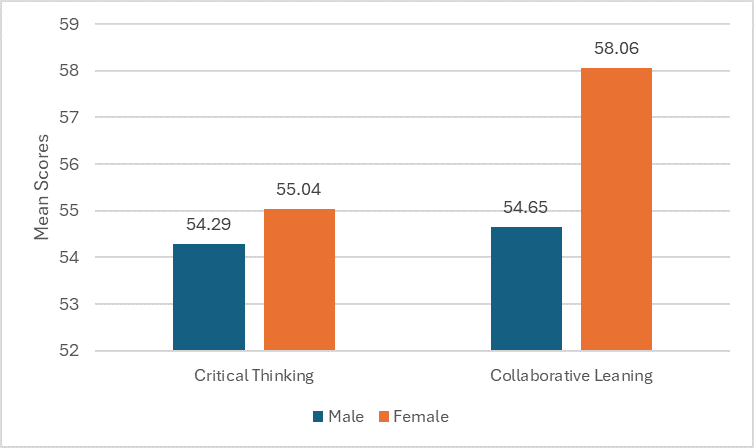
Figure 1. Comparative mean scores of medical students' perceptions of the impact of PBL on critical thinking by year of study. Error bars represent standard deviation. A significant difference was found between Year 1 and Year 2 students (p = 0.002).
The present study looked at medical students' views of the impact of PBL on critical thinking and collaborative learning and investigated whether these views differed across demographic subgroups. Overall, the findings support the primary hypothesis, with a large proportion of participants reporting positive views of PBL's thinking and interpersonal benefits. Notably, 61% of students showed that PBL improved their critical thinking, specifically in analyzing problems and combining information. These findings align with previous research showing that PBL encourages deeper learning, flexible problem-solving, and big improvements in critical thinking in higher education [15, 18–20]. The data also reveal that collaborative learning is a cornerstone of the PBL experience, with over half of students agreeing it encourages different idea creation and improves interpersonal skills. These findings match previous research stressing PBL's role in strengthening teamwork and communication [6, 21, 22]. Together, these results suggest that PBL supports both academic skill development and professional skills important for healthcare practice.
Despite these benefits, some students reported challenges related to group dynamics, including participation hesitancy and dominant group members overshadowing quieter peers. Such issues are well documented in PBL literature and highlight the need for structured support strategies—such as guided turn taking, and rotating roles—to make sure everyone participates fairly.
In checking subgroup differences, the findings partly supported the second hypothesis. Gender was not strongly linked with views of critical thinking or collaborative learning, which matches Al-Drees et al. for collaborative learning but contrasts with their findings for critical thinking [23]. This difference suggests that gender-related differences in PBL experiences may be context-specific, shaped by cultural, teaching, or institutional factors.
Age differences were seen for critical thinking but not for collaborative learning. First-year students, still adjusting to PBL's self-directed approach, may view it as less supportive of critical thinking. While the consistency across year levels for collaborative learning aligns with Ibrahim et al., variations in critical thinking across academic years show that increased PBL exposure and progressively complex cases may shape students' views of its thinking benefits [16].
The study's implications are both theoretical and practical.
Theoretically, the findings contribute to the growing evidence base supporting PBL's role in encouraging critical thinking and higher-order learning processes, consistent with constructivist learning theory. Practically, the results suggest that medical teachers should continue combining PBL in preclinical years but with improved attention to group support strategies to make sure everyone participates and learns fairly. Institutions may also consider faculty development programmes focused on managing group dynamics, supporting critical thinking development, and supporting students who are less participatory or new to PBL environments.
These results should be explained in light of the study's limitations.
The cross-sectional design and reliance on self-reported views prevent causal interpretations. The use of convenience sampling and online survey distribution may also introduce selection bias, while the single institution setting limits generalizability of the findings. However, these limitations do not weaken the central finding that students generally view PBL as beneficial for both critical thinking and collaborative learning; rather they provide context for the findings and stress the need for cautious inference.
Conclusion
Overall, the survey results show that medical students hold positive views of PBL, recognizing its meaningful contribution to the development of critical thinking and collaborative learning skills.
The study also suggests that students' views of PBL's impact on critical thinking vary by age and academic year, while gender does not appear to affect either outcome. These findings stress the importance of adjusting PBL approaches to consider students' age and academic progress, which could further improve their development of these key skills.
These results, while limited by the study's cross-sectional design and single-institution setting, offer meaningful practical guidance for medical teachers. Supporting students in their early years as they transition to self-directed learning may improve their ability to fully benefit from PBL. Also, actively managing group dynamics through skilled support is crucial to making sure that collaborative learning environments remain fair and productive. Despite the study's limitations, the overall trends provide valuable insights for curriculum planning and highlight the need for future research looking at the long-term effects of PBL on student performance.
Ethical considerations
Ethical approval was granted for this research by the Campus Research Ethics Committee at the University of the West Indies, St Augustine, with the approval number Ref: CREC-SA.2366/11/2023. The study followed set ethical principles and institutional guidelines throughout. Informed consent was gotten from the participants involved in the study.
Artificial intelligence utilization for article writing
During the preparation of this work, the authors used ChatGPT in order to improve language and grammar. After using this tool, the authors reviewed and edited the content as needed and took full responsibility for the content of the publication.
Acknowledgment
The authors are grateful to the participants who took part in the survey.
Conflict of interest statement
The authors declare no conflict of interest.
Author contributions
All authors contributed to the study's conceptualization. PKS, MJ, KR, AS, BD, and MG contributed to the methodology. Investigation was done by MJ, KR, and AS. The literature search was done by KR, AS, and BD. Data analysis was carried out by PKS, BD, and MG. The original draft was written by MJ, KR, AS, BD, and MG. Review and editing were done by PKS and MJ. All authors read and approved the final manuscript.
Funding
No funding was received for doing this study.
Data availability statement
The data that support the findings of this study are available from the corresponding author upon reasonable request.
Background & Objective: Over the past few decades, researchers and teachers have focused more on the role of Problem-Based Learning (PBL) in improving critical thinking and encouraging collaborative learning in medical education. This study looks at medical students' views of PBL's impact on critical thinking and collaborative learning based on age, gender and year of study.
Materials & Methods: A descriptive cross-sectional study was done among 269 MBBS students (years 1–3) at the University of the West Indies, St. Augustine, using convenience sampling. Data were collected using a validated questionnaire, created through expert review and pilot testing, which included demographic items and a 5-point Likert scale measuring views of PBL's impact on critical thinking and collaborative learning. Data analysis involved descriptive statistics and inferential tests (t-tests, ANOVA, Post-hoc Tukey) using IBM SPSS.
Results: Participants were mostly second-year students (42.01%), with a majority being female (70.26%). Most students (84%) agreed that PBL creates curiosity and encourages exploration of different solutions, while 84.4% agreed on PBL's role in developing interpersonal skills. Age strongly affected views of critical thinking (p = 0.003), with younger students reporting less positive views. First-year and second-year students also differed strongly in their views of critical thinking (p = 0.002). However, gender had no big impact. For collaborative learning, no big differences were found across age, gender, or year of study.
Conclusion: Students generally expressed positive views of PBL, recognizing its meaningful contribution to critical thinking and collaborative learning. These findings stress the importance of adjusting PBL approaches to consider students' age and academic progress, which could further improve their development of these key skills.
Introduction
Within the Caribbean context, the University of the West Indies (UWI), St. Augustine uses a hybrid PBL-lecture model in its MBBS programme. While a prior local study showed positive student attitudes towards PBL [15], there is limited evidence on how students view its specific contribution to the development of critical thinking and collaborative learning. It also remains unclear whether these views differ based on key student characteristics such as gender, age, and year of study. This gap leaves uncertainty about how well PBL supports skill development within this Caribbean context.
To address this gap, the present study aims to look at medical students' views of PBL's impact on critical thinking and collaborative learning, and to find out whether these views vary across gender, age, and year of study. Specifically, it seeks to answer the research question: What are medical students' views of the impact of PBL on critical thinking and collaborative learning, and do these views differ by gender, age, or year of study?
Based on the existing literature, we think that: (1) medical students will report positive views of PBL's impact on their critical thinking and collaborative learning. (2) views of PBL's impact will differ across demographic and academic subgroups, including gender, age, and year of study.
By providing context-specific insights, this study seeks to inform targeted improvements of the PBL curriculum at UWI and contribute to the broader understanding of PBL's role in developing future physicians.
Materials & Methods
Design and setting(s)
The study, done during the 2023-2024 academic year at the School of Medicine, The University of the West Indies, St. Augustine, used a descriptive cross-sectional design to look at the impact of PBL on critical thinking and collaborative learning skills among undergraduate medical students.
Eligible participants were MBBS students aged 18 years and older, registered in Year 1, Year 2, or Year 3 of the programme, and exposed to PBL sessions within the curriculum. Students were left out if they were younger than 18 years, enrolled in programmes such as dentistry, nursing, pharmacy, or veterinary medicine. Year 4 and Year 5 MBBS students were also left out due to their clinical commitments, which limited their availability for participation.
Participants and sampling
The study population included 762 MBBS students in Years 1 to 3 at the UWI, aged 18 and older. The sample size was found using Slovin's formula, a method suitable for populations under 1,000 [14].
Slovin's formula is expressed as: n = N ÷ (1 + N × e2) = 762 ÷ (1+ 762 × 0.052) = 262.3, where N = population of the study, n = sample size, e = marginal error (5%). Given a population size of 762 students and a 5% margin of error, the calculated minimum sample size needed for an accurate population estimate was 262 participants.
Tools/Instruments
The study used a self-administered questionnaire, which was created based on insights from previous research. To set up content validity, the draft questionnaire was reviewed by six PBL tutors, each with over five years of experience.
Their comments were used to improve wordings and remove redundancy. Then, a formal content validation process was done by a panel of six experts. The Scale-Content Validity Index (S-CVI/Ave) was 0.84 for the Critical thinking Sub-scale and 0.93 for the Collaborative Learning sub-scale, showing good to excellent content validity.
Based on experts' feedback, one item was removed from both the sub-scales due to a universally low CVR and I-CVI.
Face validity of the questionnaire was set up through a pilot study involving 20 medical students to find out the clarity and readability of each item.
Minor adjustments were made based on their feedback, confirming the instrument's suitability for the main study.
The final questionnaire has two sections. The first section captured demographic variables, including the participants' gender, age, and year of study. The second section included 32 items measured on a 5-point Likert scale ranging from "strongly agree" to "strongly disagree." Of these, 15 items assessed perception of critical thinking development, while 17 items checked collaborative learning.
Cronbach's Alpha values showed satisfactory reliability for the critical thinking (α = 0.86) and collaborative learning (α = 0.82) sub-scales.
Data collection methods
The survey was shared via a Google Form link sent through WhatsApp and other social media platforms over a four-week period (January 24 to February 25, 2024).
Convenience sampling was used, and participants were told about the study's purpose prior to voluntary participation. Informed consent was gotten by making sure that participants clearly understood the study's purpose, procedures, and implications before and after their participation.
No incentives were offered, and all answers were anonymized, meaning that no identifying information was collected, to keep confidentiality and to reduce social desirability bias. A total of 269 students agreed and completed the survey, giving a response rate of 35.3%.
Data analysis
Data were analyzed using SPSS version 28. Descriptive statistics, including frequencies, percentages, means, and standard deviations, were used to summarize participants' characteristics and key variables. To address potential bias and keep methodological transparency, missing data were handled prior to the main inferential analyses.
Any case with missing values for the critical thinking or collaborative learning variables was left out from the respective analysis using a listwise deletion method. To check medical students' views of the impact of PBL on critical thinking and collaborative learning, inferential analyses were done using Student's t-test and one-way ANOVA.
When ANOVA results were big, post hoc tests were done to find specific group differences. Descriptive findings were visually represented through graphs and bar charts. Statistical significance was set at a threshold of p < 0.05 for all inferential tests.
Results
A total of 269 answers were collected. Table 1 presents the frequency and percentage distribution of participants' demographic characteristics.
Most participants were female (n = 189, 70.26%), while males made up a smaller proportion (n = 80, 29.74%). Most participants were in the 20-22 age group (n = 190, 70.63%).
The largest group of participants was in their second year of study (n = 113, 42.01%), whereas the smallest group was in their third year (n = 63, 23.42%).
Table 1. Demographic characteristics of participants
Note: Total participants = 269.
Abbreviations: n, number of participants.
Table 2 presents medical students' perspectives on the impact of PBL on critical thinking and collaborative learning. The findings reveal that a large majority (84%) believe PBL problems create curiosity and encourage the exploration of different solutions, with a mean score of 3.95 (SD = 0.99). Also, 84.7% of students believed that PBL encouraged them to think outside of the box (M = 3.93, SD = 1.03), and 64% agreed that it improved their decision-making skills (M = 3.63, SD = 1.10). An overwhelming 85.5% of participants strongly agreed that PBL improves their ability to consider multiple perspectives and approaches to problem-solving, giving a mean score of 4.07 (SD = 0.92). Collaborative learning within PBL was also highly valued, with 84.4% acknowledging its role in encouraging interpersonal skills and 67.7% highlighting increased comfort with teamwork, reflected in mean scores of 3.98 (SD = 0.99) and 3.67 (SD = 1.14), respectively. The highest-rated aspect of PBL was the effectiveness of tutors in prompting and encouraging meaningful discussions, as noted by 88.1% of respondents, with a mean score of 4.20 (SD = 0.93).
On the other hand, challenges related to group dynamics were rated lowest, with 57.2% showing hesitation to participate in PBL sessions (M = 2.65, SD = 1.33) and 76.5% identifying domination by certain group members as a concern (M = 2.07, SD = 1.11). Overall, the results highlight that students view PBL as highly beneficial for improving critical thinking and collaborative learning, with some variations affected by gender, age, and year of study. Table 3 presents a comparative analysis of the effect of PBL on critical thinking among medical students based on gender, age, and year of study. As shown in Figure 1, female students showed slightly higher mean scores (55.04 ± 8.04 vs 54.29 ± 8.04), though this difference was not statistically big (p = 0.490).
Table 2. Medical students' perceptions of the impact of PBL on critical thinking and collaborative learningAbbreviations: n, number of participants.
Table 2 presents medical students' perspectives on the impact of PBL on critical thinking and collaborative learning. The findings reveal that a large majority (84%) believe PBL problems create curiosity and encourage the exploration of different solutions, with a mean score of 3.95 (SD = 0.99). Also, 84.7% of students believed that PBL encouraged them to think outside of the box (M = 3.93, SD = 1.03), and 64% agreed that it improved their decision-making skills (M = 3.63, SD = 1.10). An overwhelming 85.5% of participants strongly agreed that PBL improves their ability to consider multiple perspectives and approaches to problem-solving, giving a mean score of 4.07 (SD = 0.92). Collaborative learning within PBL was also highly valued, with 84.4% acknowledging its role in encouraging interpersonal skills and 67.7% highlighting increased comfort with teamwork, reflected in mean scores of 3.98 (SD = 0.99) and 3.67 (SD = 1.14), respectively. The highest-rated aspect of PBL was the effectiveness of tutors in prompting and encouraging meaningful discussions, as noted by 88.1% of respondents, with a mean score of 4.20 (SD = 0.93).
On the other hand, challenges related to group dynamics were rated lowest, with 57.2% showing hesitation to participate in PBL sessions (M = 2.65, SD = 1.33) and 76.5% identifying domination by certain group members as a concern (M = 2.07, SD = 1.11). Overall, the results highlight that students view PBL as highly beneficial for improving critical thinking and collaborative learning, with some variations affected by gender, age, and year of study. Table 3 presents a comparative analysis of the effect of PBL on critical thinking among medical students based on gender, age, and year of study. As shown in Figure 1, female students showed slightly higher mean scores (55.04 ± 8.04 vs 54.29 ± 8.04), though this difference was not statistically big (p = 0.490).
Note: Percentages represent the proportion of participants selecting each response option. Higher mean scores indicate more favorable perceptions. Full item wordings are provided in the questionnaire.
Abbreviations: PBL, problem-based learning; SD, standard deviation; %, percentage.
Abbreviations: PBL, problem-based learning; SD, standard deviation; %, percentage.
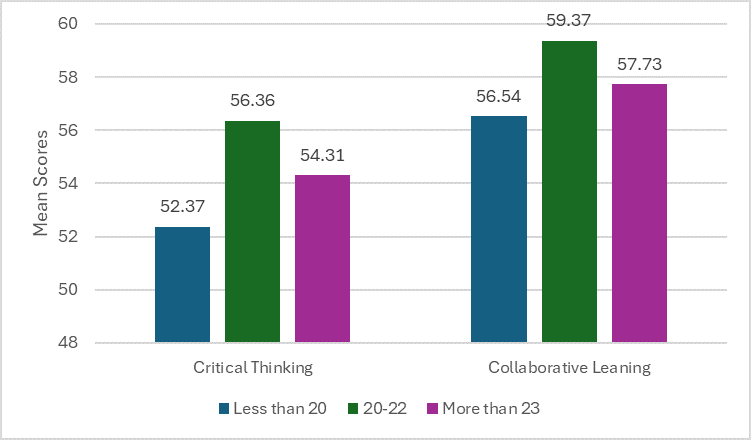
The analysis of Table 3 highlights big differences in medical students' perspectives on the effect of PBL on critical thinking based on age and year of study. For age, a one-way ANOVA showed a statistically big difference among three age groups, F(2, 266) = 6.118, p = 0.003. The effect size was similarly negligible (η² = 0.002), accounting for only 0.2% of the variance, which suggests limited practical importance. As shown in Figure 2, students aged 20-22 achieved the highest mean scores. Post hoc analyses using the Tukey HSD test confirmed a big difference specifically between students under 20 and those aged 20–22 (p = 0.002).
Table 3. Comparative analysis of medical students' perceptions of the impact of PBL on critical thinking by gender, age, and year of study
Note: Between-group comparisons were conducted using independent samples t-test (for gender) and one-way ANOVA (for age and year of study). *p < 0.05.
Abbreviations: SD, standard deviation; n, number of participants; t, t-test statistic; F, ANOVA F-statistic; PBL, problem-based learning; p-value, probability value.
Figure 1. Comparative mean scores of medical students' perceptions of the impact of PBL on critical thinking by year of study. Error bars represent standard deviation. A significant difference was found between Year 1 and Year 2 students (p = 0.002).
Figure 2. Comparative mean scores of medical students' perceptions of the impact of PBL on critical thinking by age group. Error bars represent standard deviation. A significant difference was found between students under 20 and those aged 21-22 (p = 0.002).
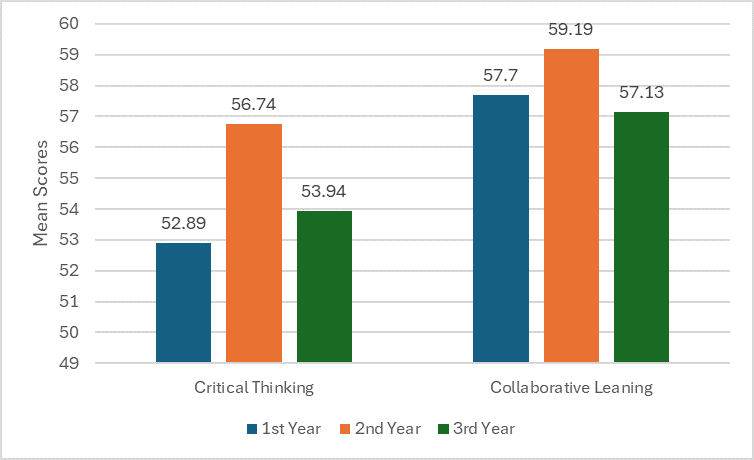
Similarly, a one-way ANOVA showed that the effect of PBL on critical thinking varied strongly by year of study, F(2, 266) = 6.52, p = 0.002. However, the effect size was very negligible (η² = 0.002), showing that academic year explains only 0.2% of the variance, and its practical significance is minimal. Post hoc analysis using Tukey HSD test identified a specific notable difference between first year and second year medical students (p = 0.002). As shown in Figure 3, second year students achieved the highest mean scores.
The analysis showed no big differences in collaborative learning based on gender, although Figure 1 shows that female students reported slightly higher mean scores. Similarly, no big differences were seen across age groups, though Figure 2 shows that students aged 20–22 had the highest mean collaborative learning scores. Across years of study, no big differences appeared, though Figure 3 highlights that second-year students had the highest mean critical thinking scores, while first-year students reported the lowest.
The analysis showed no big differences in collaborative learning based on gender, although Figure 1 shows that female students reported slightly higher mean scores. Similarly, no big differences were seen across age groups, though Figure 2 shows that students aged 20–22 had the highest mean collaborative learning scores. Across years of study, no big differences appeared, though Figure 3 highlights that second-year students had the highest mean critical thinking scores, while first-year students reported the lowest.
Figure 3. Comparative mean scores of medical students' perceptions of the impact of PBL on collaborative learning by year of study. Error bars represent standard deviation. No significant differences were found across years (p = 0.235).
DiscussionThe present study looked at medical students' views of the impact of PBL on critical thinking and collaborative learning and investigated whether these views differed across demographic subgroups. Overall, the findings support the primary hypothesis, with a large proportion of participants reporting positive views of PBL's thinking and interpersonal benefits. Notably, 61% of students showed that PBL improved their critical thinking, specifically in analyzing problems and combining information. These findings align with previous research showing that PBL encourages deeper learning, flexible problem-solving, and big improvements in critical thinking in higher education [15, 18–20]. The data also reveal that collaborative learning is a cornerstone of the PBL experience, with over half of students agreeing it encourages different idea creation and improves interpersonal skills. These findings match previous research stressing PBL's role in strengthening teamwork and communication [6, 21, 22]. Together, these results suggest that PBL supports both academic skill development and professional skills important for healthcare practice.
Despite these benefits, some students reported challenges related to group dynamics, including participation hesitancy and dominant group members overshadowing quieter peers. Such issues are well documented in PBL literature and highlight the need for structured support strategies—such as guided turn taking, and rotating roles—to make sure everyone participates fairly.
In checking subgroup differences, the findings partly supported the second hypothesis. Gender was not strongly linked with views of critical thinking or collaborative learning, which matches Al-Drees et al. for collaborative learning but contrasts with their findings for critical thinking [23]. This difference suggests that gender-related differences in PBL experiences may be context-specific, shaped by cultural, teaching, or institutional factors.
Age differences were seen for critical thinking but not for collaborative learning. First-year students, still adjusting to PBL's self-directed approach, may view it as less supportive of critical thinking. While the consistency across year levels for collaborative learning aligns with Ibrahim et al., variations in critical thinking across academic years show that increased PBL exposure and progressively complex cases may shape students' views of its thinking benefits [16].
The study's implications are both theoretical and practical.
Theoretically, the findings contribute to the growing evidence base supporting PBL's role in encouraging critical thinking and higher-order learning processes, consistent with constructivist learning theory. Practically, the results suggest that medical teachers should continue combining PBL in preclinical years but with improved attention to group support strategies to make sure everyone participates and learns fairly. Institutions may also consider faculty development programmes focused on managing group dynamics, supporting critical thinking development, and supporting students who are less participatory or new to PBL environments.
These results should be explained in light of the study's limitations.
The cross-sectional design and reliance on self-reported views prevent causal interpretations. The use of convenience sampling and online survey distribution may also introduce selection bias, while the single institution setting limits generalizability of the findings. However, these limitations do not weaken the central finding that students generally view PBL as beneficial for both critical thinking and collaborative learning; rather they provide context for the findings and stress the need for cautious inference.
Conclusion
Overall, the survey results show that medical students hold positive views of PBL, recognizing its meaningful contribution to the development of critical thinking and collaborative learning skills.
The study also suggests that students' views of PBL's impact on critical thinking vary by age and academic year, while gender does not appear to affect either outcome. These findings stress the importance of adjusting PBL approaches to consider students' age and academic progress, which could further improve their development of these key skills.
These results, while limited by the study's cross-sectional design and single-institution setting, offer meaningful practical guidance for medical teachers. Supporting students in their early years as they transition to self-directed learning may improve their ability to fully benefit from PBL. Also, actively managing group dynamics through skilled support is crucial to making sure that collaborative learning environments remain fair and productive. Despite the study's limitations, the overall trends provide valuable insights for curriculum planning and highlight the need for future research looking at the long-term effects of PBL on student performance.
Ethical considerations
Ethical approval was granted for this research by the Campus Research Ethics Committee at the University of the West Indies, St Augustine, with the approval number Ref: CREC-SA.2366/11/2023. The study followed set ethical principles and institutional guidelines throughout. Informed consent was gotten from the participants involved in the study.
Artificial intelligence utilization for article writing
During the preparation of this work, the authors used ChatGPT in order to improve language and grammar. After using this tool, the authors reviewed and edited the content as needed and took full responsibility for the content of the publication.
Acknowledgment
The authors are grateful to the participants who took part in the survey.
Conflict of interest statement
The authors declare no conflict of interest.
Author contributions
All authors contributed to the study's conceptualization. PKS, MJ, KR, AS, BD, and MG contributed to the methodology. Investigation was done by MJ, KR, and AS. The literature search was done by KR, AS, and BD. Data analysis was carried out by PKS, BD, and MG. The original draft was written by MJ, KR, AS, BD, and MG. Review and editing were done by PKS and MJ. All authors read and approved the final manuscript.
Funding
No funding was received for doing this study.
Data availability statement
The data that support the findings of this study are available from the corresponding author upon reasonable request.
Editorial: Original Research |
Subject:
Medical Education
Received: 2025/08/15 | Accepted: 2025/12/11 | Published: 2026/01/1
Received: 2025/08/15 | Accepted: 2025/12/11 | Published: 2026/01/1
Send email to the article author
| Rights and permissions | |
 |
This work is licensed under a Creative Commons Attribution-NonCommercial 4.0 International License. |