Mon, Sep 28, 2026
[Archive]
Volume 18, Issue 3 (2025)
J Med Edu Dev 2025, 18(3): 78-89 |
Back to browse issues page


Ethics code: IR.GUMS.REC.1401.007


Download citation:
BibTeX | RIS | EndNote | Medlars | ProCite | Reference Manager | RefWorks
Send citation to:


BibTeX | RIS | EndNote | Medlars | ProCite | Reference Manager | RefWorks
Send citation to:
Taheri M, Fakhari M, Babaee Hemmati Y. Academic motivation of dental students and the associated factors. J Med Edu Dev 2025; 18 (3) :78-89
URL: http://edujournal.zums.ac.ir/article-1-2453-en.html
URL: http://edujournal.zums.ac.ir/article-1-2453-en.html

1- Medical Education Research Center, Education Development Center, Guilan University of Medical Sciences, Rasht, Iran
2- School of Dentistry, Guilan University of Medical Sciences, Rasht, Iran
3- Department of Orthodontics, Dental Sciences Research Center, School of Dentistry, Guilan University of Medical Sciences, Rasht, Iran ,yasi.10482@gmail.com
2- School of Dentistry, Guilan University of Medical Sciences, Rasht, Iran
3- Department of Orthodontics, Dental Sciences Research Center, School of Dentistry, Guilan University of Medical Sciences, Rasht, Iran ,
Full-Text [PDF 574 kb]
(859 Downloads)
| Abstract (HTML) (1774 Views)
Full-Text: (103 Views)
Abstract
Background & Objective: C Understanding the factors that influence academic motivation is crucial for identifying challenges and tailoring educational interventions to enhance students' learning experiences and outcomes. Thus, this study aimed to assess the academic motivation of dental students and the factors associated with it.
Materials & Methods: This cross-sectional study evaluated 200 dental students from July 1, 2022, to October 31, 2022. The Academic Motivation Scale (AMS), which comprises three domains of intrinsic and extrinsic motivation, was used for data collection. Data were analyzed using ANOVA, the Kruskal-Wallis test, and the t-test.
Results: Of 200 participants, 117 (58.5%) were males, and 160 (80%) were single. The mean age was 24.33 ± 1.66 years. Academic motivation was significantly associated with age, gender, marital status, parental level of education, family financial status, academic level, having a dentist in the family, and university branch (p < 0.001). Females acquired a significantly higher mean score in all three domains than males (p < 0.05). The mean scores of extrinsic motivation and amotivation were significantly higher in singles, students whose parents had a high school diploma (compared with those with a higher educational level), students who did not have a dentist in their family, and students attending the Rasht branch (p < 0.05). Place of residence had a significant association with the amotivation score (p < 0.001), and family financial status had significant associations with both extrinsic motivation (p < 0.001) and amotivation (p < 0.001) scores.
Conclusion: The academic motivation score of the study population was perfect. Age, gender, marital status, parental level of education, family financial status, educational level, having a dentist in the family, and university branch were found to have a significant impact on the academic motivation of dental students.
Psychologists have emphasized the prominent role of motivation in education and learning due to its significant association with acquiring skills, strategies, and behaviors. Academic achievement is a primary construct proposed to explain academic motivation [3]. Students with similar capabilities and learning skills can exhibit significant differences in academic progression, as well as in non-academic activities [1]. These variations may be attributed to differences in their academic motivation.
The association between academic motivation and several personal and social factors has been previously confirmed, indicating a strong influence of these factors on academic motivation. Accordingly, personal, familial, academic, and social factors are associated with the academic motivation construct [3]. The correlation between learning and motivation has also been confirmed, such that previous knowledge of learners affects their motivation [4]. Poor motivation can cause problems and lead to pessimism, anxiety, depression, psychological problems, and a significant decline in individual, social, and occupational performance, adversely affecting the academic performance of students [5, 6]. A lack of job security and concerns about their future careers also hurt the academic motivation of dental students [7]. Assessing the level of academic motivation in students and its impact on their learning process may help mentors plan more efficient strategies and implement educational programs. Even the richest and most well-designed educational programs will not be sufficiently effective without understanding the level of academic motivation of students and the influential factors in this respect [7]. The instructors are well aware that a high level of academic motivation among learners facilitates the communication process, decreases their anxiety, and enhances their creativity and learning [8]. Motivation of students also encourages the mentors and improves the quality of instruction. It also affects their classroom activities [4]. The low level of academic motivation among students is a widespread issue in educational systems worldwide. This problem can have negative consequences, leading to substantial losses in scientific knowledge, cultural advancement, and economic growth [9]. This study focuses on a specific population of dental students to examine the impact of individual, familial, and academic factors on academic motivation. Given the lack of comprehensive data in this area and the limited focus on dental students, this research can serve as a reliable reference for educational planning and improving learning environments. The findings of this study have the potential to offer practical solutions for enhancing academic motivation, ultimately improving the quality of education and professionalism among dental students. Thus, this study aimed to assess the academic motivation of dental students and the factors associated with it.
Materials & Methods
Design and setting(s)
This analytical cross-sectional study was conducted among 3rd- to 6th-year (terms 5-12) dental students of Guilan University of Medical Sciences from July 1, 2022, to October 31, 2022.
Participants and sampling
The minimum sample size was calculated to be 196, according to a previous study by Naseh et al. [10], assuming a mean and standard deviation of academic motivation of 134.54, a study power of 80%, an alpha level of 0.05, and a Cohen's d of 26.91. The inclusion criterion was 3rd- to 6th-year (terms 5-12) dental students of Guilan University of Medical Sciences (Rasht and Anzali branches) in 2022. Students with incomplete questionnaires and those unwilling to participate were excluded from the study. In the Iranian dental education system, terms 5 to 12 comprise the professional phase of study, including both preclinical and clinical training; thus, students in these semesters were selected for this study.
Tools/Instruments
The Persian version of the Academic Motivation Scale (AMS) used in this study was adapted from the version validated by Naseh et al. [10], who reported strong content validity and internal consistency (Cronbach's alpha = 0.87). To further ensure reliability in our population, the questionnaire was pilot-tested with 20 dental students, yielding a Cronbach's alpha of 0.87, which confirms acceptable internal consistency. This scale was selected for the current study due to its multidimensional structure, theoretical foundation, and previous use in various educational and cultural contexts, including studies in Iran. The AMS, initially developed by Vallerand et al. [11], is a standardized and theory-based instrument grounded in Self-Determination Theory (SDT). It is widely used in educational research to assess three distinct types of motivation: intrinsic motivation, extrinsic motivation, and amotivation. This scale has three domains: intrinsic motivation, extrinsic motivation, and amotivation. The intrinsic motivation domain has three dimensions: intrinsic motivation toward accomplishment (questions 6, 13, 20, and 27), intrinsic motivation to know (questions 2, 9, 16, and 23), and intrinsic motivation to experience stimulation (questions 4, 11, 18, and 25) [12]. The extrinsic motivation domain has three dimensions: external regulation (questions 3, 10, 17, and 24), introjection (questions 7, 14, 21, and 28), and identification (questions 1, 8, 15, and 22). Questions 5, 12, 19, and 26 addressed amotivation. The questionnaire was scored using a 7-point Likert scale. Answer choice 1 indicated that the respective statement (question) does not correspond at all to the student's reason for going to university. Answer choices 2-6 indicated low to high agreement, and answer choice 7 indicated complete agreement with the student's opinion. Thus, the answer choice or score of 4 was average. A total score between 28 and 69 indicates poor academic motivation; scores ranging from 70 to 112 suggest moderate academic motivation and scores above 112 reflect high academic motivation. The demographic questionnaire included items on age, gender, marital status, place of residence, parental level of education, family financial status, academic term, Grade Point Average (GPA), and whether the student had a dentist in the family. An English translation of the exact Persian version used in the study is provided in Appendix A for reference.
Data collection methods
The questionnaires, which included the informed consent form, a demographic questionnaire, and the Persian version of the AMS, were created using the Porsline online survey platform. Students were selected through cluster sampling, with each academic year serving as a separate cluster. Considering the number of admissions in each academic year, the total number of students, and the required sample size, the share of each cluster was determined. The survey link was distributed through email addresses and virtual messaging platforms. Students first read and electronically confirmed the informed consent. They then completed the demographic section, followed by the AMS.
Data analysis
The normality of the data distribution was assessed using the Shapiro-Wilk test, while the homogeneity of variances was evaluated using Levene's test. Accordingly, independent sample t-tests, analysis of variance (ANOVA), Tukey's Honestly Significant Difference (HSD), and Games-Howell tests (for pairwise comparisons) were used for the analysis of quantitative variables when the assumptions were met. The Kruskal-Wallis test, the Mann-Whitney test with Bonferroni adjustment (for pairwise comparisons), and Spearman's rank correlation test were used for data analysis when the assumptions were not met. All statistical analyses were performed using Statistical Package for the Social Sciences (SPSS) version 26 (SPSS Inc., IL, USA) at a 0.05 level of significance.
Results
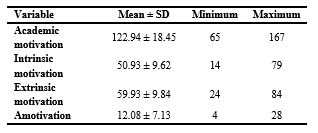
A total of 200 dental students participated in this study, comprising 83 females (41.5%) and 117 males (58.5%). The mean age of the participants was 24.33 ± 1.66 years. Among them, 80% (n = 160) were single. Also, 55% (n = 110) were living with their families, 27.5% (n = 55) had rented a place, and 17.5% (n = 35) were living in a dormitory. The parental level of education was a Bachelor's degree or higher in 72% of the students and a high school diploma in 26.5%. The family's financial status was moderate in 57.5% of the cases and good in 38.5% of the cases. Overall, Term 12 students had the highest frequency (50%), followed by Term 9 students (12.5%). Additionally, 16.5% reported having a dentist in their family. Of all, 67.5% were attending the Rasht branch, and 32.5% were attending the Anzali branch. The mean GPA of students was 16.24 ± 1.15 out of 20. Given that the total number of eligible students was 282, this corresponds to a response rate of approximately 70.9%. The academic motivation was good in 71.5%, moderate in 28%, and poor in 0.5% of the students. Table 1 shows the mean scores acquired by students in the three domains of academic motivation.
Table 1. Descriptive statistics for academic motivation domains in study participants
Pairwise comparisons using the Mann-Whitney test revealed a significantly higher score for students with moderate financial status compared to
those with good economic status (p < 0.001). However, the differences between the good and moderate groups (p = 0.169) and the poor and moderate groups (p = 0.999) were not significant. Academic motivation showed a significant correlation with the academic level (term), as indicated by Spearman's correlation test (r = 0.464, p < 0.001). GPA had no significant correlation with the academic motivation score of students (r = 0.006, p = 0.935).
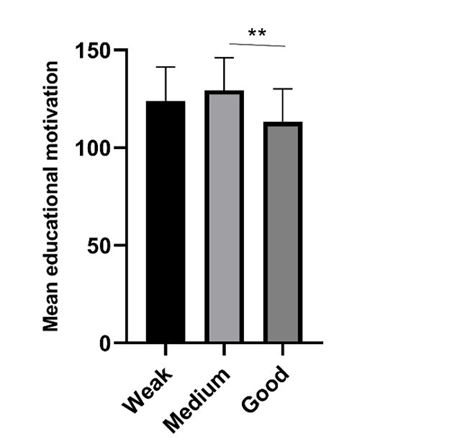
Table 3. Correlation of academic motivation domain scores with age, academic level (term), and GPA of students
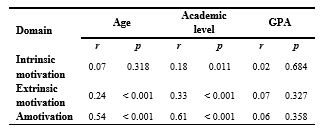
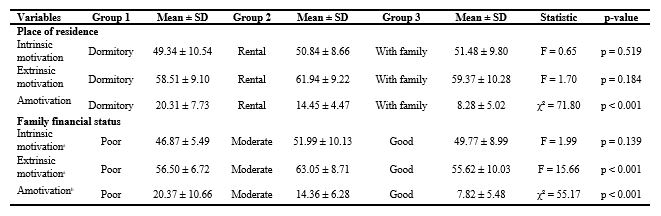
Table 5. Association of academic motivation domain scores with place of residence and family financial status of dental students
Discussion
This study investigated the academic motivation of dental students and the factors that influence it. The results indicated that the majority of dental students exhibited good academic motivation (71.5%), which aligns with findings from previous studies conducted on Iranian dental students at various universities [13-15]. Considering that dental students in Iran strive to pass the university entrance exam, they are expected to possess strong academic motivation [16]. Imagining a bright future with optimal job satisfaction and a high level of income can further increase their motivation [14]. This study makes a novel contribution to the literature on academic motivation among dental students in Iran, focusing on students from the 5th to 12th terms, which encompasses both the preclinical and clinical phases of dental education. While previous studies have primarily explored motivation through qualitative approaches [17] or focused on limited educational stages [18], our study quantitatively investigates motivation across a broader academic spectrum using the validated Persian version of the AMS. Furthermore, by examining associations between academic motivation and multiple demographic factors—such as parental education, family financial status, and the presence of a dentist in the family—our findings provide a more nuanced understanding of social and familial influences on dental students' motivation. This approach builds upon prior research and offers practical insights for designing interventions to enhance motivation and academic performance in dental education [19]. In the Iranian dental curriculum, the first four semesters are primarily dedicated to basic sciences and general university courses, with minimal focus on core dental content. Starting from semester 5, students enter the professional phase of their training, which includes both preclinical and clinical education specific to dentistry. This phase marks a significant transition in academic demands, learning environments, and the responsibilities of students. Therefore, by including only students from semesters 5 to 12, this study aims to assess academic motivation during the period when students are fully engaged with dental education and are more likely to be influenced by the complexities of skill acquisition, clinical exposure, and future professional expectations. This approach ensures relevance and precision in evaluating factors that shape motivation in the context of professional dental training [17]. In the present study, the extrinsic motivation score of students was higher than their intrinsic motivation score. The amotivation score was the lowest, which is in agreement with the results of Roshan Milan et al. [7] and Clark and Schroth [20], but in contrast to the findings of Azizzadeh Forozi et al. [21], who reported almost equal extrinsic and intrinsic scores among university faculty members. This difference can be due to different target groups and study populations (dental students vs. university faculty members).
In the current study, the academic motivation of students increased significantly with age, which may be due to their greater involvement in clinical practice at higher academic levels, thereby improving their motivation. The same result was reported by Vakilimofrad et al. [22]. Additionally, females demonstrated significantly higher academic motivation than males in the present study, which is in agreement with previous findings [14, 16, 23, 24]. A prior survey of gender-specific differences in academic motivation and progression reported higher intrinsic motivation in females and higher extrinsic motivation in males [25]. Another study, however, found no significant association between gender and academic motivation [26]. Higher academic motivation in Iranian female students may be due to their eagerness for financial independence (unlike the previous generation).
Additionally, as reported in the literature, the number of female dental students exceeds that of male dental students in many countries [27-30]. Dentistry is an appealing profession for women as it allows them to strike a balance between their personal and professional lives [31]. The present results also showed that the mean academic motivation score was significantly higher in singles than married students, which was in contrast to the findings of Roshan Milan et al. [7] and Izadi et al. [14], who found no significant association between marital status and academic motivation, and the results of Hakimi et al. [26], who showed significantly higher academic motivation of married students. A small number of married students in the present study may explain the differences in the results. The mean academic motivation score of students living in a dormitory was significantly higher than that of students living with their parents or those who had rented a place to live. Similarly, Vakilimofrad et al. [17] reported higher academic motivation scores for non-native students. However, Win and Miller [32] found no significant association between place of residence and academic motivation. The mean academic motivation score of students whose parents had a high school diploma was higher than that of students whose parents had a higher educational level. Similarly, Naseh et al. [10] found an inverse correlation between parental educational level and the student's academic motivation. However, Zahiri Naw and Rajabi [23] reported that students whose parents had a higher educational level exhibited higher academic motivation, while another study found no significant association in this regard [14]. This controversy warrants further investigation in this respect. In the present study, students with a moderate family financial status had a significantly higher academic motivation score than those with good economic status. Consistent with the present results, a significant inverse correlation between academic motivation and family economic status has also been reported by many previous studies [33, 34]. This finding may be due to a lack of financial concerns among students from wealthy families. With an increase in academic level, the motivation score of students significantly increased in the current study, which aligns with the results of Hakim et al. [26] and may be attributed to the initiation of clinical practice. However, this finding differs from the results of some previous studies [16, 26], which reported a decline in motivation as academic levels increased, likely due to a heightened awareness of professional issues [35]. Additionally, the academic motivation score was higher in students who did not have a dentist in their family, which may be due to the good financial status of families with a dentist as a family member and, subsequently, lower motivation in students. The present results also showed higher motivation scores among students attending the Rasht branch, likely because this branch requires a higher entrance exam score for admission, offers superior facilities, and is free, whereas the Anzali branch has a higher admission fee and fewer facilities. The GPA of students had no significant association with their academic motivation, which was in contrast to previous studies that reported higher motivation among students with higher GPAs [13]. The different results observed in the present study may be attributed to the impact of COVID-19 on students' GPAs. The assessment of the association between academic motivation domains and various parameters revealed that age had a significant positive correlation with the domains of extrinsic motivation and amotivation. Additionally, females scored higher in all three domains than males, which aligns with the results of Roshan Milan et al. [7], who reported significantly higher motivation scores in general as well as in the extrinsic and intrinsic domains for females. However, some studies [36] found no significant difference in intrinsic motivation between males and females. Variations in the reported results can be due to differences in study populations, educational conditions, and social factors. Single students exhibited significantly higher scores in both extrinsic motivation and amotivation. Previous studies found no significant association between academic motivation and marital status [10, 37], which may be due to differences in study populations, educational conditions, and social factors.
In terms of place of residence, the present results revealed significantly lower amotivation scores in students living with their families compared with those living in a dormitory or having rented a place. Also, the mean amotivation score of those who had rented a place was significantly lower than the mean score of students staying in a dormitory. Moreover, students attending the Rasht branch had the significantly higher extrinsic motivation and amotivation scores. Naseh et al. [10] also noted a significant association between the attending university and students' academic motivation. Furthermore, the extrinsic motivation and amotivation scores of students whose parents held a high school diploma were higher than those of students whose parents had a higher level of education. The mean extrinsic motivation score of students with moderate financial status was higher than that of students with good economic status. Also, the mean amotivation score of students with moderate and poor economic status was higher than that of students with good financial status. Additionally, with an increase in academic level, the mean score of all three domains increased significantly. Students without a dentist in their family acquired significantly higher extrinsic motivation and amotivation scores. Gobena et al. [38], in their study in East Ethiopia, found that family income had no significant effect on the educational progression of students; however, parental educational level contributed to their academic progression by 40.96%. Griffin et al. [39] demonstrated that parental involvement, cultural background, and family environment can have a significant impact on a child's motivation. Mohebbi et al. [19] reported that low financial support was associated with a higher level of academic burnout. Another study found a significant correlation between fathers' high educational levels and students' academic motivation [40]. The main limitations of this study included poor cooperation from some students in completing the questionnaire, desirability bias, and the psychological status of the students, which may have influenced their responses. Future research should consider the educational history of students, such as their performance on basic science exams, to gain deeper insights into their academic motivation. Additionally, factors like the academic level of students should be standardized in future studies to yield more accurate results.
Conclusion
The academic motivation score of the study population was perfect.
Age, gender, marital status, parental level of education, family financial status, academic level, having a dentist in the family, and university branch were found to have a significant impact on the academic motivation of dental students.
Ethical considerations
The study protocol was approved by the university's ethics committee (IR.GUMS.REC.1401.007).
Artificial intelligence utilization for article writing
The authors declare that no artificial intelligence technologies were used in the process of writing this article for generating content, ideas, analysis, or other purposes.
Acknowledgment
This work was supported by Guilan University of Medical Sciences and derived from the doctoral thesis of a dental student at Guilan University of Medical Sciences.
Conflict of interest statement
The authors declare that they have no conflicts of interest.
Author contributions
MT: Study Design, Review, and Editing, Final Approval
MF: Data Collection, Manuscript Preparation, Final Approval
YBH: Study Concept, Manuscript Preparation, Investigation, Visualization, Final Approval
Funding
None.
Data availability statement
The datasets used and/or analyzed during the current
Study are available from the corresponding author upon
reasonable request. Additionally, the datasets that support the conclusions of this article are included within the article
itself.
Background & Objective: C Understanding the factors that influence academic motivation is crucial for identifying challenges and tailoring educational interventions to enhance students' learning experiences and outcomes. Thus, this study aimed to assess the academic motivation of dental students and the factors associated with it.
Materials & Methods: This cross-sectional study evaluated 200 dental students from July 1, 2022, to October 31, 2022. The Academic Motivation Scale (AMS), which comprises three domains of intrinsic and extrinsic motivation, was used for data collection. Data were analyzed using ANOVA, the Kruskal-Wallis test, and the t-test.
Results: Of 200 participants, 117 (58.5%) were males, and 160 (80%) were single. The mean age was 24.33 ± 1.66 years. Academic motivation was significantly associated with age, gender, marital status, parental level of education, family financial status, academic level, having a dentist in the family, and university branch (p < 0.001). Females acquired a significantly higher mean score in all three domains than males (p < 0.05). The mean scores of extrinsic motivation and amotivation were significantly higher in singles, students whose parents had a high school diploma (compared with those with a higher educational level), students who did not have a dentist in their family, and students attending the Rasht branch (p < 0.05). Place of residence had a significant association with the amotivation score (p < 0.001), and family financial status had significant associations with both extrinsic motivation (p < 0.001) and amotivation (p < 0.001) scores.
Conclusion: The academic motivation score of the study population was perfect. Age, gender, marital status, parental level of education, family financial status, educational level, having a dentist in the family, and university branch were found to have a significant impact on the academic motivation of dental students.
Introduction
Motivation is a psychological construct that drives individuals to pursue their goals [1]. It can be divided into two main categories: intrinsic and extrinsic motivation. Intrinsic motivation involves personal reinforcers that create a natural desire to engage in an activity. In contrast, extrinsic motivation refers to influences that prompt a person to strive for a goal that is separate from and external to themselves. Academic motivation is essential for students and is defined as a pervasive internal desire that directs one's behavior toward learning and academic progress. Both intrinsic and extrinsic motivational factors influence academic motivation. Academic motivation enables students to put in the required effort to complete tasks, achieve goals, and acquire a certain level of competence in their field of study [2].Psychologists have emphasized the prominent role of motivation in education and learning due to its significant association with acquiring skills, strategies, and behaviors. Academic achievement is a primary construct proposed to explain academic motivation [3]. Students with similar capabilities and learning skills can exhibit significant differences in academic progression, as well as in non-academic activities [1]. These variations may be attributed to differences in their academic motivation.
The association between academic motivation and several personal and social factors has been previously confirmed, indicating a strong influence of these factors on academic motivation. Accordingly, personal, familial, academic, and social factors are associated with the academic motivation construct [3]. The correlation between learning and motivation has also been confirmed, such that previous knowledge of learners affects their motivation [4]. Poor motivation can cause problems and lead to pessimism, anxiety, depression, psychological problems, and a significant decline in individual, social, and occupational performance, adversely affecting the academic performance of students [5, 6]. A lack of job security and concerns about their future careers also hurt the academic motivation of dental students [7]. Assessing the level of academic motivation in students and its impact on their learning process may help mentors plan more efficient strategies and implement educational programs. Even the richest and most well-designed educational programs will not be sufficiently effective without understanding the level of academic motivation of students and the influential factors in this respect [7]. The instructors are well aware that a high level of academic motivation among learners facilitates the communication process, decreases their anxiety, and enhances their creativity and learning [8]. Motivation of students also encourages the mentors and improves the quality of instruction. It also affects their classroom activities [4]. The low level of academic motivation among students is a widespread issue in educational systems worldwide. This problem can have negative consequences, leading to substantial losses in scientific knowledge, cultural advancement, and economic growth [9]. This study focuses on a specific population of dental students to examine the impact of individual, familial, and academic factors on academic motivation. Given the lack of comprehensive data in this area and the limited focus on dental students, this research can serve as a reliable reference for educational planning and improving learning environments. The findings of this study have the potential to offer practical solutions for enhancing academic motivation, ultimately improving the quality of education and professionalism among dental students. Thus, this study aimed to assess the academic motivation of dental students and the factors associated with it.
Materials & Methods
Design and setting(s)
This analytical cross-sectional study was conducted among 3rd- to 6th-year (terms 5-12) dental students of Guilan University of Medical Sciences from July 1, 2022, to October 31, 2022.
Participants and sampling
The minimum sample size was calculated to be 196, according to a previous study by Naseh et al. [10], assuming a mean and standard deviation of academic motivation of 134.54, a study power of 80%, an alpha level of 0.05, and a Cohen's d of 26.91. The inclusion criterion was 3rd- to 6th-year (terms 5-12) dental students of Guilan University of Medical Sciences (Rasht and Anzali branches) in 2022. Students with incomplete questionnaires and those unwilling to participate were excluded from the study. In the Iranian dental education system, terms 5 to 12 comprise the professional phase of study, including both preclinical and clinical training; thus, students in these semesters were selected for this study.
Tools/Instruments
The Persian version of the Academic Motivation Scale (AMS) used in this study was adapted from the version validated by Naseh et al. [10], who reported strong content validity and internal consistency (Cronbach's alpha = 0.87). To further ensure reliability in our population, the questionnaire was pilot-tested with 20 dental students, yielding a Cronbach's alpha of 0.87, which confirms acceptable internal consistency. This scale was selected for the current study due to its multidimensional structure, theoretical foundation, and previous use in various educational and cultural contexts, including studies in Iran. The AMS, initially developed by Vallerand et al. [11], is a standardized and theory-based instrument grounded in Self-Determination Theory (SDT). It is widely used in educational research to assess three distinct types of motivation: intrinsic motivation, extrinsic motivation, and amotivation. This scale has three domains: intrinsic motivation, extrinsic motivation, and amotivation. The intrinsic motivation domain has three dimensions: intrinsic motivation toward accomplishment (questions 6, 13, 20, and 27), intrinsic motivation to know (questions 2, 9, 16, and 23), and intrinsic motivation to experience stimulation (questions 4, 11, 18, and 25) [12]. The extrinsic motivation domain has three dimensions: external regulation (questions 3, 10, 17, and 24), introjection (questions 7, 14, 21, and 28), and identification (questions 1, 8, 15, and 22). Questions 5, 12, 19, and 26 addressed amotivation. The questionnaire was scored using a 7-point Likert scale. Answer choice 1 indicated that the respective statement (question) does not correspond at all to the student's reason for going to university. Answer choices 2-6 indicated low to high agreement, and answer choice 7 indicated complete agreement with the student's opinion. Thus, the answer choice or score of 4 was average. A total score between 28 and 69 indicates poor academic motivation; scores ranging from 70 to 112 suggest moderate academic motivation and scores above 112 reflect high academic motivation. The demographic questionnaire included items on age, gender, marital status, place of residence, parental level of education, family financial status, academic term, Grade Point Average (GPA), and whether the student had a dentist in the family. An English translation of the exact Persian version used in the study is provided in Appendix A for reference.
Data collection methods
The questionnaires, which included the informed consent form, a demographic questionnaire, and the Persian version of the AMS, were created using the Porsline online survey platform. Students were selected through cluster sampling, with each academic year serving as a separate cluster. Considering the number of admissions in each academic year, the total number of students, and the required sample size, the share of each cluster was determined. The survey link was distributed through email addresses and virtual messaging platforms. Students first read and electronically confirmed the informed consent. They then completed the demographic section, followed by the AMS.
Data analysis
The normality of the data distribution was assessed using the Shapiro-Wilk test, while the homogeneity of variances was evaluated using Levene's test. Accordingly, independent sample t-tests, analysis of variance (ANOVA), Tukey's Honestly Significant Difference (HSD), and Games-Howell tests (for pairwise comparisons) were used for the analysis of quantitative variables when the assumptions were met. The Kruskal-Wallis test, the Mann-Whitney test with Bonferroni adjustment (for pairwise comparisons), and Spearman's rank correlation test were used for data analysis when the assumptions were not met. All statistical analyses were performed using Statistical Package for the Social Sciences (SPSS) version 26 (SPSS Inc., IL, USA) at a 0.05 level of significance.
Results
A total of 200 dental students participated in this study, comprising 83 females (41.5%) and 117 males (58.5%). The mean age of the participants was 24.33 ± 1.66 years. Among them, 80% (n = 160) were single. Also, 55% (n = 110) were living with their families, 27.5% (n = 55) had rented a place, and 17.5% (n = 35) were living in a dormitory. The parental level of education was a Bachelor's degree or higher in 72% of the students and a high school diploma in 26.5%. The family's financial status was moderate in 57.5% of the cases and good in 38.5% of the cases. Overall, Term 12 students had the highest frequency (50%), followed by Term 9 students (12.5%). Additionally, 16.5% reported having a dentist in their family. Of all, 67.5% were attending the Rasht branch, and 32.5% were attending the Anzali branch. The mean GPA of students was 16.24 ± 1.15 out of 20. Given that the total number of eligible students was 282, this corresponds to a response rate of approximately 70.9%. The academic motivation was good in 71.5%, moderate in 28%, and poor in 0.5% of the students. Table 1 shows the mean scores acquired by students in the three domains of academic motivation.
Table 1. Descriptive statistics for academic motivation domains in study participants
Note: Descriptive statistics were calculated for all academic motivation domains. Values represent the distribution of scores across study participants.
Abbreviations: SD, standard deviation.
The Spearman's correlation test revealed a significant correlation between age and academic motivation, with academic motivation increasing significantly with age (r = 0.375, p < 0.001).
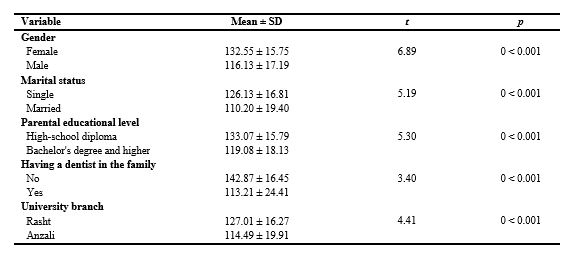
Table 2 presents the association between gender, marital status, parental education level, having a dentist in the family, and university branch, and the academic motivation score.
Table 2. Association of gender, marital status, parental educational level, having a dentist in the family, and university branch with academic motivation scoresAbbreviations: SD, standard deviation.
The Spearman's correlation test revealed a significant correlation between age and academic motivation, with academic motivation increasing significantly with age (r = 0.375, p < 0.001).
Table 2 presents the association between gender, marital status, parental education level, having a dentist in the family, and university branch, and the academic motivation score.
Note: Independent samples t-test was used for data analysis.
Abbreviations: SD, standard deviation; t, independent samples t-test statistic; p, probability value.
Abbreviations: SD, standard deviation; t, independent samples t-test statistic; p, probability value.
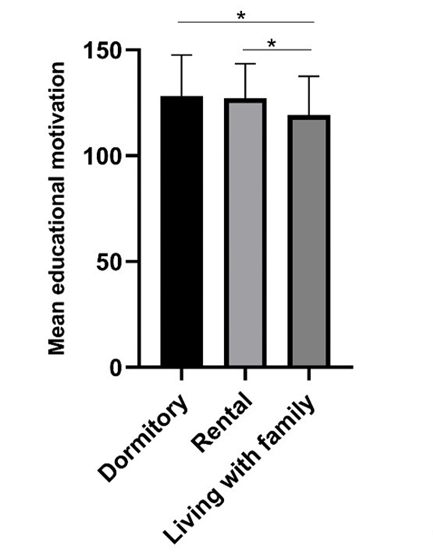
The mean academic motivation score was significantly higher among females compared to males (p < 0.001), among singles compared to married students (p < 0.001), among those whose parents had a high school diploma compared to those whose parents held a Bachelor's degree or a higher level of education (p < 0.001), among those without a dentist in their family (p < 0.001), and students attending the Rasht branch (p < 0.001). Academic motivation was significantly associated with the place of residence, as shown by ANOVA (p = 0.005, Figure 1), with the mean academic motivation score of those living in a dormitory being higher than that of the other two groups.
Pairwise comparisons using Tukey's test revealed that the mean motivation score of individuals living with their families was significantly lower than that of students who had rented a place (p = 0.029) or were living in a dormitory (p = 0.020).
The difference between the latter two groups was not statistically significant (p = 0.969).
Pairwise comparisons using Tukey's test revealed that the mean motivation score of individuals living with their families was significantly lower than that of students who had rented a place (p = 0.029) or were living in a dormitory (p = 0.020).
The difference between the latter two groups was not statistically significant (p = 0.969).
Figure 1. Academic motivation of students based on their place of residence
The Kruskal-Wallis test indicated a significant association between academic motivation scores and the family financial status of students (p < 0.001, Figure 2). The mean academic motivation score for those with moderate financial status was higher than that of the other two groups.Pairwise comparisons using the Mann-Whitney test revealed a significantly higher score for students with moderate financial status compared to
those with good economic status (p < 0.001). However, the differences between the good and moderate groups (p = 0.169) and the poor and moderate groups (p = 0.999) were not significant. Academic motivation showed a significant correlation with the academic level (term), as indicated by Spearman's correlation test (r = 0.464, p < 0.001). GPA had no significant correlation with the academic motivation score of students (r = 0.006, p = 0.935).
Figure 2. Academic motivation of students based on their family financial status
Table 3 presents the correlation between academic motivation domains and age, academic level (term), and GPA of students. As shown, age had a positive significant association with extrinsic motivation (p < 0.001) and motivation (p < 0.001) such that these parameters increased with age. The academic level (term) also had a positive and significant association with all three domains (p < 0.05). However, GPA had no significant association with any domain (p > 0.05).Table 3. Correlation of academic motivation domain scores with age, academic level (term), and GPA of students
Note: Spearman's rank correlation was used for data analysis.
Abbreviations: GPA, grade point average; r, Spearman's rank correlation coefficient; p, probability value.
Table 4 presents the association of academic motivation domain scores with gender, marital status, parental educational level, having a dentist family member, and the attending university branch. As indicated, females achieved a significantly higher mean score in all three domains than males (p < 0.05). The mean scores of extrinsic motivation and amotivation were significantly higher in singles than married students (p < 0.05), in students whose parents had high-school diplomas compared with Bachelor's degrees and higher (the third group was omitted due to the small number of members), students who did not have a dentist in their family, and students attending the Rasht branch (p < 0.05).
Table 4. Association of academic motivation domain scores with demographic and institutional characteristics of dental students
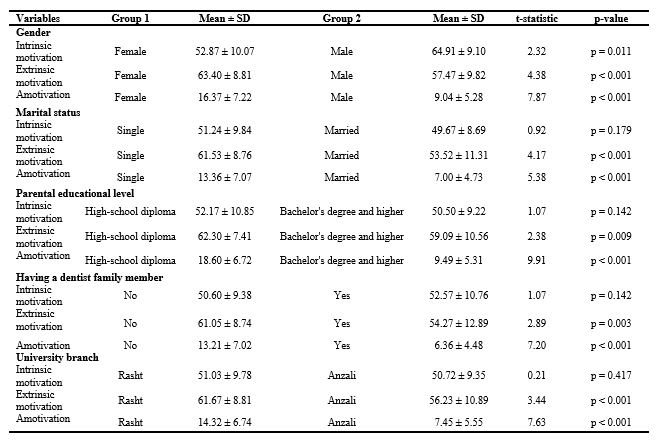
Note: Independent samples t-test was used for data analysis to compare mean scores between groups for each demographic variable.
Abbreviations: SD, standard deviation; t, t-statistic; p, probability value.
Table 5 presents the association between academic motivation domain scores, place of residence, and family financial status.
As indicated, the place of residence had a significant association with the amotivation score (p < 0.001). Pairwise comparisons revealed that the mean amotivation score of students living with their families was significantly lower than that of students living in a dormitory (p < 0.001) or those who had rented a place (p < 0.001). Additionally, the mean amotivation score of students who had rented a place was significantly lower than that of students living in a dormitory (p < 0.001).
Family financial status had a significant association with extrinsic motivation (p < 0.001) and amotivation (p < 0.001) scores. Pairwise comparisons regarding the extrinsic motivation score showed that the mean extrinsic motivation score of those with moderate family financial status was significantly higher than that of students with good family financial status (p < 0.001). Pairwise comparisons of the amotivation scores showed that the mean motivation scores for students with moderate (p < 0.001) and poor (p < 0.001) family financial status were significantly higher than those of students with good family financial status.
Abbreviations: GPA, grade point average; r, Spearman's rank correlation coefficient; p, probability value.
Table 4 presents the association of academic motivation domain scores with gender, marital status, parental educational level, having a dentist family member, and the attending university branch. As indicated, females achieved a significantly higher mean score in all three domains than males (p < 0.05). The mean scores of extrinsic motivation and amotivation were significantly higher in singles than married students (p < 0.05), in students whose parents had high-school diplomas compared with Bachelor's degrees and higher (the third group was omitted due to the small number of members), students who did not have a dentist in their family, and students attending the Rasht branch (p < 0.05).
Table 4. Association of academic motivation domain scores with demographic and institutional characteristics of dental students
Note: Independent samples t-test was used for data analysis to compare mean scores between groups for each demographic variable.
Abbreviations: SD, standard deviation; t, t-statistic; p, probability value.
Table 5 presents the association between academic motivation domain scores, place of residence, and family financial status.
As indicated, the place of residence had a significant association with the amotivation score (p < 0.001). Pairwise comparisons revealed that the mean amotivation score of students living with their families was significantly lower than that of students living in a dormitory (p < 0.001) or those who had rented a place (p < 0.001). Additionally, the mean amotivation score of students who had rented a place was significantly lower than that of students living in a dormitory (p < 0.001).
Family financial status had a significant association with extrinsic motivation (p < 0.001) and amotivation (p < 0.001) scores. Pairwise comparisons regarding the extrinsic motivation score showed that the mean extrinsic motivation score of those with moderate family financial status was significantly higher than that of students with good family financial status (p < 0.001). Pairwise comparisons of the amotivation scores showed that the mean motivation scores for students with moderate (p < 0.001) and poor (p < 0.001) family financial status were significantly higher than those of students with good family financial status.
Table 5. Association of academic motivation domain scores with place of residence and family financial status of dental students
Note: One-way ANOVA was used for comparisons marked with a, and the Kruskal-Wallis test was used for comparisons marked with b. For place of residence comparisons, one-way ANOVA was used for intrinsic and extrinsic motivation, and Kruskal-Wallis test was used for amotivation.
Abbreviations: SD, standard deviation; F, analysis of variance statistic; χ², Chi-square statistic; p, probability value.
Abbreviations: SD, standard deviation; F, analysis of variance statistic; χ², Chi-square statistic; p, probability value.
Discussion
This study investigated the academic motivation of dental students and the factors that influence it. The results indicated that the majority of dental students exhibited good academic motivation (71.5%), which aligns with findings from previous studies conducted on Iranian dental students at various universities [13-15]. Considering that dental students in Iran strive to pass the university entrance exam, they are expected to possess strong academic motivation [16]. Imagining a bright future with optimal job satisfaction and a high level of income can further increase their motivation [14]. This study makes a novel contribution to the literature on academic motivation among dental students in Iran, focusing on students from the 5th to 12th terms, which encompasses both the preclinical and clinical phases of dental education. While previous studies have primarily explored motivation through qualitative approaches [17] or focused on limited educational stages [18], our study quantitatively investigates motivation across a broader academic spectrum using the validated Persian version of the AMS. Furthermore, by examining associations between academic motivation and multiple demographic factors—such as parental education, family financial status, and the presence of a dentist in the family—our findings provide a more nuanced understanding of social and familial influences on dental students' motivation. This approach builds upon prior research and offers practical insights for designing interventions to enhance motivation and academic performance in dental education [19]. In the Iranian dental curriculum, the first four semesters are primarily dedicated to basic sciences and general university courses, with minimal focus on core dental content. Starting from semester 5, students enter the professional phase of their training, which includes both preclinical and clinical education specific to dentistry. This phase marks a significant transition in academic demands, learning environments, and the responsibilities of students. Therefore, by including only students from semesters 5 to 12, this study aims to assess academic motivation during the period when students are fully engaged with dental education and are more likely to be influenced by the complexities of skill acquisition, clinical exposure, and future professional expectations. This approach ensures relevance and precision in evaluating factors that shape motivation in the context of professional dental training [17]. In the present study, the extrinsic motivation score of students was higher than their intrinsic motivation score. The amotivation score was the lowest, which is in agreement with the results of Roshan Milan et al. [7] and Clark and Schroth [20], but in contrast to the findings of Azizzadeh Forozi et al. [21], who reported almost equal extrinsic and intrinsic scores among university faculty members. This difference can be due to different target groups and study populations (dental students vs. university faculty members).
In the current study, the academic motivation of students increased significantly with age, which may be due to their greater involvement in clinical practice at higher academic levels, thereby improving their motivation. The same result was reported by Vakilimofrad et al. [22]. Additionally, females demonstrated significantly higher academic motivation than males in the present study, which is in agreement with previous findings [14, 16, 23, 24]. A prior survey of gender-specific differences in academic motivation and progression reported higher intrinsic motivation in females and higher extrinsic motivation in males [25]. Another study, however, found no significant association between gender and academic motivation [26]. Higher academic motivation in Iranian female students may be due to their eagerness for financial independence (unlike the previous generation).
Additionally, as reported in the literature, the number of female dental students exceeds that of male dental students in many countries [27-30]. Dentistry is an appealing profession for women as it allows them to strike a balance between their personal and professional lives [31]. The present results also showed that the mean academic motivation score was significantly higher in singles than married students, which was in contrast to the findings of Roshan Milan et al. [7] and Izadi et al. [14], who found no significant association between marital status and academic motivation, and the results of Hakimi et al. [26], who showed significantly higher academic motivation of married students. A small number of married students in the present study may explain the differences in the results. The mean academic motivation score of students living in a dormitory was significantly higher than that of students living with their parents or those who had rented a place to live. Similarly, Vakilimofrad et al. [17] reported higher academic motivation scores for non-native students. However, Win and Miller [32] found no significant association between place of residence and academic motivation. The mean academic motivation score of students whose parents had a high school diploma was higher than that of students whose parents had a higher educational level. Similarly, Naseh et al. [10] found an inverse correlation between parental educational level and the student's academic motivation. However, Zahiri Naw and Rajabi [23] reported that students whose parents had a higher educational level exhibited higher academic motivation, while another study found no significant association in this regard [14]. This controversy warrants further investigation in this respect. In the present study, students with a moderate family financial status had a significantly higher academic motivation score than those with good economic status. Consistent with the present results, a significant inverse correlation between academic motivation and family economic status has also been reported by many previous studies [33, 34]. This finding may be due to a lack of financial concerns among students from wealthy families. With an increase in academic level, the motivation score of students significantly increased in the current study, which aligns with the results of Hakim et al. [26] and may be attributed to the initiation of clinical practice. However, this finding differs from the results of some previous studies [16, 26], which reported a decline in motivation as academic levels increased, likely due to a heightened awareness of professional issues [35]. Additionally, the academic motivation score was higher in students who did not have a dentist in their family, which may be due to the good financial status of families with a dentist as a family member and, subsequently, lower motivation in students. The present results also showed higher motivation scores among students attending the Rasht branch, likely because this branch requires a higher entrance exam score for admission, offers superior facilities, and is free, whereas the Anzali branch has a higher admission fee and fewer facilities. The GPA of students had no significant association with their academic motivation, which was in contrast to previous studies that reported higher motivation among students with higher GPAs [13]. The different results observed in the present study may be attributed to the impact of COVID-19 on students' GPAs. The assessment of the association between academic motivation domains and various parameters revealed that age had a significant positive correlation with the domains of extrinsic motivation and amotivation. Additionally, females scored higher in all three domains than males, which aligns with the results of Roshan Milan et al. [7], who reported significantly higher motivation scores in general as well as in the extrinsic and intrinsic domains for females. However, some studies [36] found no significant difference in intrinsic motivation between males and females. Variations in the reported results can be due to differences in study populations, educational conditions, and social factors. Single students exhibited significantly higher scores in both extrinsic motivation and amotivation. Previous studies found no significant association between academic motivation and marital status [10, 37], which may be due to differences in study populations, educational conditions, and social factors.
In terms of place of residence, the present results revealed significantly lower amotivation scores in students living with their families compared with those living in a dormitory or having rented a place. Also, the mean amotivation score of those who had rented a place was significantly lower than the mean score of students staying in a dormitory. Moreover, students attending the Rasht branch had the significantly higher extrinsic motivation and amotivation scores. Naseh et al. [10] also noted a significant association between the attending university and students' academic motivation. Furthermore, the extrinsic motivation and amotivation scores of students whose parents held a high school diploma were higher than those of students whose parents had a higher level of education. The mean extrinsic motivation score of students with moderate financial status was higher than that of students with good economic status. Also, the mean amotivation score of students with moderate and poor economic status was higher than that of students with good financial status. Additionally, with an increase in academic level, the mean score of all three domains increased significantly. Students without a dentist in their family acquired significantly higher extrinsic motivation and amotivation scores. Gobena et al. [38], in their study in East Ethiopia, found that family income had no significant effect on the educational progression of students; however, parental educational level contributed to their academic progression by 40.96%. Griffin et al. [39] demonstrated that parental involvement, cultural background, and family environment can have a significant impact on a child's motivation. Mohebbi et al. [19] reported that low financial support was associated with a higher level of academic burnout. Another study found a significant correlation between fathers' high educational levels and students' academic motivation [40]. The main limitations of this study included poor cooperation from some students in completing the questionnaire, desirability bias, and the psychological status of the students, which may have influenced their responses. Future research should consider the educational history of students, such as their performance on basic science exams, to gain deeper insights into their academic motivation. Additionally, factors like the academic level of students should be standardized in future studies to yield more accurate results.
Conclusion
The academic motivation score of the study population was perfect.
Age, gender, marital status, parental level of education, family financial status, academic level, having a dentist in the family, and university branch were found to have a significant impact on the academic motivation of dental students.
Ethical considerations
The study protocol was approved by the university's ethics committee (IR.GUMS.REC.1401.007).
Artificial intelligence utilization for article writing
The authors declare that no artificial intelligence technologies were used in the process of writing this article for generating content, ideas, analysis, or other purposes.
Acknowledgment
This work was supported by Guilan University of Medical Sciences and derived from the doctoral thesis of a dental student at Guilan University of Medical Sciences.
Conflict of interest statement
The authors declare that they have no conflicts of interest.
Author contributions
MT: Study Design, Review, and Editing, Final Approval
MF: Data Collection, Manuscript Preparation, Final Approval
YBH: Study Concept, Manuscript Preparation, Investigation, Visualization, Final Approval
Funding
None.
Data availability statement
The datasets used and/or analyzed during the current
Study are available from the corresponding author upon
reasonable request. Additionally, the datasets that support the conclusions of this article are included within the article
itself.
Article Type : Orginal Research |
Subject:
Medical Education
Received: 2025/03/23 | Accepted: 2025/07/13 | Published: 2025/10/1
Received: 2025/03/23 | Accepted: 2025/07/13 | Published: 2025/10/1
References
1. Bandhu D, Mohan MM, Nittala NA, Jadhav P, Bhadauria A, Saxena KK. Theories of motivation: a comprehensive analysis of human behavior drivers. Acta Psychol (Amst). 2024;244:104177. [DOI:10.1016/j.actpsy.2024.104177] [PMID]
2. Morris LS, Grehl MM, Rutter SB, Mehta M, Westwater ML. On what motivates us: a detailed review of intrinsic v. extrinsic motivation. Psychol Med. 2022;52(10):1801-16. [DOI:10.1017/S0033291722001611] [PMID] []
3. Vu T, Magis-Weinberg L, Jansen BR, van Atteveldt N, Janssen TW, Lee NC, et al. Motivation-achievement cycles in learning: a literature review and research agenda. Educ Psychol Rev. 2022;34(1):39-71. [DOI:10.1007/s10648-021-09616-7]
4. Zheng B, Chang C, Lin CH, Zhang Y. Self-efficacy, academic motivation, and self-regulation: how do they predict academic achievement for medical students? Med Sci Educ. 2021;31(1):125-30. [DOI:10.1007/s40670-020-01143-4] [PMID] []
5. Mahdavi P, Valibeygi A, Moradi M, Sadeghi S. Relationship between achievement motivation, mental health and academic success in university students. Community Health Equity Res Policy. 2023;43(3):311-7. [DOI:10.1177/0272684X211025932] [PMID]
6. Kotera Y, Taylor E, Fido D, Williams D, Tsuda-McCaie F. Motivation of UK graduate students in education: self-compassion moderates pathway from extrinsic motivation to intrinsic motivation. Curr Psychol. 2023;42(12):10163-76. [DOI:10.1007/s12144-021-02301-6] [PMID] []
7. Roshan Milani S, Aghaii Monvar I, Kheradmand F, Saboory E, Mikaili P, Masudi S, et al. A study on the academic motivation and its relation with individual state and academic achievement on basic medical students of Urmia university of medical sciences. J Urmia Nurs Midwifery Fac. 2011;9(5): 357-66
8. Güngör A, Sari HI. Effects of academic motivation on school burnout in Turkish college students. Int J Adv Couns. 2022;44(3):414-31. [DOI:10.1007/s10447-022-09477-x] [PMID] []
9. Eremicheva OY, Yudin VV, Sheptukhina II, et al. Research of academic motivation at the stage of forming a threshold level of mastering competences. Int J Environ Sci Educ. 2016;11(14):6949-62.
10. Naseh L, Mardanian Dehkordi L, Naseh H. Investigation of educational motivation and its related factors in students of Shahrekord university of medical sciences. J Med Educ Dev. 2017;12(1):27-39. [DOI:10.52547/ethicnurs.6.3.4.1]
11. Vallerand RJ, Pelletier LG, Blais MR, Briere NM, Senecal C, Vallieres EF. The academic motivation scale: a measure of intrinsic, extrinsic, and amotivation in education. Educ Psychol Meas. 1992;52(4):1003-17. [DOI:10.1177/0013164492052004025]
12. Weisani M, Lavasani MG, Ejei J. The effect of achievement goals on statistic anxiety through academic motivation and statistic learning. J Psychol. 2012;16(2):142-60.
13. Yousefi A, Ghassemi G, Firouznia S. The relationship between academic motivation and academic achievement in medical students of Isfahan university of medical sciences. Iran J Med Educ. 2009;9(1):79-84
14. Izadi S, Jouybari L, Behnampoor N, Taghavi A, Baiky F. Academic motivation and associated factors of the Golestan university of medical sciences. Dev Strateg Med Educ. 2014;1(2):44-50.
15. Sharififard F, Asayesh H, Nourozi K, Hosseini MA, Kharameh ZT. The relationship between motivation and academic burnout in nursing and paramedical students of Qom university of medical sciences, Iran. 2016;9(12):72-8.
16. Rouhi G, Hoseini SA, Badeleh MT, Rahmani H. Educational motivation and its relationship with some factors among the students of Golestan university of medical sciences. Strides Dev Med Educ. 2008;4(2):77-83.
17. Katebi K, Ghaffarifar S, Dehghani G, Pourabbas A. Exploring the experiences of dentistry students of Tabriz university of medical sciences of academic motivation: a content analysis study. BMC Med Educ. 2024;24(1):245. [DOI:10.1186/s12909-024-05237-0] [PMID] []
18. Khami M, Murtomaa H, Jafarian M, Vehkalahti M, Virtanen J. Study motives and career choices of Iranian dental students. Med Princ Pract. 2008;17(3):221-6. [DOI:10.1159/000117796] [PMID]
19. Mohebbi SZ, Gholami M, Chegini M, Ghoreyshi Y, Gorter RC, Bahramian H. Impact of career choice motivation on academic burnout in senior dental students: a cross-sectional study. BMC Med Educ. 2021;21(1):52. [DOI:10.1186/s12909-020-02475-w] [PMID] []
20. Clark MH, Schroth CA. Examining relationships between academic motivation and personality among college students. Learn Individ Differ. 2010;20(1):19-24. [DOI:10.1016/j.lindif.2009.10.002]
21. Azizzadeh Forozi M, Mohammad Alizadeh S, Fasihi Harandi T. Motivational factors affecting educational performance from the point of view of faculty members. Strides Dev Med Educ. 2006;2(2):102-8.
22. Vakilimofrad H, Ahmadian M, Masoumi L, Halaj MM. Factors affecting academic motivation of medical library and information science students: a case study of Hamadan university of medical sciences, Iran. Libr Philos Pract. 2021;5340.
23. Zahiri Naw B, Rajabi S. The study of variables reducing academic motivation of Persian language and literature students. Teach Learn Res. 2009;7(1):69-80.
24. Tamnnaeifar MR, Seddighi Arfaei F, Maspi A. An investigation about the relationship between personality traits, advanced motivation and learning styles among university students. High Educ Lett. 2014;7(25):145-58.
25. Salta K, Koulougliotis D. Assessing motivation to learn chemistry: adaptation and validation of Science Motivation Questionnaire II with Greek secondary school students. Chem Educ Res Pract. 2015;16(2):237-50. [DOI:10.1039/C4RP00196F]
26. Hakim A, Azimi N, Latifi M, Ghalvandi H. Nursing students viewpoints about educational motivation and its related factors in Ahvaz Jundishapur university of medical sciences. Res Med Educ. 2015;7(1):35-44. [DOI:10.18869/acadpub.rme.7.1.35]
27. Scarbecz M, Ross JA. Gender differences in first-year dental students' motivation to attend dental school. J Dent Educ. 2002;66(8):952-61. [DOI:10.1002/j.0022-0337.2002.66.8.tb03564.x] [PMID]
28. Vigild M, Schwarz E. Characteristics and study motivation of Danish dental students in a longitudinal perspective. Eur J Dent Educ. 2001;5(3):127-33. [DOI:10.1034/j.1600-0579.2001.050306.x] [PMID]
29. Hennequin M, Tubert S, Devillers A, et al. Socio-economic and schooling status of dental undergraduates from six French universities. Eur J Dent Educ. 2002;6(3):95-103. [DOI:10.1034/j.1600-0579.2002.60301.x] [PMID]
30. Stewart FM, Drummond JR, Carson L, Hoad Reddick G. The future of the profession--a survey of dental school applicants. Br Dent J. 2004;197(9):569-73. [DOI:10.1038/sj.bdj.4811810] [PMID]
31. Stewart FM, Drummond JR, Carson L, Theaker ED. Senior dental students' career intentions, work-life balance and retirement plans. Br Dent J. 2007;203(5):257-63. [DOI:10.1038/bdj.2007.790] [PMID]
32. Win R, Miller PW. The effects of individual and school factors on university students' academic performance. Aust Econ Rev. 2005;38(1):1-18. [DOI:10.1111/j.1467-8462.2005.00349.x]
33. Yukseloglu SM, Karaguven MH. Academic motivation levels of technical high school students. Procedia Soc Behav Sci. 2013;106:282-8. [DOI:10.1016/j.sbspro.2013.12.033]
34. Rostami B, Moein Z, Fakour E, Amini K, Rostami H. Academic motivation and relevant predictive factors in pharmaceutical students of Zanjan university of medical sciences, Zanjan, Iran in 2016. J Med Educ Dev. 2018;10(28):27-38. [DOI:10.29252/edcj.10.28.27]
35. Kosgeroglu N, Acat MB, Ayranci U, Ozabaci N, Erkal S. An investigation on nursing, midwifery and health care students' learning motivation in Turkey. Nurse Educ Pract. 2009;9(5):331-9. [DOI:10.1016/j.nepr.2008.07.003] [PMID]
36. Dehghan F. The academic motivation and academic achievement in Iranian universities of medical sciences: a systematic review and meta-analysis. Int J Educ Cogn Sci. 2023;4(3):54-65. [DOI:10.61838/kman.ijecs.4.3.6]
37. Kavousipour S, Noorafshan A, Pourahmad S, Dehghani-Nazhvani A. Achievement motivation level in students of Shiraz university of medical sciences and its influential factors. J Adv Med Educ Prof. 2015;3(1):26-32.
38. Gobena GA. Family socio-economic status effect on students' academic achievement at college of education and behavioral sciences, Haramaya University, Eastern Ethiopia. J Teach Educ Educ. 2018;7(3):207-22.
39. Griffin B, Hu W. Parental career expectations: effect on medical students' career attitudes over time. Med Educ. 2019;53(6):584-92. [DOI:10.1111/medu.13812] [PMID]
40. Pinneo L, Nolen A. Parent involvement and student academic motivation towards science in 9th grade. Humanit Soc Sci Commun. 2024;11(1):273. [DOI:10.1057/s41599-024-02707-0]
Send email to the article author
| Rights and permissions | |
 |
This work is licensed under a Creative Commons Attribution-NonCommercial 4.0 International License. |